From toy-store game to sport, Spikeball launched in 2008
Spikeball’s rise was engineered, not accidental: a 2008 relaunch, Shark Tank exposure, and tournament ladders turned a toy-store memory into a real sport.

Spikeball did not become a sport by drifting naturally into the culture. It was rebuilt, branded, and pushed into repeatable competition through a very specific sequence of business decisions: Jeff Knurek’s invention in the late 1980s, Chris Ruder’s rediscovery of the game as a kid, and the June 14, 2008 launch that turned a backyard toy into an organized product with a public identity. That is the real turning point in roundnet history. The game’s rise has always been less about spontaneous adoption than about someone deciding it needed structure, a name, a company, and eventually a pathway to tournaments.
From toy-store novelty to a repeatable game
The origin story starts with Jeff Knurek, who invented roundnet in the late 1980s. Chris Ruder encountered it as a child when neighbors found the game in a toy store, then kept playing it with his brothers as they grew up. Clemson University’s history of roundnet makes the arc easy to see: the game lived first as a novelty, then as a memory, and finally as a business Ruder would return to about 20 years later.
That long gap matters. Roundnet was not the kind of idea that exploded on its own from one perfect summer. It needed a relaunch, and Ruder was the person who gave it one. The sport’s modern era begins when he flipped the switch on Spikeball.com on June 14, 2008, launching from Chicago’s North Ave Beach. That date is the hinge in the story, because it marks the moment the game stopped being only a recollection from childhood and started behaving like a product with repeat customers and a growing audience.
The 2008 relaunch turned a game into a brand
Spikeball’s own 10-year retrospective says the company reached nearly $50 million in worldwide sales during its first decade and donated thousands of sets. Those numbers tell you the relaunch was not a vanity project. It was a commercial engine, and commercial scale gave the sport room to breathe. Once a game has product distribution, replacement gear, and players who know exactly what to buy, it can move from a one-off party trick to something that gets practiced, taught, and repeated.
The company has leaned hard into that identity, calling itself “trusted since ’08” and describing its growth as moving from garage rallies to a global community. That language is not just branding fluff. It reflects the core playbook behind roundnet’s spread: make the equipment portable, make the rules easy to absorb, and make the social loop simple enough that players can bring more players into it. The result was a sport that could travel from a beach to a college quad without losing its basic shape.
Why the name matters as much as the rules
Spikeball also draws a clear line between brand and sport. The company uses “Spikeball” for the trademarked brand and “roundnet” for the sport itself, and says non-official clubs or teams should use “roundnet” unless authorized. That distinction sounds minor until you look at how the sport matured. It explains why you will see both names in circulation, and why the culture around the game has become broader than the product that helped launch it.
That separation also marks a familiar stage in sports history. The most durable games eventually outgrow their original commercial wrapper. Roundnet has done that in plain sight. The brand opened the door, but the sport now has its own language, its own organizing structure, and its own competitive life.
Shark Tank gave the game a national stage
The next leap came on May 15, 2015, when Spikeball appeared on Shark Tank. The company says CEO Chris Ruder proposed a $500,000-for-20%-of-the-company deal with Daymond John, though the deal did not close. Even without a final handshake, the appearance gave Spikeball something money cannot buy cleanly: instant cultural recognition.
That visibility mattered because it pushed the game beyond people who already knew the set. Once a product becomes recognizable on national television, it starts entering gift lists, dorm rooms, beaches, and pickup circles faster. ESPN’s 2018 profile captured the scale of that movement, describing Spikeball as having more than 4 million players worldwide and noting that the sport had moved well past the yard-game label. By then, the audience was no longer just buying a toy. It was buying into an activity that looked and felt like a real sport.
Tournament infrastructure gave the sport a ladder
The clearest sign that roundnet had become organized competition is the tournament map. ESPN noted that the 2018 Spikeball Roundnet Association Tournament Series stretched from Boston to San Diego, which is exactly what a real sports ecosystem looks like once it has enough participants to support travel, regional hubs, and a competitive calendar. That kind of spread does not happen by accident. It requires organizers, schedules, and enough committed players to make a bracket matter.

Some of that structure grew organically, but it still needed people willing to formalize it. ESPN pointed to the Coney Island event, which began in 2013 with Jack Scotti and friends before he later became a Spikeball Roundnet Association director. That detail is important because it shows how the sport’s culture was built from the ground up: players staged events first, then those events became part of the formal circuit. In roundnet, the path to legitimacy ran through beaches, parks, and improvised tournaments before it reached a polished association structure.
College play pushed roundnet into a lasting pipeline
The college scene is where the sport’s future starts to look durable. Spikeball’s college roundnet page lists 10 U.S. sections, 1,100-plus players, and 125-plus clubs. That is not fringe participation anymore. It is a network, with enough density to create rivalries, regional identity, and a steady stream of new players who learn the game in a structured environment rather than at a casual picnic.
The 2024-2025 college season page says College Nationals were scheduled for May 24-25 at Grand Park Sports Campus in Westfield, Indiana. That kind of national championship date and venue gives the sport an annual tentpole. It also shows how far roundnet has come from the beach-origin story. When a game has sections, clubs, and a title event, it is no longer just a product demo with a net in the middle.
Why the game still works
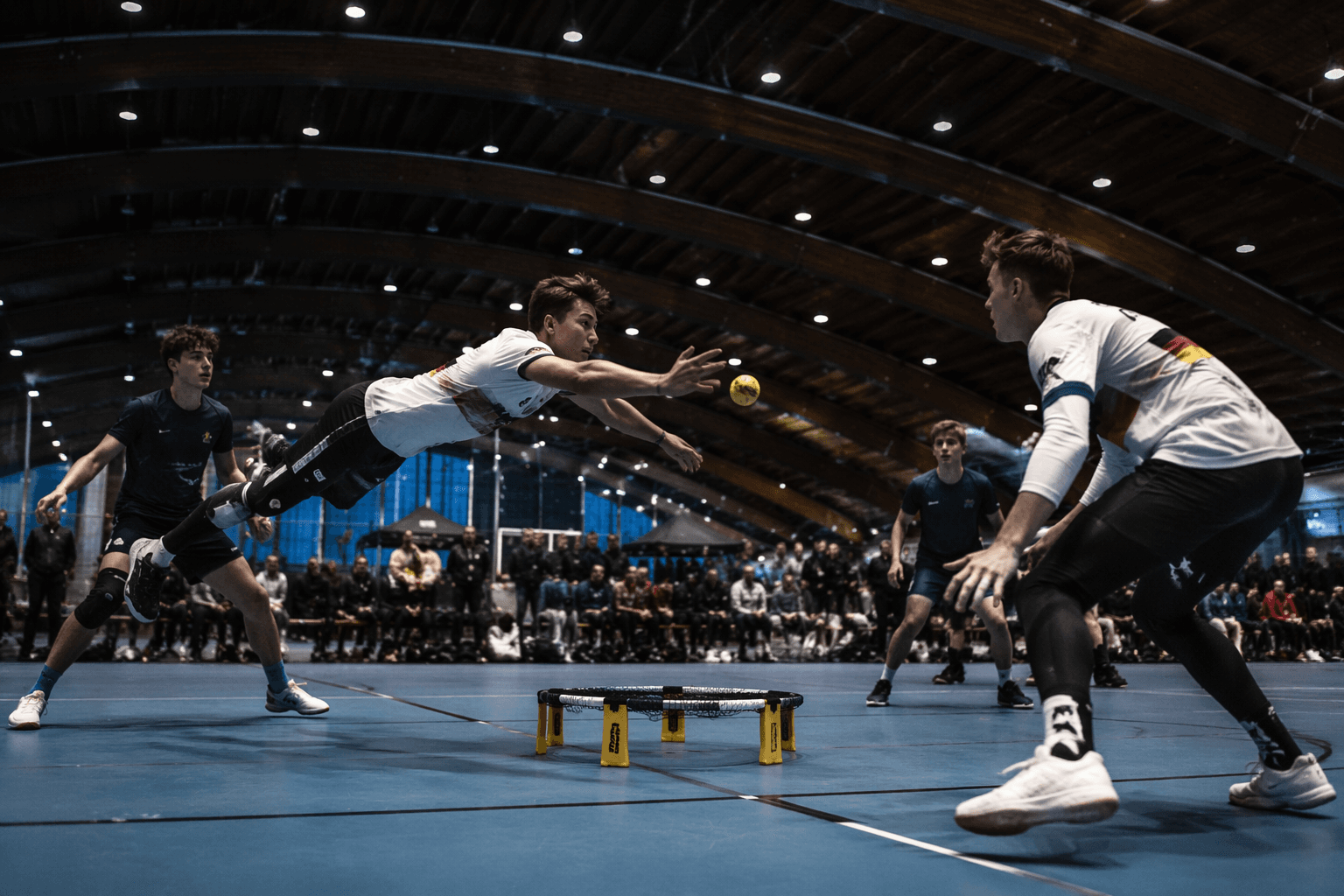
Part of roundnet’s staying power comes from how quickly the rules make sense. Spikeball describes it as a 2-vs-2 game and compares it to volleyball plus foursquare. That is the sort of shorthand that wins people over instantly. The game looks strange for about 30 seconds, and then the geometry clicks: serve, set, attack, recover.
That simplicity is the engine behind the whole rise. Ruder did not just sell a set. He helped create a sport that could be understood in one sentence, taught in one minute, and played almost anywhere. Once the business side supplied gear, identity, and events, the culture followed. Roundnet’s history is proof that mainstream adoption often has a manufacturer behind it, a media amplifier beside it, and a competition ladder underneath it.
This article was produced by Prism’s automated news system from verified source data, official records, and press releases, then run through automated quality and moderation checks before publishing. The system is built and supervised by the people who set the standards it runs under. Read our full AI policy.
Did this article answer your question?