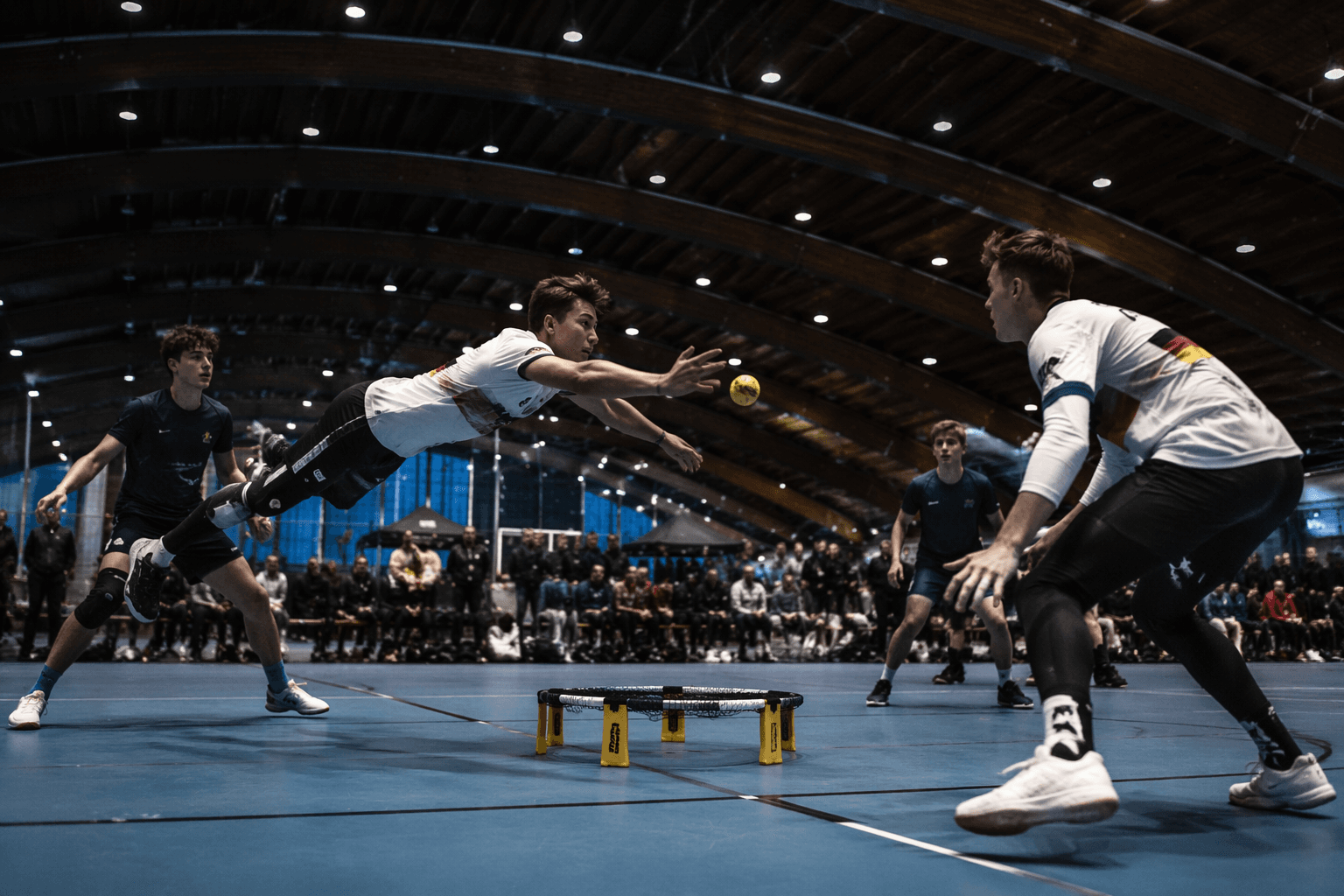
IRF rules reveal the exact dimensions of a legal roundnet set
A legal roundnet set is tighter than it looks: the frame, net, ball, and court all have exact dimensions that shape bounce, control, and tournament legality.

An approved roundnet set is circular with an inner diameter of 91.4 cm and a height of 20.3 cm, with a net stretched across the top. If the frame sits too low, too high, or too wide, the rebound changes enough to alter touch one, touch two, and the whole rhythm of the rally.
A set that looks fine from a distance can still be wrong in practice. A few centimeters may not sound like much, but in roundnet they affect how sharply the ball comes off the net, how quickly defenders can react, and whether a tournament director can call the setup legal.
The ball has to be the right ball
The ball is just as tightly regulated as the frame. Official play uses an IRF-approved ball with air pressure between 2000 and 3500 pascals, or 0.3 and 0.5 PSI, and a circumference between 29 and 31 cm. That range is narrow for a reason: too soft and the rebound dies; too hard and the ball plays fast, awkward, and less forgiving on contact.
The rules also set a net-tension check. Under the rules, if a ball is dropped from 1.5 meters, it should bounce about 50 cm from the net, measured from the bottom of the ball. That is the kind of detail players feel immediately, even if they never measure it with a tape. A loose net makes the ball sit up; a tight one can send it flying off at a harsher angle, changing how much control the hitter and the defense actually have.
The court is small, but the geometry matters
Roundnet is compact, but the court has fixed geometry. The IRF recommends a minimum playing area of 10 by 10 meters for each court, even though there are no out-of-bounds lines after the serve.
The service setup is where the geometry really matters. The service line circle should be drawn 2.6 meters from the center of the court, the edge of the set should be 2.13 meters from that line, and the no-hit-zone line should sit 91.4 cm from the center of the court. Those measurements create the opening lane every serious player recognizes: the serve has structure, the first exchange has limits, and then the rally opens up. That layout gives every point the same starting geometry, whether you are on a beach court, a gym floor, or a permanent tournament surface.
What small setup errors actually change
Roundnet punishes sloppy setup because the equipment and court are part of the strategy, not just the background. If the net is uneven, the ball will rebound with different angles around the frame. If the ball pressure is off, the touch game changes, and teams lose the predictable second-contact windows that skilled pairs rely on.
The same goes for court markings. A service circle that is even slightly off-center changes the serving angle and can distort the no-hit-zone spacing. That is why the rulebook’s exact measurements matter before league play or a sanctioned event.
How to check your setup before you play
The easiest way to stay legal is to treat the setup like part of your warm-up. Before a league night or sanctioned event, check the frame diameter, confirm the height, inspect the net tension, and make sure the ball is within the approved pressure and circumference range. If anything looks loose, uneven, or out of spec, fix it before the first serve.
A simple practical sequence works:
1. Assemble the frame cleanly and confirm the circular inner diameter is 91.4 cm.
2. Check that the frame height is 20.3 cm.
3. Attach the net evenly and tightly, then test the rebound with the 1.5-meter drop.
4. Measure the ball’s pressure and circumference.
5. Mark the court geometry so the service line circle, set position, and no-hit zone all match the IRF measurements.
That routine matters because roundnet is a game of repeated touches, not one isolated contact.
A portable sport still needs standards
Spikeball’s beginner guide advises players to assemble the frame, attach the net evenly and tightly, and check the height by dropping a ball from eye level and seeing whether it rebounds above the waist. Players can verify that in a driveway, on a beach, or in a gym before a whistle ever blows.
Tape can be used indoors when lines cannot be drawn.
This article was produced by Prism’s automated news system from verified source data, official records, and press releases, then run through automated quality and moderation checks before publishing. The system is built and supervised by the people who set the standards it runs under. Read our full AI policy.
Did this article answer your question?