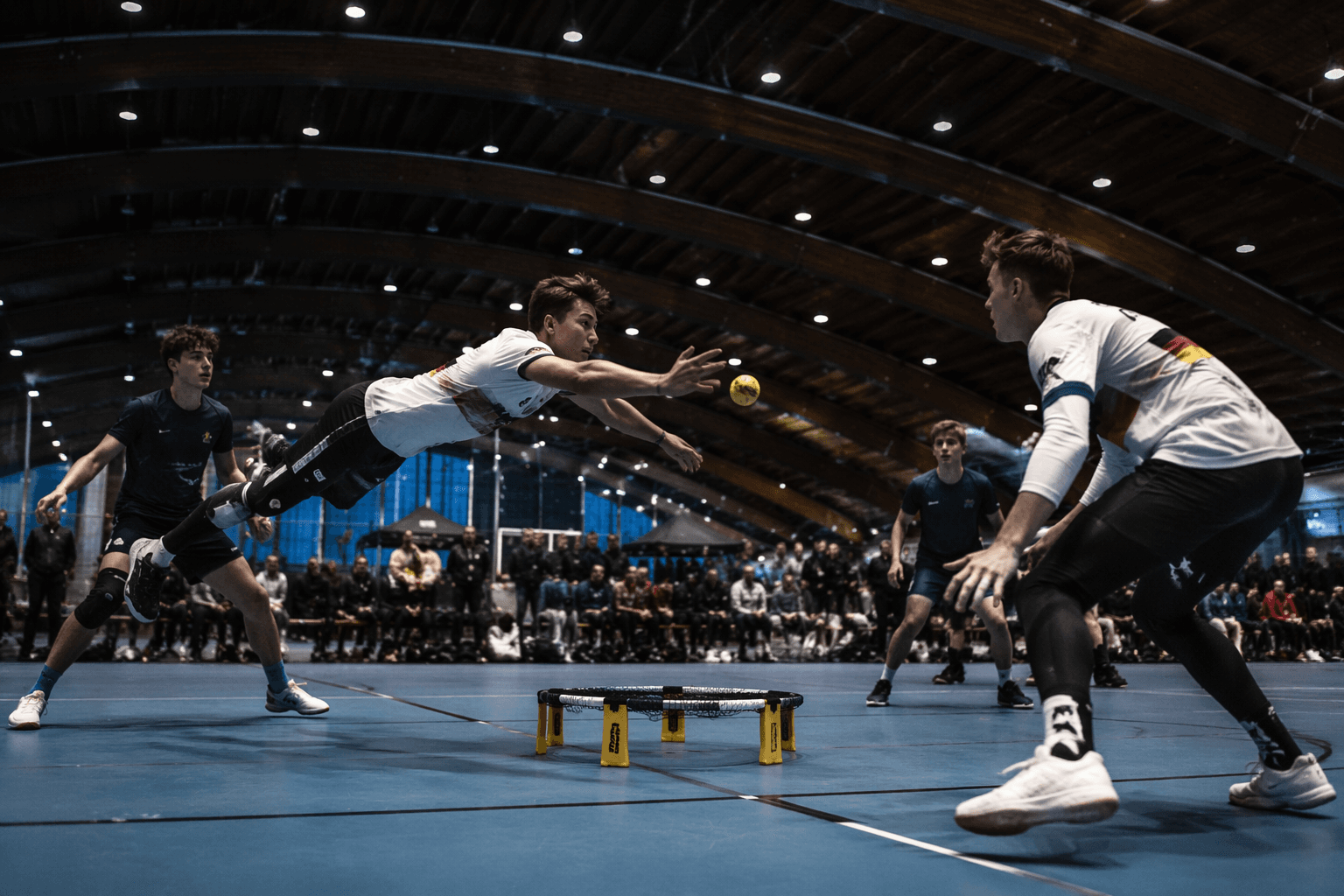
Roundnet grows from backyard game into world championship sport
Roundnet’s first world championship gave the sport a real international spine, then Europe answered America’s early dominance with its own title run.
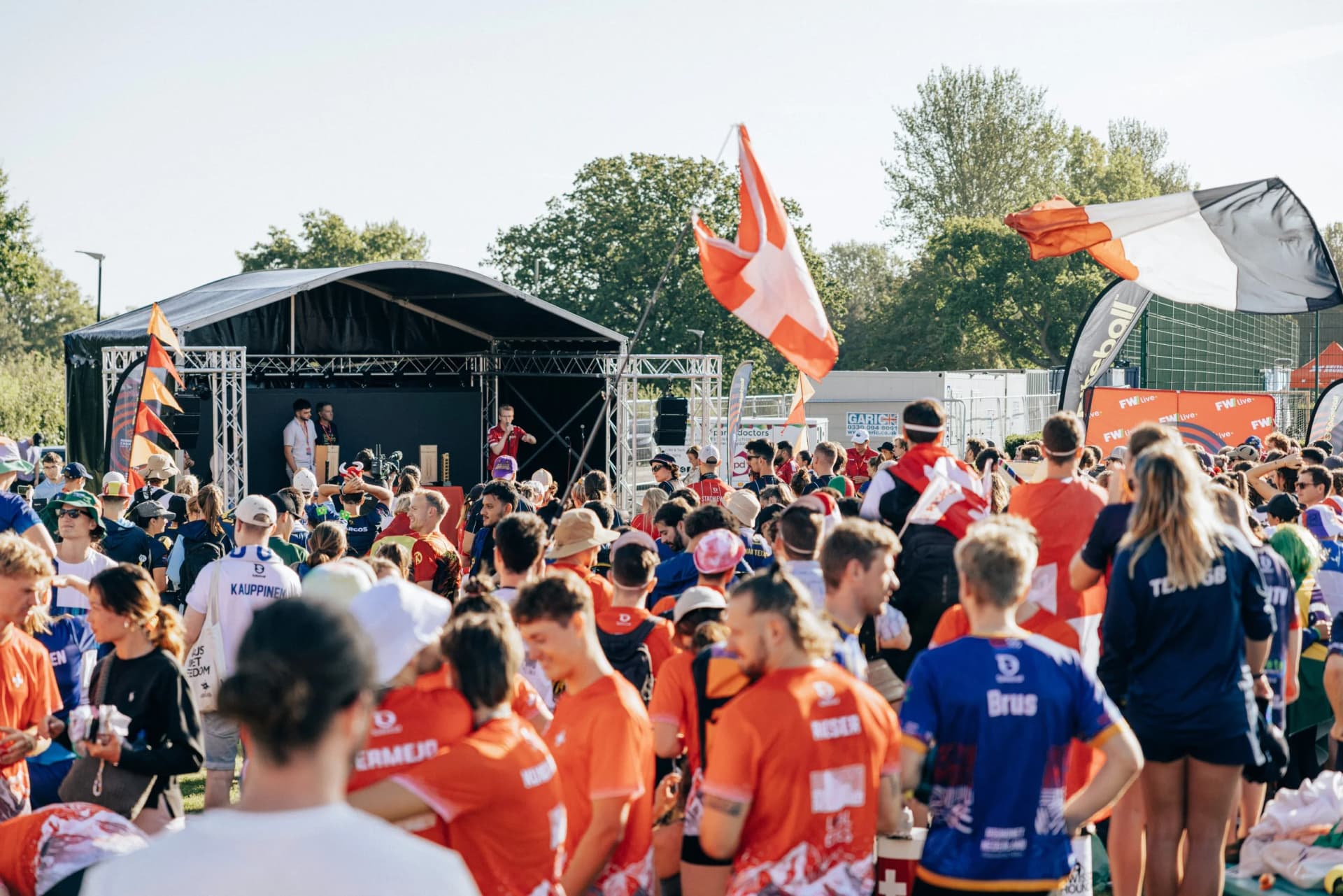
Roundnet’s first official world championship did more than hand out medals. It forced a backyard game into the structure of an actual international sport, with uniform rules, national-team limits, and a governing body built to make the whole thing hold together.
From toy to federation
The sport’s origin story starts in 1989, when toy designer Jeff Knurek invented the game that would later be marketed as Spikeball. It eventually faded from view, then came back through Chris Ruder and Spikeball Inc., who helped revive it, commercialize it, and push it into organized competition. That revival matters because roundnet did not become a world-championship sport by accident. It had to be rebuilt from a novelty into something with tournaments, rankings, and a federation that could actually run a global event.
That federation is the International Roundnet Federation, a non-profit international governing body created, in its own words, in an “Olympic Model” to give the sport the infrastructure to grow at an international level. The IRF also took on the unglamorous but essential job of writing and updating the official rules for sanctioned international play. Its rules record shows initial rules adopted on October 21, 2021, with updates on August 10, 2022, and June 24, 2024, which is the kind of paperwork that separates a real sport from a rec-league pastime.
Belgium set the first standard
The first official World Championship was announced for September 8 to 11, 2022, at Park Molenheide in Belgium, and that debut set the template for everything that followed. The event was built around both individual and squad competition in men’s, women’s, and mixed divisions, with national teams allowed to send five men’s teams, three women’s teams, and one mixed team in squad play. That is not backyard logic. That is federation logic, and it gave the sport a clear international format from day one.

The 2022 field showed immediate reach. The IRF’s recap says squad play included 29 men’s nations and 22 women’s nations, a strong sign that the event was already larger than a simple U.S.-centric showcase. The Americans still owned the top of the bracket, though. The U.S. swept the open podium, and Buddy Hammon and Clark Marshall, playing as “Assistive Touch,” took the open title after a dramatic three-set semifinal and then a final over Abrams/Gross.
The women’s side had its own clear hierarchy. Graham/Rogers led the women’s field, Hui/Gross claimed mixed gold, and Germany and Switzerland battled for women’s bronze. That mix of American control at the top and broader European presence underneath told you exactly where the sport stood in 2022: the structure was global, but the best-established competitive base was still heavily U.S. driven.
Guildford showed the field had changed
By the time the second World Championship arrived at Surrey Sports Park in Guildford, Great Britain, the picture looked different. British Roundnet said 32 countries gathered for the event, which is a concrete measure of how quickly the championship had become a real international meeting point rather than a one-off launch. The IRF also says the 2024 format was adjusted based on lessons from 2022 to improve both competition and the spectator experience, which is exactly what an emerging sport should be doing after its first test run.
The format itself remained the sport’s calling card. Individual Worlds still gave each country the chance to field three men’s teams, three women’s teams, and one mixed team, while squad championships allowed up to five teams per country. That setup matters because it turns national depth into a competitive asset. A country cannot fake that kind of roster construction. Either it has enough players to fill multiple brackets, or it does not.
The results in 2024 showed a sport no longer locked into one nation’s ceiling. The U.S. kept both squad titles, but European teams won all three individual crowns. Germany’s Eisentrager/Siemer took the men’s title, Austria’s Leybourne/Kadlec won the women’s title, and Switzerland’s Kunzelmann/Felix captured mixed gold. That shift is the strongest proof that roundnet’s world championship is doing what it was built to do: expose the true competitive map of the sport and keep forcing the map to expand.
Why the championship format matters
The value of the world championship is not just the trophy. It is the institution around the trophy. The IRF’s uniform rules give sanctioned events a common language, and the squad-plus-individual structure gives countries a reason to develop beyond one star pairing. When a sport allows five men’s teams, three women’s teams, and a mixed entry in squad play, it is rewarding depth, coaching, and pipeline building, not just a single elite duo.
That is the real arrival story here. Roundnet used to look like a portable game built for a park or a beach. Now it has an international federation, a rulebook that gets updated, a championship cycle every two years since 2022, and national teams from 32 countries showing up to fight for titles. The 2022 event proved the sport could stage a world championship; the 2024 event proved the title now means something beyond the country that invented the fastest version of the game.
This article was produced by Prism’s automated news system from verified source data, official records, and press releases, then run through automated quality and moderation checks before publishing. The system is built and supervised by the people who set the standards it runs under. Read our full AI policy.
Did this article answer your question?