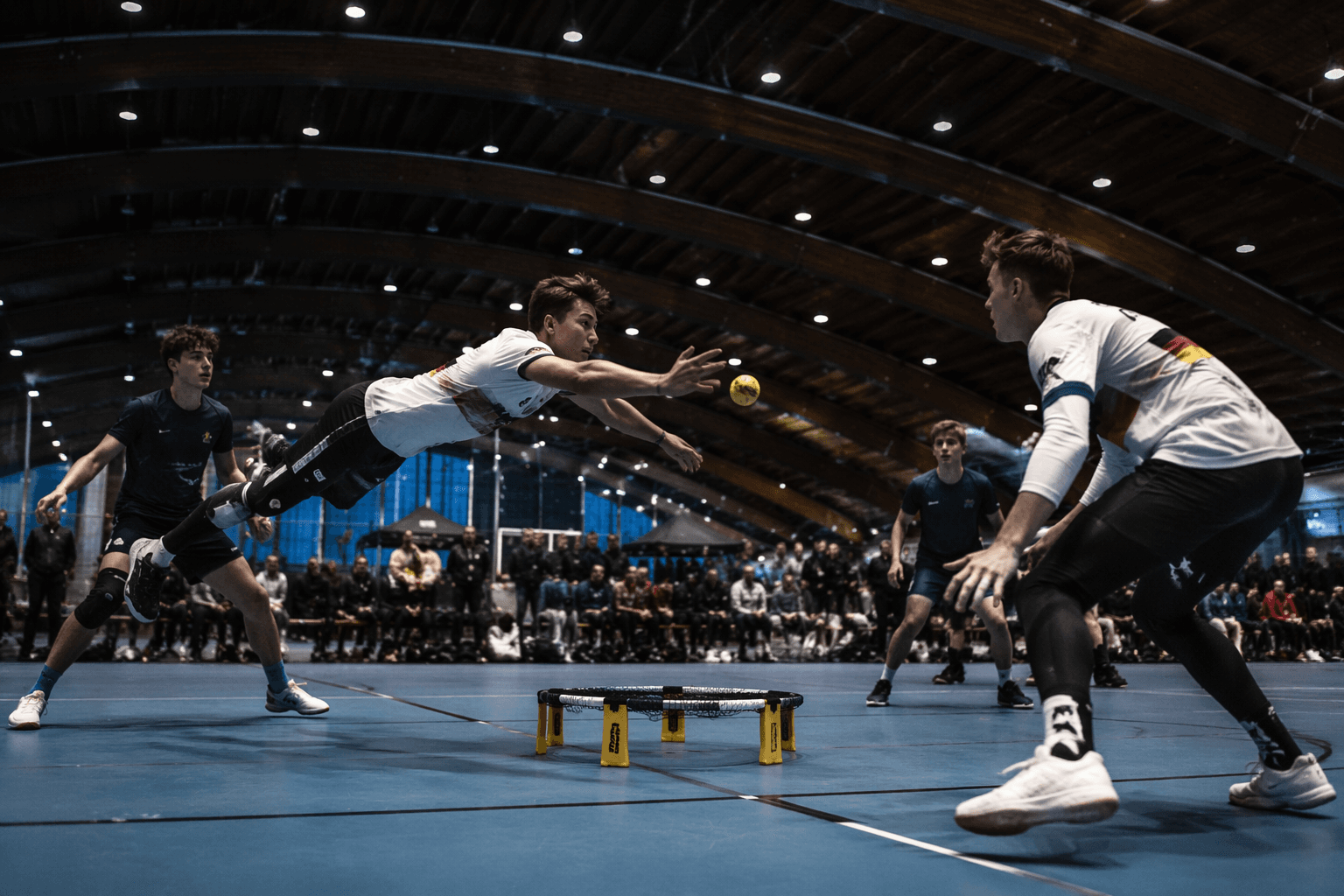
Roundnet observers keep disputes fast, fair, and player-driven
Roundnet’s real edge is not chaos control, it is restraint. Players call most of the game themselves, and observers step in only on a narrow set of final, rule-based disputes.

Roundnet only looks loose until a point turns contentious. The sport does not hand every judgment to an official, and that is the point: players handle most of the call-making, while observers step in on a tightly defined list of disputes and no farther. That balance keeps matches moving, but it also gives elite play a hard edge when a line fault, a lift, or the score itself is suddenly in question.
Self-officiating is the default
USA Roundnet describes the sport as “predominantly self-officiated,” and that is not a throwaway phrase. It is the operating model for how the game is supposed to work, with players making the first call on almost everything and the observer serving as a backstop rather than a live referee. USA Roundnet is even blunter about the role, saying the observer’s duty is not to provide “full justice” to a game.
That philosophy matches the basic shape of the rally. Under the official rules, play continues until a team cannot legally return the ball, and a team gets up to three touches before sending it back to the net. In practice, that means the sport is built around continuous play and quick judgment, not long stoppages and constant intervention.
What the observer can rule on
The observer does not get to wander into every disagreement. The active calls are narrow and objective: foot faults, encroachment over the service line, illegal service tosses, illegal net contact, and illegal ball contact such as lifts, carries, catches, and double hits. On top of that, the observer can rule on incorrect rotation, serving order, and score.
That list matters because it tells you what the sport values in dispute resolution. If a call can be tied to a clear rule and a visible action, the observer can decide it. If it is just a vague argument about advantage or intent, the system pushes players back toward self-officiation first. The Spikeball Tour Series frames the observer’s job simply: settle disputes, ensure adherence to the rules, and promote sportsmanship.

The process is built to be fast. Players are expected to handle the call themselves first. If they cannot agree, they can bring it to the observer, whose decision is final. If the observer cannot make a definitive call, the point is replayed. And once both teams keep playing after a possible infraction, they cannot come back later and ask for an observer ruling on that issue. That last rule is the pressure release valve: live play has to stay live, or the whole system bogs down.
The staffing gets heavier when the stakes do
Roundnet does not pretend every match needs the same level of oversight. Tournament staffing scales up as the bracket tightens, which is exactly where match pressure and disputed calls tend to spike. Quarterfinals use one observer per game, semifinals use two, and finals use three observers plus one person tracking score and serving order.
The International Roundnet Federation pushes that same logic even harder at the business end. Its observer guidance says the goal is to have three observers available for every match in the quarterfinals and onward. Before the quarterfinals, observers are assigned where available, with priority to matches between closely seeded or higher-ranked teams. In other words, the sport is not throwing more people at every match by default; it is concentrating oversight where the stakes, and the likelihood of one critical dispute, are highest.
USA Roundnet leaves one more important lever in the hands of the tournament director, who has the final say on assigning observers to matches. The same guidance recommends pairing new observers with experienced ones when possible. That is a smart detail, because it treats observer work as a skill set, not just a warm body with a whistle-free shirt.
Why the system looks this way
Roundnet’s officiating structure makes more sense once you remember where the sport came from. Jeff Knurek invented it in 1989, originally as a leisure and family game before it evolved into a more organized competitive sport. A sport with that origin story was never going to adopt a heavy, referee-driven model overnight, and it does not need one to stay credible.
The rulebook itself shows how the sport has been formalized over time. The International Roundnet Federation’s official rules were initially adopted on October 21, 2021, then updated on August 10, 2022 and June 24, 2024. That is a pretty clear marker that the game is still sharpening its competitive standards while keeping its core self-officiated identity intact.
The broader design choice is simple: preserve player autonomy, then add objective intervention points so obvious mistakes do not stick. That is why the observer can settle a foot fault or a score dispute, but cannot turn into a full-time decision-maker for every touch, screen, or argument around a point. Roundnet wants players to own the match, and it only reaches for outside authority when the rules leave no room for debate.
Reducing ambiguity where disputes start
Not every rule has to stay messy. Roundnet Canada has taken a practical approach on serving by using a 7-foot service line with lean, which makes tossing calls easier to judge than an imaginary curved line. That may sound like a small tweak, but it targets one of the sport’s most common ambiguity problems: where the serve starts and whether the toss stays legal.
That kind of adjustment fits the broader observer model perfectly. The sport does not chase perfect micro-control over every moment. It trims the gray areas where it can, reserves observers for clear violations and final disputes, and leaves the rest to the players standing on the court.
This article was produced by Prism’s automated news system from verified source data, official records, and press releases, then run through automated quality and moderation checks before publishing. The system is built and supervised by the people who set the standards it runs under. Read our full AI policy.
Did this article answer your question?