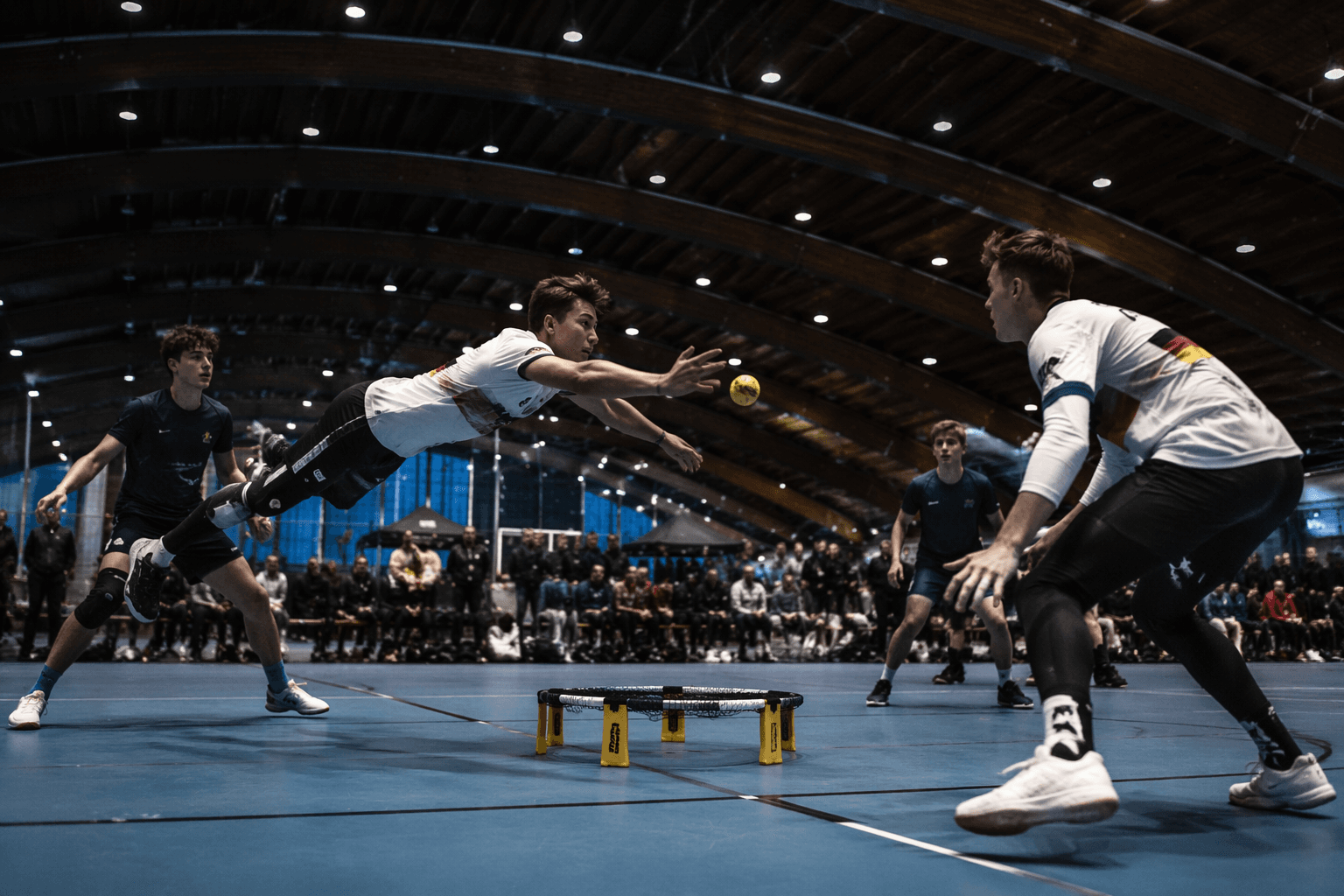
Roundnet rule revolution aims to extend rallies and curb aces
Elite roundnet is trying to lengthen rallies without flattening the chaos, and the newest rule tweaks are a design test of what the sport should reward.

Roundnet’s biggest battle right now is not speed versus skill. It is whether elite matches can last long enough for defense, touch and reading to matter, instead of letting the first serve decide everything. The International Roundnet Federation built its Rule Revolution 2025 around that problem, saying the sport needed more rallies, fewer aces and fewer double faults because hitting had become so strong that defense was nearly impossible and serving had become the only realistic path to points.
The problem is not the chaos, it is the imbalance
That is the part worth paying attention to if you watch roundnet closely. The sport works because it is fast, messy and constantly changing in a few square feet around the net, but the elite game starts to lose its shape when every point turns into a serve lottery. The IRF’s own framing is blunt: too few rallies, too many double faults and a one-dimensional game are not just style issues, they are growth issues.
That matters because roundnet is still young enough to treat the rulebook like a design document. When leaders change a line, a contact rule or a replay standard, they are not simply tidying up language. They are deciding whether the best players are rewarded for power, placement, touch, defensive reading or just a hot hand on serve.
2021 showed the blueprint for rule-by-rule design
The 2021 Spikeball Tour Series update is the clearest example of that design mindset in action. It explains, in plain terms, why specific changes were made. The 7-foot service line with lean was meant to clarify toss violations, while requiring the pivot foot to stay planted until net contact made serve calls easier.
Those are small fixes, but they target the exact places where elite points can collapse into arguments. A cleaner service line makes the beginning of the rally easier to officiate. A firmer pivot-foot rule reduces the gray area on a motion that happens hundreds of times in a tournament day.

The update also tightened other parts of the game that affect how long points last. Pockets got a more uniform definition, consecutive contacts off first touches were allowed so more scrambled balls could stay alive, and the strong-play hinder was removed from the replay equation to simplify decisions. Taken together, the message was clear: more playable points, fewer dead ends.
The no-hit zone is the clearest attempt to stretch rallies
For top divisions only, the no-hit zone was the boldest move in that 2021 package. It pushed hitters back from the net, made angles harder to create and made defense easier to read. In practical terms, it was an attempt to stop attackers from living on the tape and forcing defenders into guesswork before the ball was even gone.
That change gets to the heart of the sport’s identity problem. If the hitter stands too close, roundnet becomes a reflex drill with very little recovery time for the defense. If the hitter is pushed back just enough, the court opens up, reads become visible and rallies can breathe without losing the sport’s speed.
That is the design tension the elite game keeps circling back to. Too much freedom for the serve and the match turns into short, high-pressure bursts. Too much restriction on attacking and you lose the violence of motion that made people fall in love with the sport in the first place.
Why the fine print decides the feel of the pro game
The hard part is that roundnet rules do not move in broad strokes. A 7-foot line, a lean allowance, a pivot-foot standard or a no-hit zone can change whether the best sequence on court is a pure serve winner, a read-and-counter, or a long scramble that ends with a creative touch at the net. That is why the same rule can look like housekeeping to a casual fan and like a tactical earthquake to a pro player.
The 2021 changes were designed to make the sport more fun to play and watch, and the wording around serveball shows how central that issue is. Serve-dominant points can be thrilling in small doses, but if the serve becomes the only clean way to score, the sport narrows fast. The best version of roundnet still needs the first strike, but it cannot let the first strike erase the rest of the point.
An evolving rulebook is part of the story now
The official IRF rules page reinforces that this is not a one-time correction. Its change logs in 2022, 2024 and 2025 show a ruleset still being actively tuned, which is unusual for a sport that already moves as quickly as roundnet does. The federation is not pretending the book is finished; it is openly treating the book as something that has to keep up with how the game is actually being played.
That ongoing revision is what makes the current debate so interesting. The question is no longer whether roundnet should change, but which changes actually create longer, more strategic rallies and which ones begin sanding off the edge that gives the sport its personality. If the adjustments slow the server just enough to let defense answer, the game gets richer. If they go too far, the pro level risks feeling less like roundnet and more like a tamed version of it.
This article was produced by Prism’s automated news system from verified source data, official records, and press releases, then run through automated quality and moderation checks before publishing. The system is built and supervised by the people who set the standards it runs under. Read our full AI policy.
Did this article answer your question?