Roundnet study finds intense cardio demands and real injury risk
Roundnet looks casual, but match play drives real cardio load and a clear injury pattern in shoulders, ankles, knees and elbows.

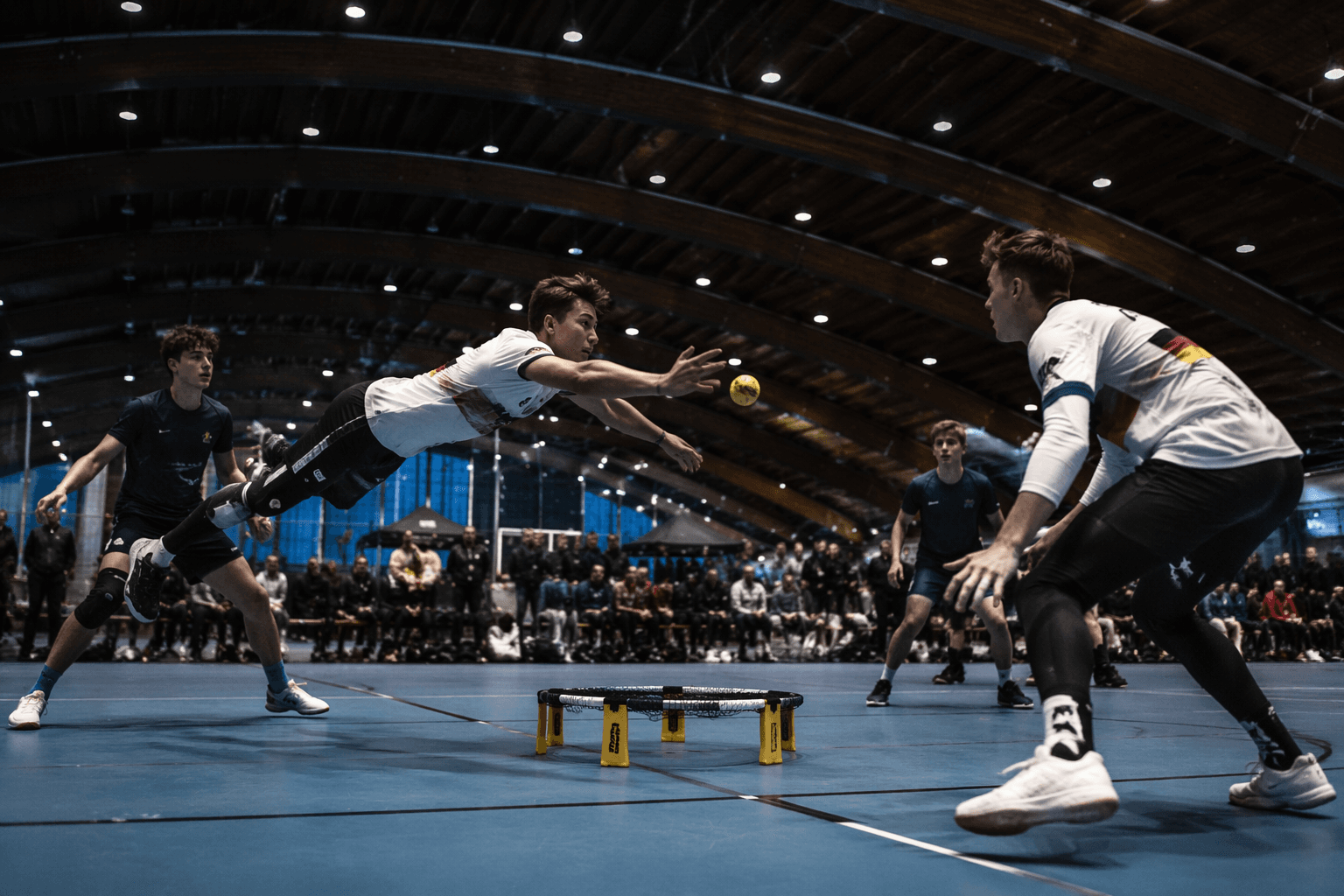
A tiny roundnet court can still tax elite bodies. In an official-rule match in Cologne, 12 experienced male players averaged 133.6 beats per minute, peaked at 159.7 bpm, and covered about 790.5 steps in a 10.8-minute set while rating the effort 13.2 on the RPE scale. A separate thesis at California State University, Chico in Chico, California, found the same broad pattern: among 20 male participants, every player reached at least moderate intensity, and nine crossed into vigorous work, with experienced players averaging 135 bpm during match play.
The workload under the net
Roundnet’s appeal is speed and simplicity, but the movement profile is anything but gentle. The Cologne team measured heart rate, lactate, step count, and perceived exertion during an official-rule match, and the numbers point to repeated acceleration rather than a casual hit-and-catch exchange. Averaging 73.1 steps per minute across a 360-degree play space, players were constantly adjusting to rebounds, cutting, and reacting at close range, which helps explain why the average heart rate sat at about 70 percent of each player’s personal maximum.
Spikeball, Inc. has turned that physical reality into an organized sport. Founded in 2008, the company has run a national Spikeball Tour Series since 2014 and uses roundnet as the formal name outside the brand.
The injury map is specific
The clearest warning sign is not a single dramatic collision injury but a spread of wear-and-tear problems. In a 2024 BMJ Open Sport & Exercise Medicine study of 166 athletes, 279 injuries were reported and 86.1 percent of players said they had suffered at least one injury during their roundnet career. Shoulders led the list at 20 percent, followed by ankles at 18 percent, with knees and elbows at 14 percent each.
Nearly half of those injuries, 47 percent, were attributed to overuse. Sixty-seven percent of injuries forced athletes to miss competition time, and the average absence was two months. Ten injuries required surgery, and the study found no significant differences in injury frequency or characteristics between elite and non-elite athletes.
How to train for the game you actually play
Train the parts of the body that absorb the sport’s load so the rallies can stay fast. The BMJ study points directly at shoulder strength, shoulder range of motion, and ankle stability, and the intensity data make the case for conditioning that prepares you for repeated bursts near 133 to 160 bpm rather than a leisurely warmup jog.
A useful training emphasis looks like this:
- Build shoulder strength work that keeps the joint stable through reaching and overhead touches, because the shoulder was the most common injury site at 20 percent.
- Keep shoulder range of motion honest with regular mobility work before and after play, since overuse made up 47 percent of injuries.
- Train ankle stability and lower-leg control, because ankles accounted for 18 percent of injuries and constant cutting is built into the sport.
- Practice short acceleration and deceleration drills that mimic the 73.1 steps per minute and rapid direction changes of match play.
- Add reaction work that forces you to move in all directions, because the rebound can send the next touch anywhere around the 360-degree net.
Warmups should match that load profile. A few minutes of arm circles will not prepare a body for a 10.8-minute set that sits at moderate exertion and spikes much higher in short exchanges. The better pattern is a progressive warmup that opens the shoulders, wakes up the ankles, and raises the heart rate before the first serve, then a cooldown that lowers soreness and keeps tightness from stacking on top of repeated match play.
What players, coaches, and organizers should change
The biggest mistake is treating pain as part of the price of entry. Because 67 percent of injuries in the BMJ study caused missed competition time and the average layoff was two months, the smarter move is to treat shoulder ache, ankle instability, and elbow irritation as early warning lights, not badge-of-honor discomfort. Players should scale volume when overuse creeps in, coaches should monitor how often athletes are diving, reaching, and repeating overhead touches, and tournament organizers should build breaks into schedules so intensity does not turn into unnecessary wear.
This article was produced by Prism’s automated news system from verified source data, official records, and press releases, then run through automated quality and moderation checks before publishing. The system is built and supervised by the people who set the standards it runs under. Read our full AI policy.
Did this article answer your question?