Roundnet youth exchange in Hungary promotes sport, health and culture
Roundnet’s Hungarian youth exchange is bigger than a weekend of games: it turns a fast-growing niche sport into a cross-border classroom for leadership, health, and culture.

Roundnet usually enters the conversation through brackets, standings and who survived the most brutal rally of the day. The Nyíregyháza youth exchange flips that script. Here, the sport is being used as a vehicle for intercultural learning, healthy living and community building, which is exactly the kind of growth lane grassroots roundnet has been waiting for.
Roundnet on a different stage
This project places roundnet inside the Erasmus+ youth exchange model, and that changes everything about how the sport is valued. Instead of treating the game as a pure competition, the format turns it into a shared experience built around teamwork, movement and social connection. In a sport that is still finding its identity across Europe, that matters as much as a clean serve or a clutch save.
The setting in Nyíregyháza, Hungary, is not just a backdrop. It signals that roundnet can travel well, work in mixed-nationality groups and create common ground quickly, even when participants arrive with different sporting backgrounds. That is a powerful test case for a sport that wants to expand beyond club regulars and tournament diehards.
Why Erasmus+ fits roundnet so cleanly
The Erasmus+ youth exchange model is built for short, intense group experiences. Participants come together from at least two countries, work through workshops, exercises, debates, role-plays, simulations and outdoor activities, and leave with more than memories of a few matches. The European Youth Portal says these exchanges usually run for 5 to 21 days, not counting travel time, and Erasmus+ guidance says they are open to all young people, with particular attention to those with fewer opportunities.
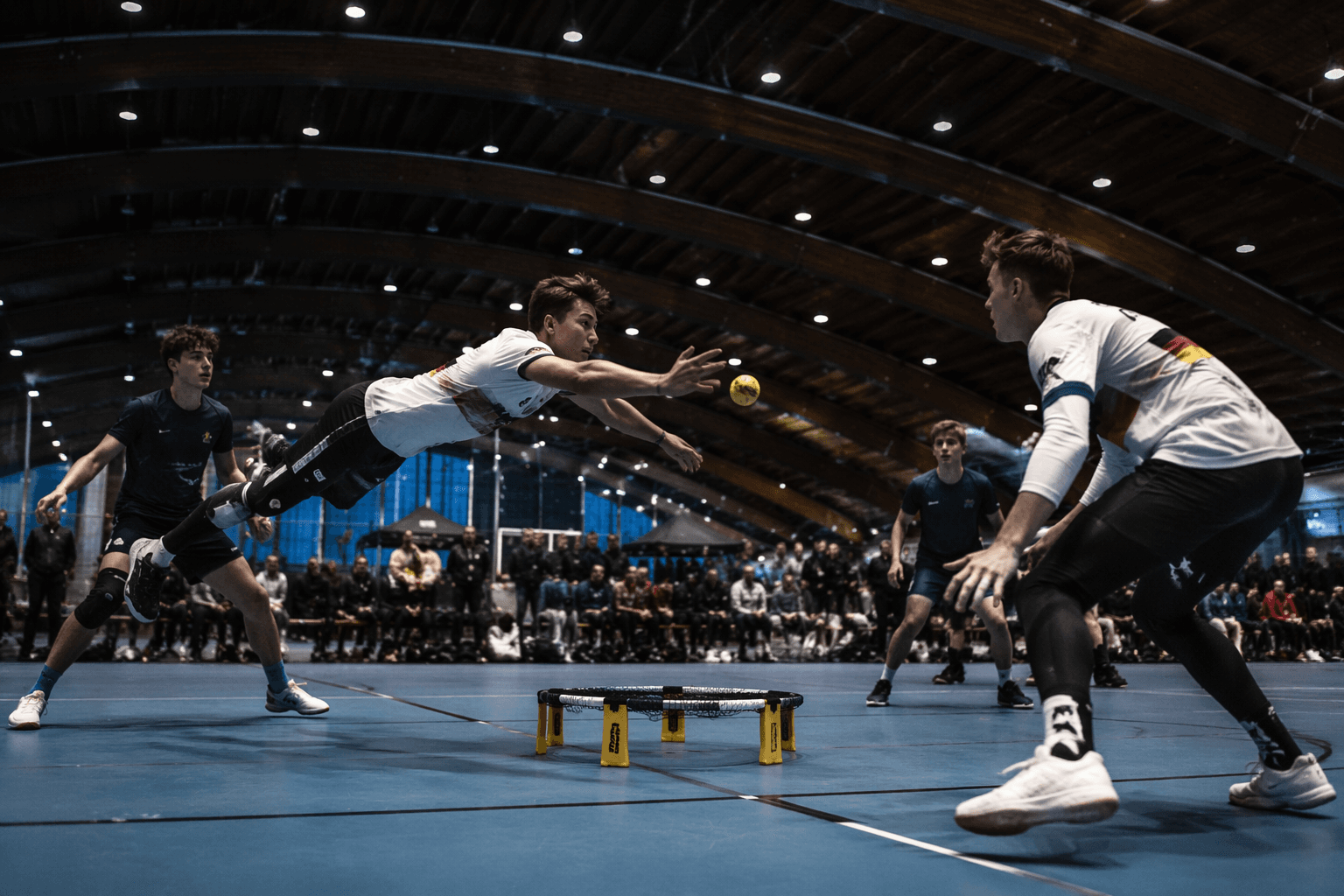
That structure matches roundnet almost perfectly. The sport is fast to explain, quick to start and played by two-person teams around a circular net, so it does not require the kind of long technical runway that can slow down other games in a mixed group. The European Spikeball Roundnet Association describes it as a fast, intense 2v2 sport, and that intensity gives the exchange a competitive edge without shutting out newcomers.
The real value is not just that people play together. It is that they learn together. Erasmus+ says youth exchanges are meant to develop competencies, raise awareness of relevant issues and help young people discover new cultures, habits and lifestyles while strengthening solidarity, democracy and friendship. Roundnet fits that brief because it combines movement, communication and trust in a format that is easy to share across language barriers.
What participants gain beyond the matches
The smartest part of this story is that the exchange is not really about a scoreboard. It is about what happens when a sport becomes a social tool. The International Roundnet Federation’s educational resources are aimed not only at players, but also at local community leaders, tournament directors and coaches, and that tells you where the sport sees its next wave of growth.
For participants, that means the exchange can build coaching skills, not just playing skills. It can create people who know how to explain the game, organize a session, keep a group engaged and turn a casual pickup circle into something sustainable. In a developing sport, those are not side benefits. Those are the people who keep the sport alive once the event ends.
It also creates cultural ties that last longer than a match point. A youth exchange built around roundnet gives young players a reason to talk, teach, lead and adapt together. That is how a sport starts producing ambassadors, not just athletes. The most valuable takeaway may be simple: when players learn to organize around a net in one country, they are more likely to build a community around that same net when they go home.
Why this matters for roundnet’s European growth
This is more than a clever one-off. It is a sign that roundnet is widening its pipeline. The sport is moving into youth work, mobility programs and community education, which can be just as important for expansion as national titles or world championships. If a sport wants to grow across Europe, it needs more than elite play. It needs entry points, and Erasmus+ provides one of the best.
Hungary is a useful place to watch that evolution because the sport has already started to organize there. Roundnet Hungary, the Magyar Roundnet Szövetség, was officially founded in October 2024 with the aim of making the game a real community-building force in the country. That is not the language of a novelty sport. That is the language of a federation trying to build roots.
The wider international picture backs that up. A 2025 Hungarian sports report said roundnet had official national federations in more than 35 countries, while the International Roundnet Federation says the first World Championships were held in September 2022 in Belgium. Its official rules were updated on June 24, 2024, which shows a sport that is still young, still formalizing, and still pushing outward. That combination often creates the fastest growth.
The bigger lesson from Nyíregyháza
Nyíregyháza is showing how roundnet can work when the objective is not just to crown a winner, but to build a network. The sport’s 2v2 format, quick learning curve and cooperative rhythm make it ideal for an exchange where young people are expected to listen, adapt and lead. That is the kind of setup that can turn a niche game into a cross-border habit.
If roundnet is going to keep spreading in Europe, it will need more than viral clips and championship results. It will need people who can coach, organize, translate and invite the next player in. This youth exchange points straight at that future, and it suggests the sport’s next breakthrough may come not from the final point of a tournament, but from the first conversation around a circular net.
This article was produced by Prism’s automated news system from verified source data, official records, and press releases, then run through automated quality and moderation checks before publishing. The system is built and supervised by the people who set the standards it runs under. Read our full AI policy.
Did this article answer your question?