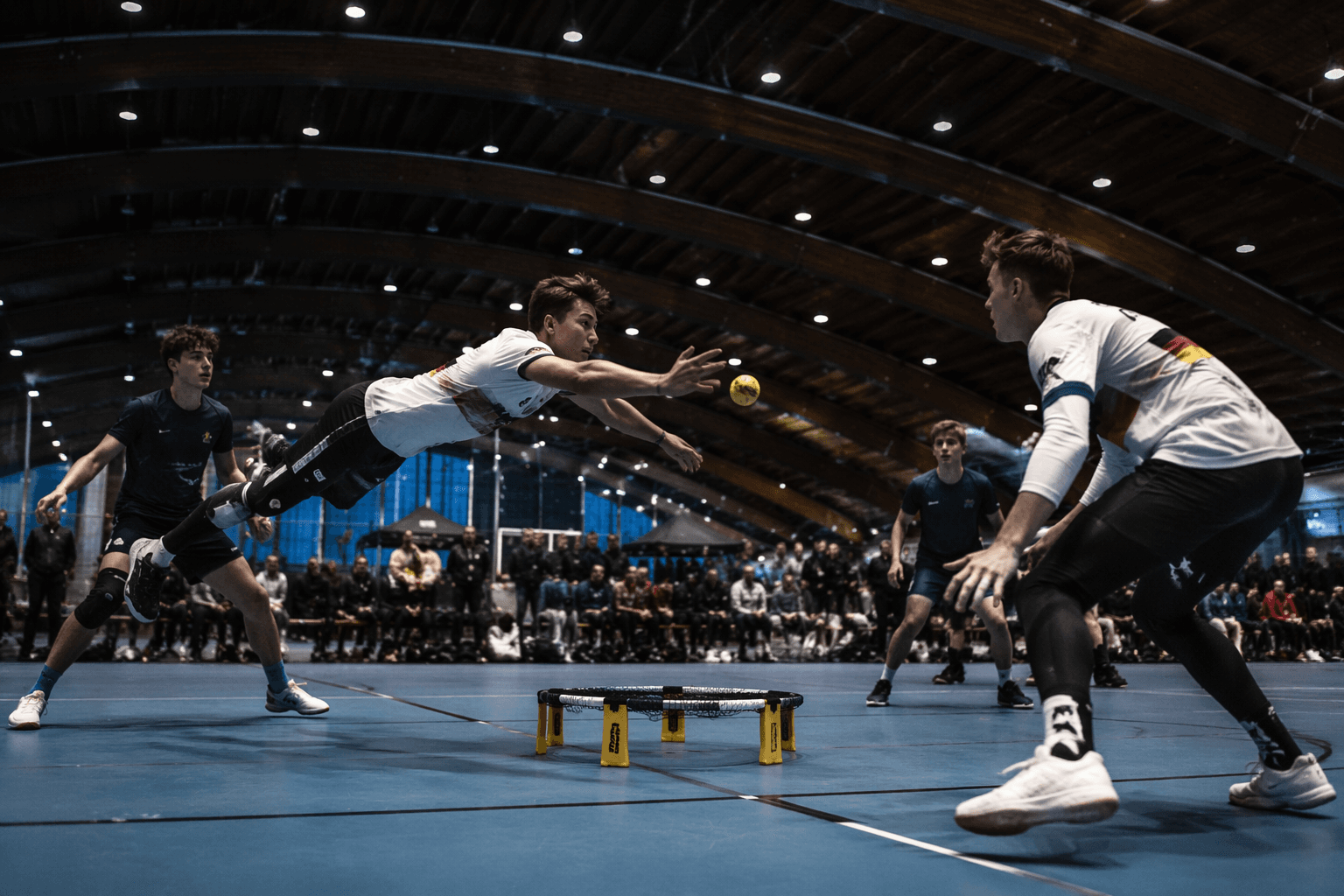
Spikeball player ratings map the path from beginner to tournament-ready
Spikeball’s rating ladder gives roundnet a clear climb: rules and rotations at 1.0, controlled touches at 1.5, and tournament-ready reads by 3.0.

Spikeball defines 3.0 as tournament-ready intermediate play. The ladder measures improvement from a first clean serve to the defensive spacing and partner timing that hold up in tournament play.
Start with the rotation, not the highlight reel
At 1.0, the game starts with basic literacy: know the rules, know the serving and scoring rotations, and understand how the court moves around the net. The server switches positions with a teammate after winning a point, and every player rotates one spot counterclockwise every five points so sun and wind do not keep favoring the same side.
Self-officiation is a fundamental component of the sport, which means the player who only chases athletic plays is still missing part of the game. A 1.0 player is not just learning where to stand, but how the rally, the rotation, and the call all fit together.
1.5 and 2.0 are about control before power
Spikeball’s 1.5 level shifts the focus from basic structure to repeatable contact. The markers are simple but demanding: serve onto the net without forcing power, spike under control, and pass toward the net reliably. That is the first real sign that the ball is being placed on purpose, not just hit hard.
At 2.0, a player can run away from the net to defend, then recover to attack, while also hitting powerful serves with more than a 50 percent success rate. Players at this level can defend space, reset balance, and still generate pressure on serve.
At 2.5, the game becomes a reading test
At 2.5, both hands matter, and the player chooses between a drop shot and a big spike based on defensive positioning. The server, passer, and attacker are responding to the same clues: where the defense is leaning, how the ball is set, and whether the safe play is a softer touch or a faster finish.
A player who can switch between those options shapes rallies.

3.0 is the tournament-ready checkpoint
Spikeball defines 3.0 as tournament-ready intermediate play. The player can hit at least two kinds of serves consistently, make accurate passes that account for teammate and defense positioning, and hold ideal defensive shape based on where the offense and ball are located.
SpikeSchool organizes instruction around passing, hitting, defense, and serving, not one-off tricks. Good roundnet at 3.0 is built on first-contact control, a second touch that lands where a partner can use it, and defensive recovery that keeps the shape of the rally intact.
The 2026 college series uses the standard International Roundnet Federation ruleset, including equal serving, a 100 cm no-hit zone, and an 8.5 meter boundary. Spikeball’s Premier division is reserved for the top 1 percent of players.
The sport around the ladder has become more formalized
Roundnet has existed since 1989, and USA Roundnet is a new organization focused on the sport’s growth, player advancement, inclusive communities, and international representation for the United States.
Spikeball began hosting Tour Series events in 2013, when it was the only organization staging roundnet events. Organized college roundnet has existed since 2017, and USA Roundnet now runs a national college competition circuit.
Clubs or teams not officially associated with the company should use roundnet rather than Spikeball.
Spikeball aired on Shark Tank on May 15, 2015, with CEO Chris Ruder pitching the game on national television. More recently, it was the official sponsor of the 2024 Roundnet World Championship at Surrey Sports Park in London from August 29 to September 1, 2024.
This article was produced by Prism’s automated news system from verified source data, official records, and press releases, then run through automated quality and moderation checks before publishing. The system is built and supervised by the people who set the standards it runs under. Read our full AI policy.
Did this article answer your question?