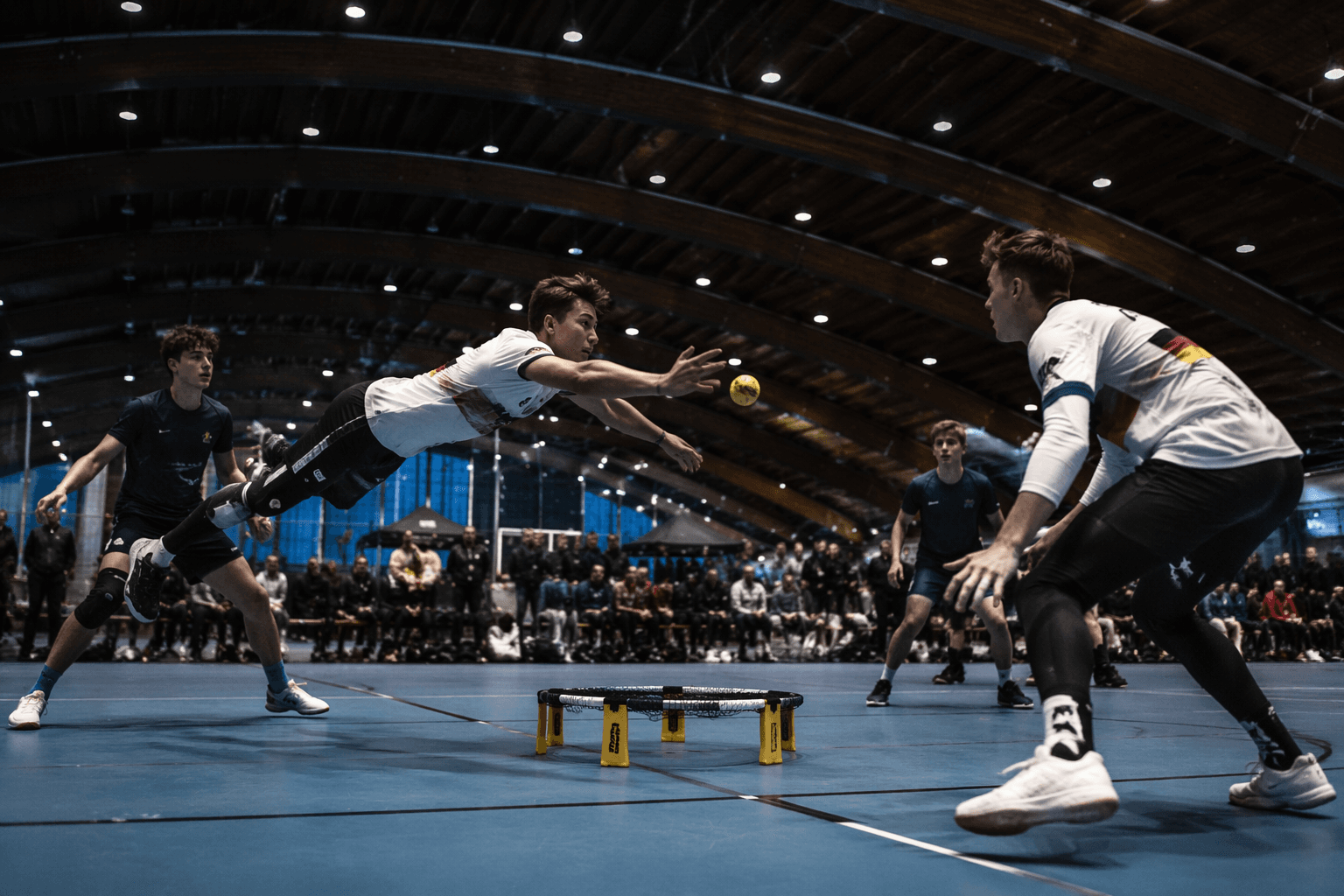
Spikeball Tour Series says shorter rallies hurt roundnet’s appeal
Spikeball Tour Series says elite roundnet is getting too efficient, with 2017 finals producing rally rates as low as 4.8 percent and 8.9 percent. Its biggest clips still come from the long points.

The Spikeball Tour Series says the sport’s best players are making roundnet less watchable by ending points before rallies can develop, and its own breakdown of the 2017 national finals shows how sharp that shift has become. In the Premier final in Chicago, 58.9 percent of serves were legal, 41.1 percent were missed, 14.5 percent turned into aces and only 4.8 percent became rallies. The Women’s final was longer, but still tilted heavily toward quick endings, with 80.9 percent legal serves, 19.1 percent missed serves, 4.5 percent aces and 8.9 percent rallies.
Even when the Tour Series narrowed the sample to points that actually went to a return, the exchange rates were still thin. Rallys made up only 10.9 percent of those points in Premier and 11.8 percent in Women’s, a sign that the highest level of play is often built around low-percentage aggression rather than extended back-and-forth sequences. Peter Jon Showalter and Tyler Cisek won that 2017 Premier title and went on to repeat as national champions in 2018 and 2019, underscoring how much the modern game has been shaped by a small elite whose choices define what the sport looks like on video.

The college side has already shown that roundnet can break through beyond its core. The 2017 college nationals were held at Clemson, where the University of Massachusetts Amherst won club first, and ESPN later carried the 2023 Roundnet College Nationals Championship on ESPNU and Watch ESPN. The Tour Series also maintains official college results and season pages, a sign that the pipeline is established even if the product on court is getting shorter and harder to decode for casual viewers.
That is why the sport’s most valuable highlights are often the longest ones. A rally from 2015 resurfaced on House of Highlights and climbed to nearly 3 million views while also drawing attention from Drake, a reminder that roundnet’s viral moments tend to be the exchanges with the most touches, not the cleanest finishes. The Tour Series’ argument is plain: if elite matches keep collapsing into quick serves, misses and aces, the sport risks losing the very sequences that make it legible to a wider audience.

Any fix would have to fit a sport that still lives with self-officiation at its core. USA Roundnet calls self-officiation a fundamental component of roundnet, and the Tour Series has partnered with it on a Referee Initiative to improve consistency in rule application. Roundnet dates to 1989, when Jeff Knurek invented it, and Chris Ruder later revived the game into Spikeball Inc., whose brand says it has been “Trusted Since ’08.” The next rule debate is not just about tactics. It is about whether roundnet can protect the rallies that make its best points worth watching.
This article was produced by Prism’s automated news system from verified source data, official records, and press releases, then run through automated quality and moderation checks before publishing. The system is built and supervised by the people who set the standards it runs under. Read our full AI policy.
Did this article answer your question?