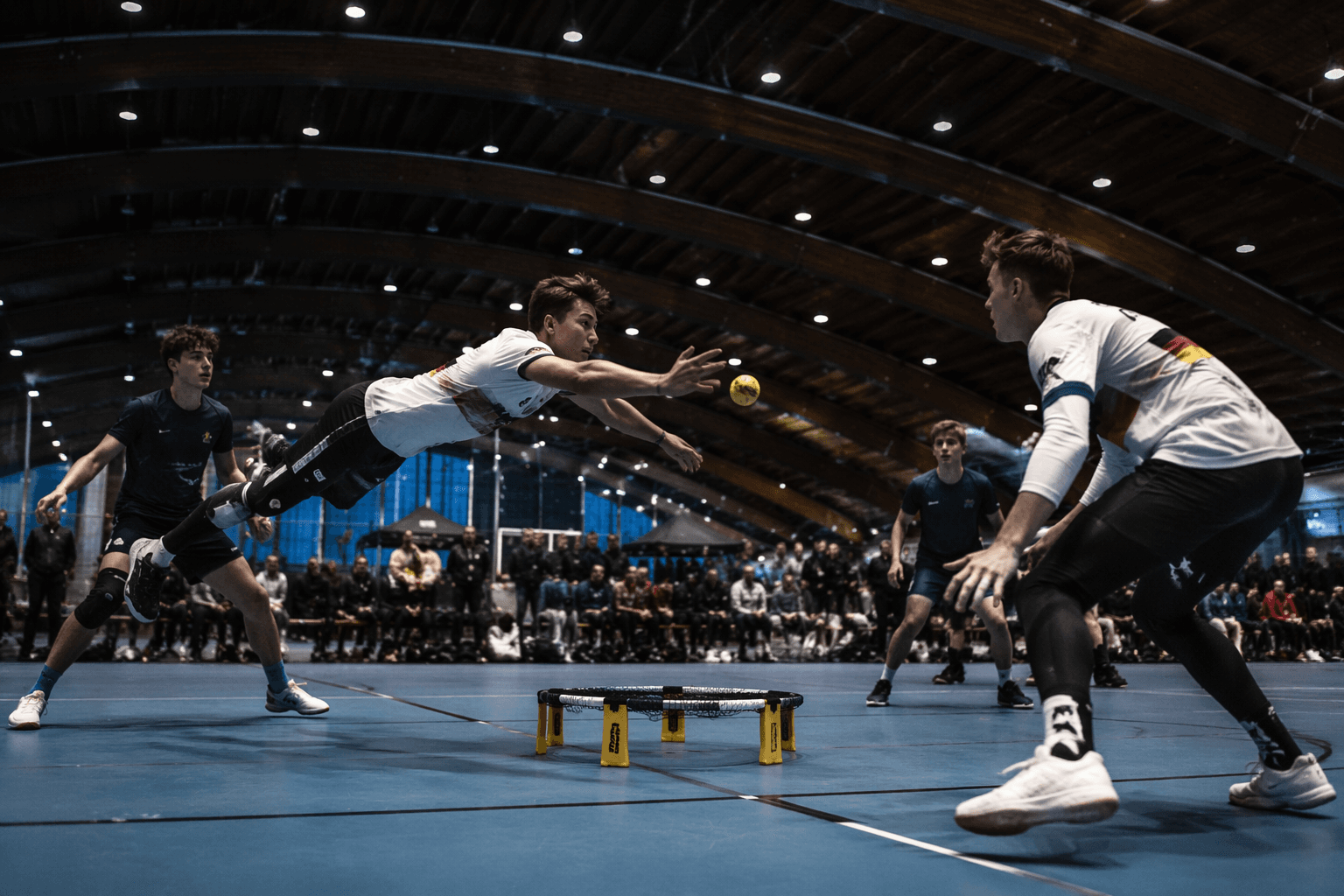
Spikeball Tour Series updates college roundnet rules for fall season
New fall college roundnet rules tighten serves, shape first-possession strategy, and standardize gear, but the bigger shift may be more sectionals in hot spots like the Northeast and East Bay.
The Spikeball Tour Series is making fall college roundnet feel more like a real circuit and less like a loose campus scramble. A 3-second serve clock, a stricter first-possession rule, and mandated TITAN sets and Atlas balls for at least all D1 events mean captains now have to budget, practice, and prep with more precision than before.
What changes on the court
The sharpest rule change is the 3-second serve clock. That sounds small until you realize how much college roundnet lives on rhythm, hesitation, and cheap delays before a serve. Faster service not only speeds matches up, it also puts more pressure on the receiving side to be organized from the first contact.
The rest of the update is just as intentional. The receiving team must use all three touches on the first possession, same-hand tosses on serves are banned, simultaneous teammate contacts count as one touch, and blocks on 1 in the NHZ are allowed if the ball has not started its downward path. Put together, those rules reward clean structure over improvisation: better first touches, fewer bailout sequences, and less ambiguity when teams are reacting in transition.
That matters for the way college games actually unfold. If a squad is used to surviving on scramble volleyball and lucky over-sets, this version of the game is less forgiving. If a team can pass, set, and finish on time, the new rules make rallies cleaner and the level gap more obvious.
What captains need to adjust right away
This is where the update becomes a real operational issue, not just a rules memo. Captains are now dealing with a fall season that asks for tighter practice planning because the first possession is more scripted and the serve clock rewards repetition. Teams that once treated serving as a casual opening action now need set routines, time discipline, and enough reps to avoid getting rushed into bad contacts.
The equipment change hits budgeting and prep in a more concrete way. The fall college season will use TITAN sets and Atlas balls at least for all D1 events, with broader use depending on supply. For clubs, that means practice gear, travel gear, and tournament gear need to line up more closely than they did under a looser setup. If you are a captain trying to get a roster ready for sectionals, matching competition conditions in practice is no longer optional if you want your team to feel the difference before game day.
Standardized gear also changes tournament prep. A club that has spent months on mixed equipment is not preparing under the same conditions as a team that knows exactly what it will see at the top level. The update narrows that gap, which is good for competitive clarity, but it also means clubs have to be more deliberate about what they train on and what they bring.
Why the sectional format matters more than the rule tweaks
The biggest structural change may not happen on the court at all. Earlier season materials described fall and spring sectionals as one tournament in each section, which was simple and easy to explain. Now the Spikeball Tour Series says multiple sectionals per section may be allowed where demand is high, especially in the Northeast and East Bay. That is a meaningful departure from the single-tournament model.
For teams, that changes the map of qualification and travel. More events in crowded sections can ease the squeeze on clubs that would otherwise fight for one slot, and it gives the circuit a better chance to absorb growth without forcing everyone into one oversized weekend. It also signals that the college game has outgrown the old assumption that one sectional per section is enough.
That growth is already baked into the scale of the system. Spikeball’s college pages describe 10 U.S. sections plus an international section, more than 1,100 players, more than 125 clubs, and 21 U.S. events. The sections themselves are clearly defined: Northeast, East Bay, Atlantic Coast, Central, Great Lakes, Pacific Northwest, Rocky Mountain, South Central, Southwest, and Tropic South. Once a circuit gets that large, sectionals stop being a formality and start becoming a pressure point.

The points system reflects that reality too. Each of the 9 sections has 1 auto bid, with 9 additional strength bids awarded in the fall. That means the path to championship play is not just about winning your section, but also about stacking enough quality results to survive the deeper field. If multiple sectionals are added in high-demand areas, those bids become even more valuable because they help sort out crowded regions without turning qualification into a free-for-all.
How this affects newer players without softening the top end
The stated goal is to lower the barrier of entry while creating a more enjoyable environment for college athletes. That is the right framing, and this update mostly backs it up. A 3-second serve clock, a mandatory three-touch first possession, and clearer contact rules are all easier to teach than a fuzzy, open-ended system where every club invents its own habits.
For newer players, that is a real advantage. The game becomes easier to understand because the first few exchanges have a recognizable structure. There is less room for confusion, less room for awkward loopholes, and fewer plays decided by who knows the quirks better on a given weekend.
But easier to enter does not have to mean watered down. In fact, these rules may do the opposite. Serious college programs still get the rally quality they want, and the block rule in the NHZ keeps the defensive side active without turning every net-side read into a guessing contest. The update does not flatten the sport; it clarifies it.
That is the balancing act college roundnet has been trying to solve for years. If the rules are too loose, the best teams spend too much time navigating chaos. If they are too rigid, the game loses the creativity that makes it worth watching. This version lands closer to the middle, and that is probably where the sport needs to be.
The calendar is getting more formal too
The 2025 College Season page makes the schedule feel more like a season and less like a string of isolated events. It lists fall sectionals, spring sectionals, and College Nationals at Grand Park Sports Campus in Westfield, Indiana, on May 24-25. It also lists the divisions offered as D1 Squads, D2 Squads, and Individual 2.0-4.0.
That matters because it shows the college calendar is no longer just about showing up and seeing what happens. The structure is set, the divisions are defined, and the title path is clear. When the season already has that much shape, changes to sectionals format and equipment standards ripple through everything from roster planning to travel budgets.
Spikeball’s college clubs also have a more organized home base now through Fwango, where colleges can create organization pages to track membership, rankings, and host tournaments. That may sound like administrative plumbing, but it matters in a sport where clubs are often built by a handful of students juggling sign-ups, practice turnout, and event hosting at the same time. Better organization tools make the fall calendar easier to manage, especially if section demand keeps climbing.
The bottom line is simple: this fall is not just about new rules, it is about a more mature college circuit. The Tour Series is tightening the game, standardizing the gear, and widening access in the places where demand is hottest. If the system works the way it is designed, newer players will get a clearer entry point and serious programs will still get the level of play they expect.
This article was produced by Prism’s automated news system from verified source data, official records, and press releases, then run through automated quality and moderation checks before publishing. The system is built and supervised by the people who set the standards it runs under. Read our full AI policy.
Did this article answer your question?