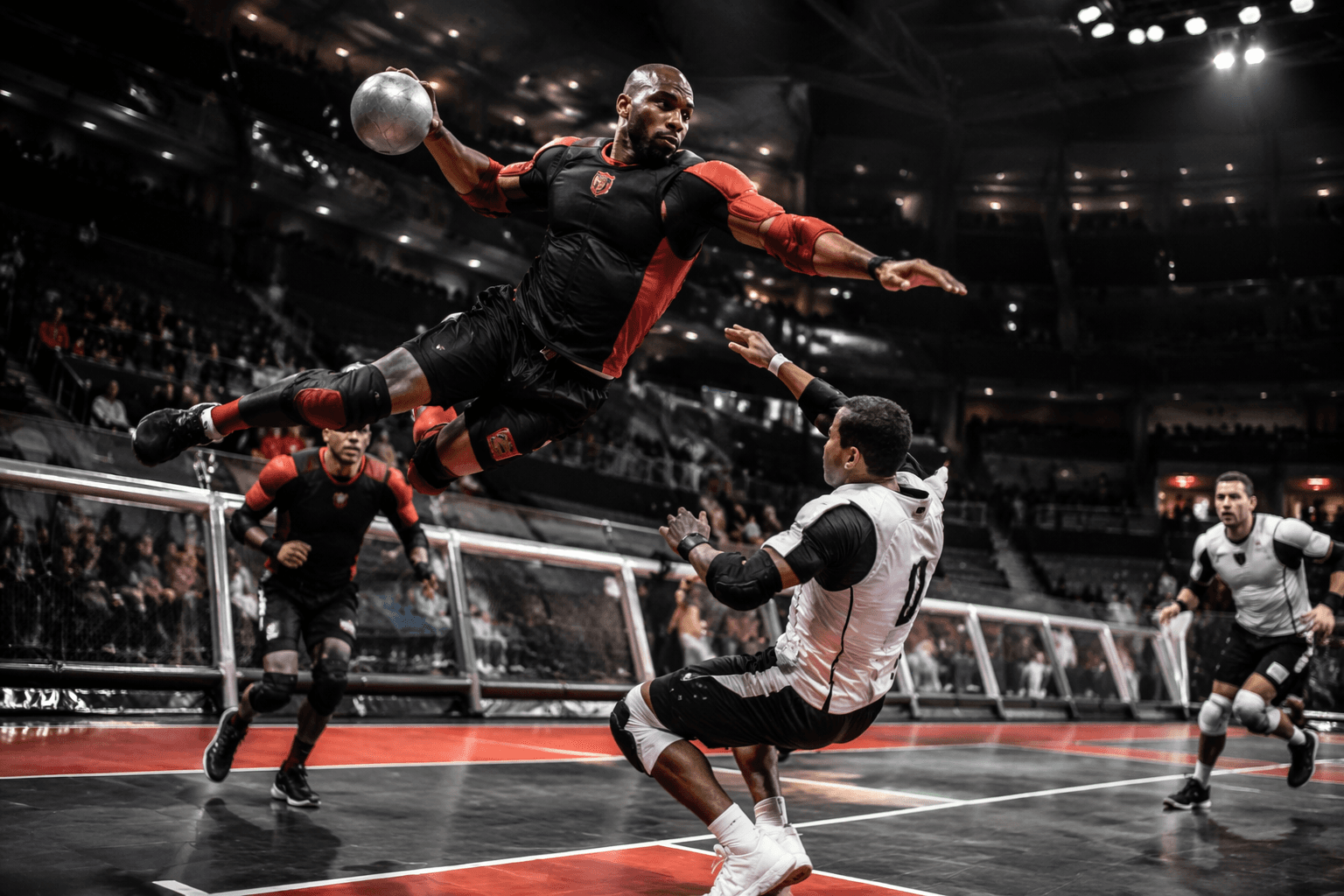
Buzzsaw roster highlights ex-football stars powering SlamBall attack
Buzzsaw’s roster reads like SlamBall’s recruiting manual: football pedigree, family legacy, and raw burst in one lineup. Raymond Taylor and Jamaal Barnes Jr. make the case.

Buzzsaw’s roster as a blueprint
Buzzsaw’s current roster says almost as much about SlamBall as it does about the club. The team is one of the league’s active clubs, and the mix of bodies and backgrounds on the squad page shows how the sport sells itself through athletes who already feel familiar to fans of football and basketball.
That is the real story here: Buzzsaw is not built around generic highlight seekers. It is built around players whose athletic resumes explain why SlamBall works at all, with handlers, gunners, and hybrid athletes who can survive contact, space, and the league’s spring-loaded chaos.
Football pedigree still drives the attack
Raymond Taylor is the clearest example of the formula. Listed at 5-foot-10 and 185 pounds, the Wichita, Kansas native is tagged as a handler, but his identity comes from football first. Taylor spent two years at Oklahoma State and one year at Tulsa as a running back, and his SlamBall bio says he posted six rushing touchdowns, 581 all-purpose yards, and a 5.6 yards-per-carry average across those college stops.
That profile matters because it explains the kind of player SlamBall still values. Taylor was a walk-on who became a starter and a key performer at Oklahoma State, which is exactly the kind of climb that translates to a league where leverage, toughness, and quick adaptation matter as much as pure size. In a sport that rewards instant acceleration and decisive contact, his route from overlooked college grinder to featured contributor reads like a recruiting template.
Buzzsaw’s other football-adjacent pieces reinforce that idea. DeVonte Pratt is listed as a 6-foot-1, 205-pound handler from Toledo, Ohio, while Malik Abdul-Haqq is a 6-foot-7, 185-pound gunner from Seattle, Washington. Together, they show a roster that is not trying to mimic one sport so much as harvest the best traits from several, then drop them into a format where those traits become the point.
Why the positions matter
The labels on the team page are more revealing than they might first appear. Buzzsaw is not presented through the normal basketball vocabulary of wings, guards, and bigs. Instead, the roster is framed around handlers and gunners, which fits a game built for speed, collisions, and live substitutions.
That structure shapes roster construction in a very specific way. Handlers like Taylor and Pratt have to operate in traffic, make decisions fast, and stay composed when the floor turns into a series of quick breaks and abrupt physical challenges. Gunners like Abdul-Haqq bring vertical range and long-limbed disruption, which gives SlamBall the kind of rim pressure and shot-blocking value that looks familiar, but is deployed in a much different environment.
The league’s design makes those traits more than cosmetic. SlamBall’s court is only 96 feet long by 64 feet wide, and the springbeds at each end turn every possession into a test of timing and body control. With hockey-like substitutions that happen during live play, rosters are not just about talent depth. They are about interchangeable athletes who can jump in, sprint hard, and keep the pace from breaking.
Jamaal Barnes Jr. adds the family line
If Taylor represents the football pipeline, Jamaal Barnes Jr. represents the family pipeline. Buzzsaw selected him in the third round, and his player page says his explosive style and range made him a fit for the club. He is also the son of former SlamBall gunner Jamaal Barnes Sr., which gives Buzzsaw a direct tie to the sport’s earlier era and makes the roster feel like more than a collection of imported athletes.
Barnes Jr. is the sort of player whose background helps explain SlamBall to anyone who is still learning the league. He led the Inland Empire Athletic Conference in scoring at 18.8 points per game at Mt. San Jacinto College in the 2019-20 season, then transferred to Utah Tech, where he appeared in 10 games. That track from junior college production to Division I exposure mirrors the kind of athletic translation SlamBall prizes: score, adjust, then survive at a higher level.
There is also a broader point buried in his biography. SlamBall says Barnes Jr. is one of four current players whose father previously played the sport, which means the league is starting to produce its own lineage instead of relying only on outside sports for credibility. That is a meaningful step for any niche league trying to move from curiosity to continuity.
Buzzsaw’s coach ties the present to the league’s past
Buzzsaw’s identity is not only shaped by the roster. Head coach Hernando Planells Jr. gives the club a direct line to SlamBall history. The team site identifies him as the head coach, and SlamBall says he previously coached the Bouncers in the 2002 and 2003 seasons.
That historical thread matters because it links the modern version of the sport to its original era, when the league was still figuring out how to package itself. SlamBall’s June 27, 2023 relaunch announcement said the league returned with eight team names, logos, coaches, and seven-man rosters. The 2023 season then opened on July 21 at Cox Pavilion in Las Vegas on ESPN, after SlamBall had been dormant in the United States for 15 years.
Planells gives Buzzsaw a memory bank. The roster gives it a selling point. Together, they show a league trying to prove that its future is strongest when it respects the people and the athletic backgrounds that got it here.
What Buzzsaw says about SlamBall’s model
Buzzsaw is compelling because it shows how SlamBall recruits. The league wants football burst, basketball range, family history, and athletes who understand pressure when the game gets vertical and violent. It also wants players who can fit a sport defined by speed, live changes, and a court that punishes hesitation.
That is the deeper significance of this roster. Buzzsaw is not just stocked with names that can sell a ticket or fill a highlight package. It is built from the kinds of backgrounds that make SlamBall legible, and that may be the league’s smartest strategy. For now, the formula looks less like borrowed credibility and more like a working identity: football toughness, second-generation continuity, and enough raw explosiveness to make the sport feel inevitable.
This article was produced by Prism’s automated news system from verified source data, official records, and press releases, then run through automated quality and moderation checks before publishing. The system is built and supervised by the people who set the standards it runs under. Read our full AI policy.
Did this article answer your question?