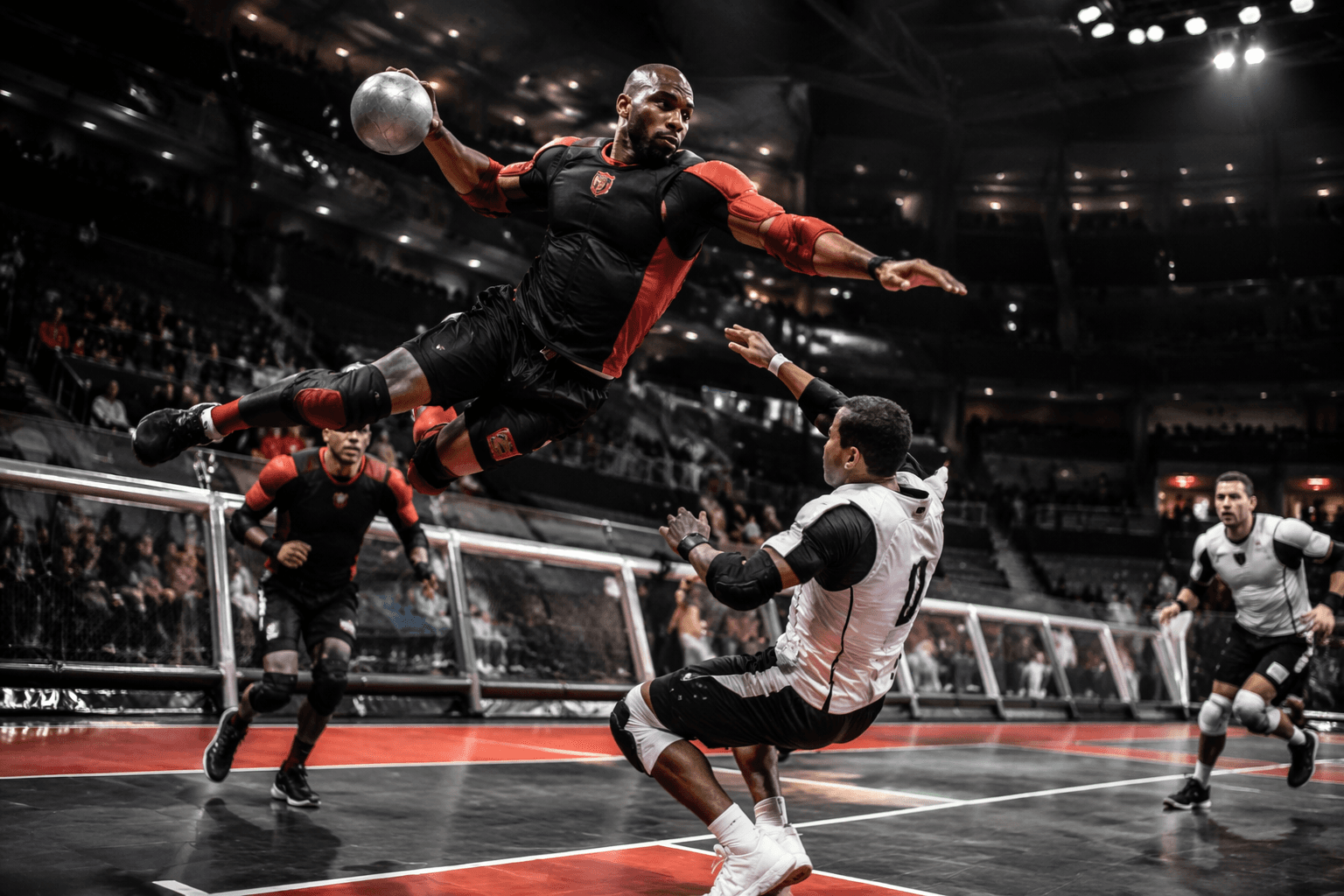
Ozone leans on father-son bond, towering Vincent Boumann to build identity
Ozone is building its clearest identity through family ties and body type. Trevor Anderson, Bryan Bell-Anderson, and Vincent Boumann show how SlamBall can sell role clarity, not just chaos.
Family first, then the roster
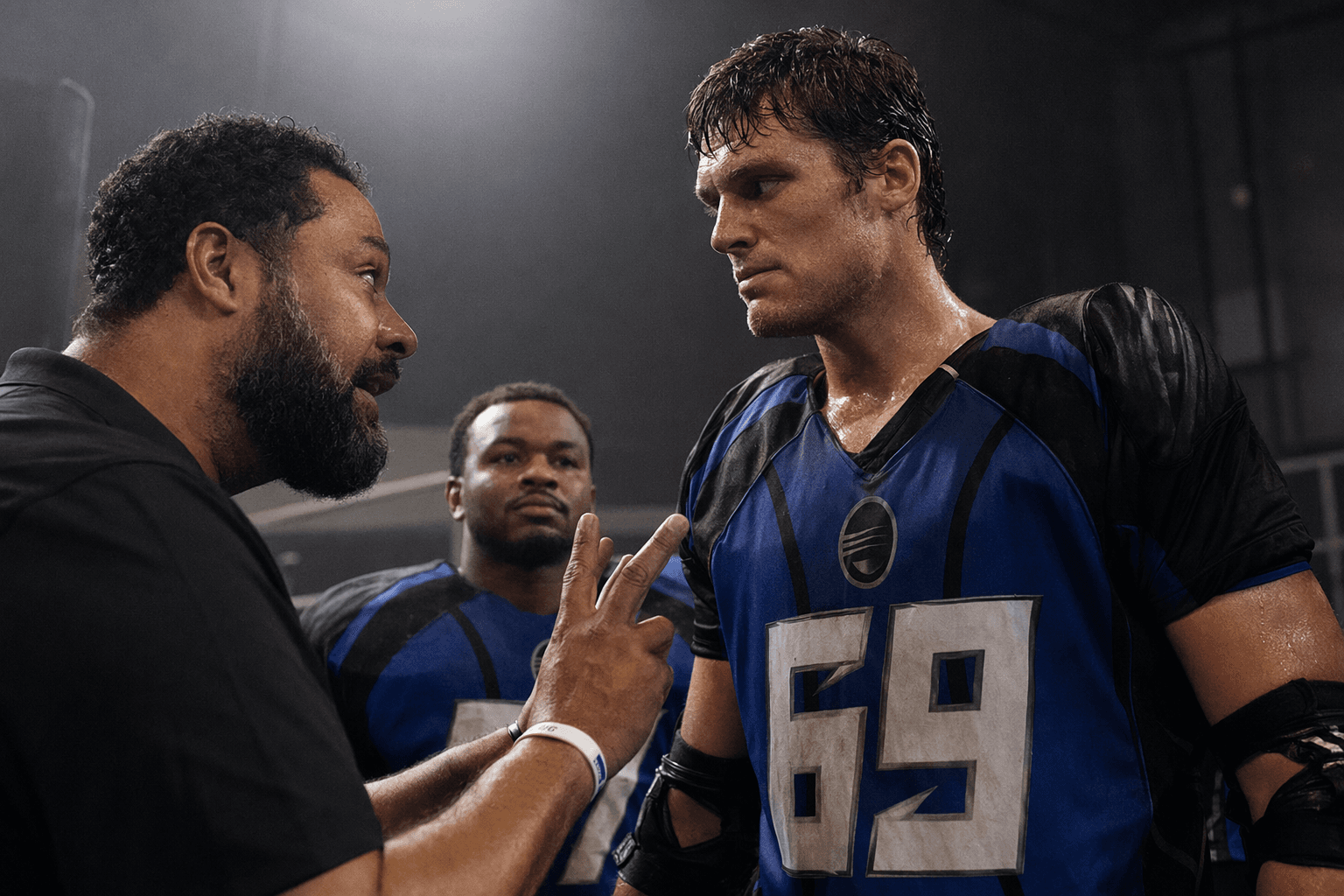
Ozone’s most revealing story starts with the coach and ends with his son. Trevor Anderson, a pioneering SlamBall star with 24 years of coaching experience, is steering the team while mentoring Bryan Bell-Anderson, the player he selected with the seventh pick in Round 1 of the 2023 draft. That choice gives Ozone something the league can market instantly: a father-son link that is real, specific, and easy to understand in a sport built on fast decisions and clear roles.
The connection is more than sentimental branding. Anderson’s own history as a SlamBall legend gives him authority in a league where trust matters, and Bryan’s path from Columbia University defensive back to SlamBall gunner gives the team a bridge between established football talent and the sport’s hybrid demands. Ozone is not being introduced as a collection of names. It is being presented as a unit with inherited knowledge, and that is exactly the kind of identity SlamBall needs if it wants to feel like more than a replay-friendly spectacle.
Trevor Anderson gives Ozone a coaching voice the league can recognize
Anderson’s profile matters because it tells fans this team is being shaped by someone who already understands the sport from the inside. He is based in Sarasota, Florida, and his coaching résumé stretches across 24 years, which suggests the kind of long-view stability that can help a young or unconventional roster stay organized. In a league where role definition is everything, a coach with a deep relationship to the game can turn a roster into a system instead of a highlight reel.
That is why the Bryan Bell-Anderson pick stood out so sharply. In the 2023 league launch materials, Anderson did not just coach his son, he drafted him, making the family tie literal draft-day history. Bryan was described as a former Columbia defensive back from Sarasota, Florida, and that background fits the league’s appetite for players who can process contact, space, and timing quickly. Ozone’s identity starts with the simplest possible message: this is a team built by somebody who knows the sport and someone he already knows how to teach.
Bryan Bell-Anderson brings football pedigree and a useful kind of size
At 5-foot-10 and 180 pounds, Bryan Bell-Anderson is not the kind of player who sells SlamBall through brute force. His value comes from precision, defensive instincts, and a background that already demanded open-field tackling and fast reactions. At Columbia, he recorded more than 75 total tackles, one pick-six, and 17 pass deflections, a stat line that suggests a player comfortable playing with urgency, leverage, and anticipation.
His earlier resume makes the same point. At Dr. Phillips High School in Orlando, he helped win the 2017 Florida Class 8A state championship as a junior and also finished state runner-up the year before. That kind of winning experience matters in a sport where players have to learn how to survive impact while still making clean reads. Bryan gives Ozone a recognizable development story, one that starts with football credibility and becomes part of SlamBall’s own pipeline.
Vincent Boumann changes the geometry of the court
If Bryan represents the family link, Vincent Boumann represents the physical outlier. At 6-foot-9 and 285 pounds, he is listed as the tallest and heaviest player on the season, and the nickname “Lumberjack” tells you exactly how the league wants him seen. His profile says he can bully the inside, which is the kind of language that matters in SlamBall because it points to control, not just collision.
Boumann’s résumé also gives Ozone an unusual mix of basketball touch and ruggedness. As a senior at Western Oregon University in 2017-18, he averaged 10.4 points and 5.4 rebounds and shot 63.0% from the field, the second-highest rate in school annals. Before Western Oregon, he played at Point Loma and Clackamas Community College, then went on to spend four years in professional basketball and one year in professional rugby for the Colorado XOs. That combination, basketball and rugby, is almost custom-built for SlamBall’s collision-heavy environment, where size has to be paired with balance and discipline.
Boumann is important because he tells you what kind of athlete can still dominate here. He is not just tall. He is tall with a contact background, efficient finishing, and a history of adapting across sports. In a league still defining its ideal player, Boumann suggests that the winning template may be part post, part power forward, part rugby enforcer.
The rest of Ozone’s roster points to a clear role structure
Ozone’s squad page reinforces that the team is being built with purpose rather than randomness. Keith McGee is listed as a handler from Rochester, New York, while LaQuavius Cotton is a gunner from Cleveland, Mississippi, Marcus Gray is a gunner from Jeffersonville, Indiana, and Donavin Byrd is a gunner from Gainesville, Florida. Those labels matter because they show how the league wants fans to read the team: not as a generic roster, but as a set of defined functions.
That presentation is part of the franchise’s larger pitch. Ozone’s official team page packages the roster, the upcoming schedule, and ticketing together, which makes the team page feel like a central entry point rather than a static bio page. The message is simple and smart: this is the team, this is when it plays, and this is how to follow it. For a sport still proving its staying power, that kind of clarity is a branding advantage.
Keenan Love also appears on the current squad page, which adds to the sense that Ozone’s roster is assembled around specific roles and not just star names. The league is selling a unit, and the unit is easier to understand because each piece is clearly placed. That makes Ozone a useful case study for SlamBall’s larger problem: how to build a product around identity, not noise.
Why Ozone says something bigger about SlamBall
Ozone is interesting because it raises the right question about the league itself. Is this family-run core a competitive edge, a marketing tool, or evidence that the talent pool is still narrow enough for personal relationships to matter this much? The answer may be all three. A coach drafting his son, a giant interior anchor with a rugby past, and a roster organized by explicit roles show a league trying to decide what kind of athlete wins here and what kind of story makes fans care.
That is what makes Ozone feel durable. It is not leaning on novelty alone. It is showing how SlamBall can build culture through intimacy, through trust between generations, through bodies that fit the sport’s violent geometry, and through a roster that is easy to read the moment you see it. If SlamBall is going to grow beyond spectacle, teams like Ozone may be the blueprint.
This article was produced by Prism’s automated news system from verified source data, official records, and press releases, then run through automated quality and moderation checks before publishing. The system is built and supervised by the people who set the standards it runs under. Read our full AI policy.
Did this article answer your question?