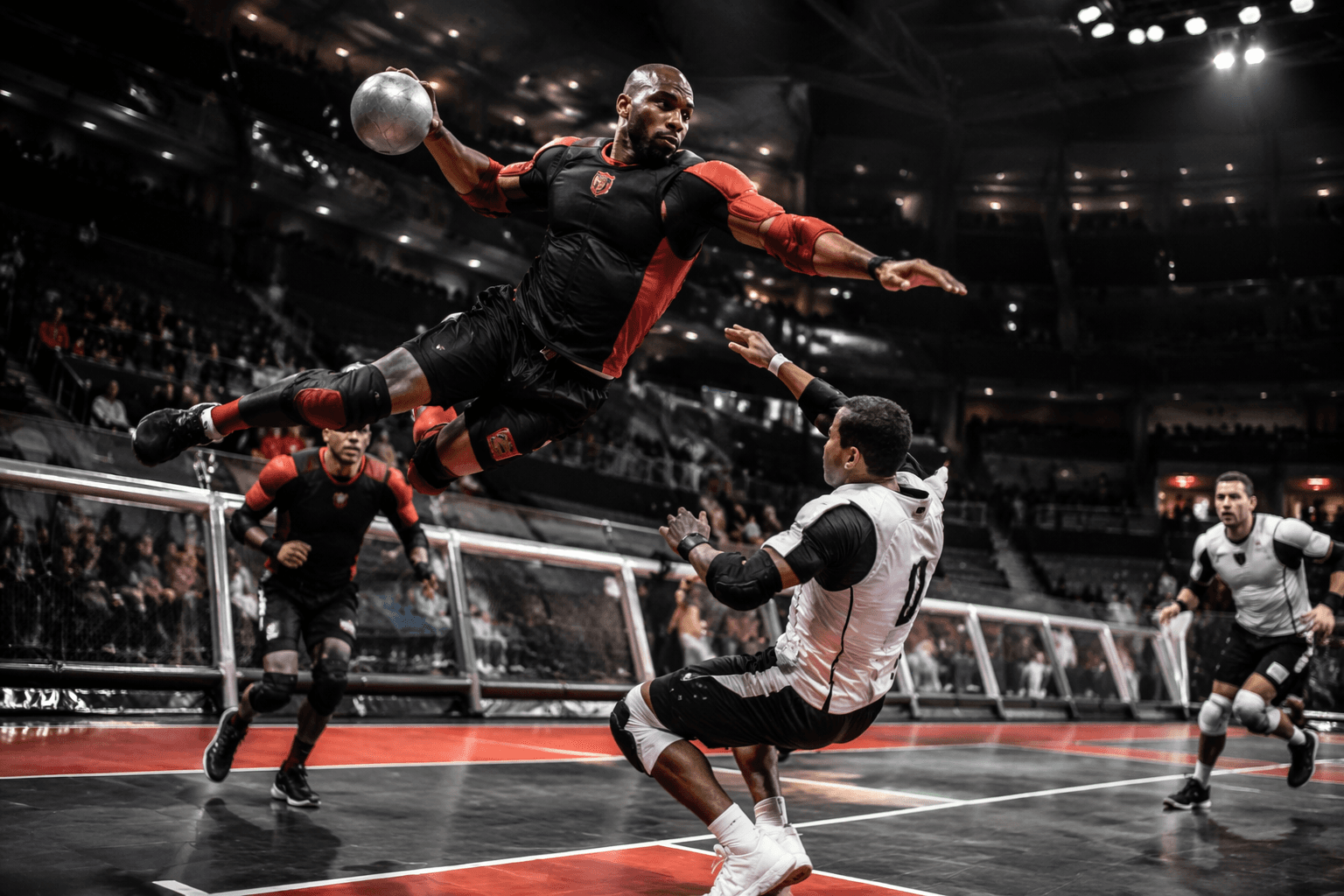
Nick Parks' speed gives Wrath a perfect SlamBall fit
Nick Parks gives Wrath the rare crossover profile SlamBall wants: elite speed, track pedigree and the discipline to learn a sport built on contact and spacing.

Nick Parks is the kind of crossover athlete SlamBall is built to showcase
Wrath’s roster makes a simple point with real strategic weight: SlamBall still depends on athletes who can bring verified speed, absorb punishment, and then learn a game with its own language. Nick Parks sits at the center of that idea. Listed as a 6-foot-4, 200-pound gunner from Lithonia, Georgia, Parks arrives with the kind of résumé that can translate in a league where acceleration matters as much as instincts and where every possession is compressed by trampolines, contact rules and a 20-second clock.
That is what makes him more than a novelty. Parks was a two-time All-American at Purdue, won the Boilermakers’ Male Track MVP honor and owns a college-best 400-meter time of 45.71 seconds, a mark that stood out enough to break Purdue’s long-standing record. In a sport built on launch angles, body control and finishing under pressure, those details read like a blueprint rather than a footnote.
Wrath’s roster shows how SlamBall is built around roles, not just highlights
Wrath’s squad page is useful because it clarifies how the league wants players to fit together. Darion Slade gives the team a handler presence, Shawn Stith and Greg Helt add interior weight, Steven Julian III and Trey Landers provide gunner and stopper options, and Ty McGee rounds out the group. Parks fits into that mix as the speed piece who can change the geometry of a possession.
That role clarity matters because SlamBall is not a free-form dunk contest. The game is full-contact, played on a 96-by-64-foot court with four trampolines stationed in front of each net, and it uses specific island-area contact restrictions to shape how players attack space. In that environment, a roster is less about accumulating names and more about assembling functions. Wrath looks built for that logic, and Parks gives it a burst element that can punish defenses if the timing is right.
What carries over from elite football athleticism
SlamBall’s crossover-athlete model depends on traits that travel well from football and track: first-step explosiveness, balance through contact, and the ability to process movement at full speed. Parks does not need to reinvent acceleration or lower-body force. Those are already embedded in his athletic profile, and they are the exact qualities that help a player take off from a trampoline and still finish through collision.
The most valuable transfer skill is not just speed. It is controlled speed. In football, that means arriving on time, staying square and absorbing contact without losing your base. In SlamBall, it means converting a run-up into an efficient launch, reading where bodies will arrive, and landing in a way that keeps the play alive. Parks’ track background suggests a player who understands repeatable movement, and that repeatability is a major advantage in a sport where one reckless angle can turn into a turnover or a hard hit.
What still has to be taught from scratch
The parts that do not travel automatically are the ones that make SlamBall its own sport. Even elite athletes have to learn the island-area restrictions, the timing of the 20-second shot clock and the court spacing that comes from having four trampolines in front of each net. A fast player can be dangerous immediately, but a dangerous player is not yet efficient until he understands where the rebounds go, how defenders rotate, and when a collision helps the possession rather than ends it.
That is where Parks’ mentor profile becomes especially interesting. SlamBall’s player page says he now serves as a mentor for high school and collegiate athletes, which hints at a player who understands teaching, adaptation and long-term development. In a league where so much is new even to accomplished athletes, that kind of off-court intelligence matters. The best crossover players are rarely the ones who only flash. They are the ones who can take a foreign set of rules and make them feel instinctive.
Why Parks is such a clean fit for Wrath
Parks gives Wrath a rare blend of credibility and upside. His Purdue record is not just a number on a bio page. A 45.71-second 400-meter time signals a motor that can repeat under strain, and in a league where possessions become sprints and collisions happen in tight windows, that is exactly the kind of physical baseline a roster needs. When a player can run, recover, and re-accelerate without losing form, he creates possibilities on both ends of the floor.
Wrath’s construction amplifies that value. Slade can manage the ball, Stith and Helt can stabilize the middle, Landers and Julian can handle outside duties, and Parks can turn open floor into immediate pressure. That is the essence of why crossover athletes matter in SlamBall: they do not just add athleticism, they give structure to chaos.
The bigger business story is about staying power, not spectacle
SlamBall’s modern push has been tied to a broader attempt to prove the league can survive beyond nostalgia. The sport was invented in 1999 by Mason Gordon and first played in Los Angeles, but its recent relaunch was designed to feel like a real return to a schedule, a roster system and a broadcast footprint. The two-year partnership with ESPN, the reveal of eight team names, coaches and seven-man rosters, and the 2023 season window that stretched from July 21 through the playoffs and championship in mid-August at Cox Pavilion in Las Vegas all pointed to the same goal: build a league, not just a clip factory.
That is why stories like Parks’ matter so much. A recognizable athlete biography helps the league sell legitimacy, but it also helps viewers understand what they are watching. If the sport can show that a Big Ten record holder can be converted into a productive SlamBall gunner, then the league has an argument that its model is repeatable. That is a bigger claim than entertainment value. It is a claim about talent pipeline, roster construction and whether SlamBall can keep turning unusual athletes into believable specialists.
What readers should watch next
The real test for Parks and Wrath is how quickly speed becomes production. If he can translate his burst into clean launches, disciplined landings and smart finishes inside SlamBall’s compact, contact-heavy court, he becomes proof that the crossover model still works. If he can do that while the team balances Slade’s handling, Stith and Helt’s interior size, and the rest of the rotation’s defined jobs, Wrath will not just have a flashy athlete. It will have a roster built for a sport that rewards athletes who can master a new system fast.
This article was produced by Prism’s automated news system from verified source data, official records, and press releases, then run through automated quality and moderation checks before publishing. The system is built and supervised by the people who set the standards it runs under. Read our full AI policy.
Did this article answer your question?