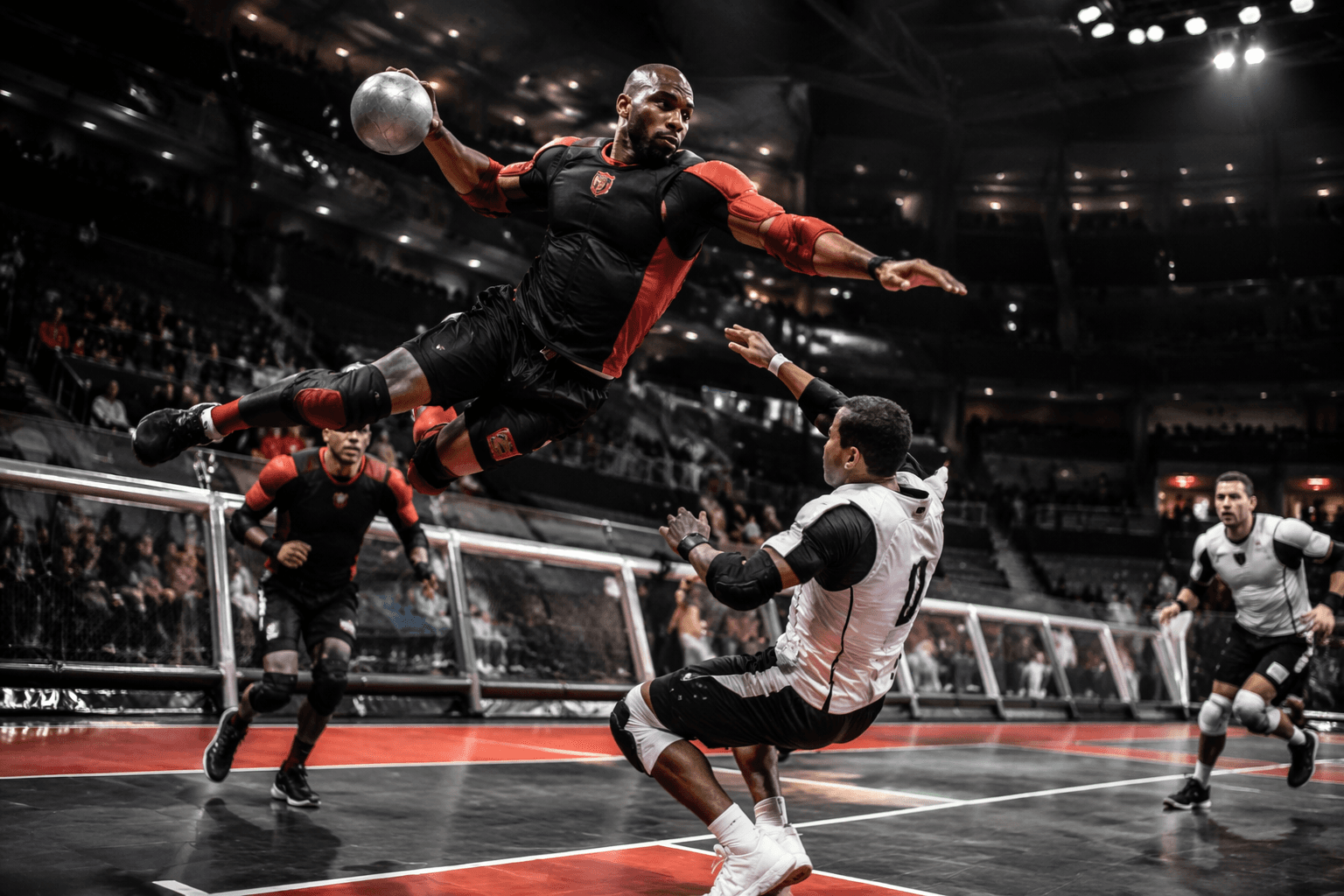
Gryphons' Adam Stanford embodies SlamBall's ideal crossover athlete profile
Stanford is the Gryphons' stabilizer: a 6-foot-4, multi-sport defender with real production, a sharp academic record, and the balance SlamBall prizes over pure flash.

The kind of body SlamBall keeps chasing
Adam Stanford gives the Gryphons exactly the sort of player the league wants to showcase: sturdy enough to battle, skilled enough to stay on the floor, and disciplined enough to keep a team organized when the game gets chaotic. SlamBall lists him at 6-foot-4, 200 pounds, from Fontana, California, and that frame matters because it sits right in the middle of the league’s crossover-athlete sweet spot, big enough to absorb contact, quick enough to move, and polished enough to do more than just hunt highlights.
His value starts with balance. On a Gryphons roster that includes Justin Holmes, Connor Hollenbeck, Kyshawn Jones, Jace Bass, Matthew Wilkerson, Deshawn Kelly, and Jordan Grant, Stanford is the player who can keep the group from becoming one-dimensional. Wilkerson brings pure size at 6-foot-7 and 270 pounds, Hollenbeck adds another strong body at 6-foot-6 and 225, and Stanford’s 6-foot-4 build gives the team a connector who can rebound, defend, and keep possessions clean without crowding the same role as the bigger stoppers.
The numbers that say he does more than score
Stanford’s high school line at A.B. Miller High School already looked like the profile of a player who affected games on both ends. In his senior season, he averaged 13.6 points, 8.8 rebounds, and 49 blocked shots, a combination that says a lot more than simple scoring volume ever could. He was not just producing offense in Fontana; he was ending possessions, protecting the paint, and making opponents account for him every trip.
That two-way shape showed up early enough for Kentucky Wesleyan to notice. Stanford was an all-district team choice as a sophomore, then built a college career that stacked up across categories rather than in one flashy column. In 80 games and 74 starts for the Panthers, he totaled 852 points, 553 rebounds, 160 assists, 184 steals, and 100 blocks. That is not the stat line of a specialist. It is the stat line of a player who touches every part of the game, and that breadth is exactly what SlamBall rewards.
Why the college stops matter to the Gryphons
Stanford’s route through Kentucky Wesleyan College and Campbellsville University adds a layer of maturity that matters in a league built on rapid adjustments. After three seasons under Happy Osbourne at Kentucky Wesleyan, he transferred to Campbellsville for his final year and kept contributing in a role that was shorter on minutes but still efficient. He played 34 games, started 10, averaged 18.4 minutes, shot 51 percent from the field, and hit 76 percent from the free-throw line while averaging 7.3 points per game.
The rebound and passing numbers in that Campbellsville season are especially useful for the Gryphons’ style. Stanford grabbed 178 rebounds and dished out 31 assists, which tells you he was not simply standing in a corner waiting for a touch. He was helping possessions extend, helping the ball keep moving, and giving a lineup something close to positional flexibility. In SlamBall, where quick resets and aggressive finishes can swing a run in a matter of seconds, that kind of reliability is often more valuable than a player who only flashes in open space.
The off-court profile fits the on-court one
Stanford’s background off the court reinforces the same theme: steadiness, range, and preparation. Campbellsville’s bio says he earned a bachelor’s degree in graphic arts, minored in communications, and planned to pursue a master’s degree in sports management. That is not window dressing. It shows a player with enough structure and discipline to handle the demands of a sport that asks for adaptability, communication, and a fast read on changing situations.
Kentucky Wesleyan’s bio fills in even more context. Stanford was a three-year football letterwinner, a two-year track letterwinner, and played one season of volleyball in high school. He was born on February 15, 1995, in Fontana, California, and his multi-sport background helps explain why he looks so naturally suited to SlamBall’s crossover model. Football gives him contact balance, track suggests straight-line explosiveness, and volleyball hints at timing and body control. Put that together with his academic record and you get the kind of player who arrives with both athletic tools and a professional base.
What the Gryphons are buying with Stanford
SlamBall’s own 2023 relaunch on ESPN opened July 21 at Cox Pavilion in Las Vegas with eight teams, and the league leaned hard into the idea that its best players would come from different sporting backgrounds. Stanford was selected by the Gryphons in the 2023 draft, which makes sense when you look at what the franchise seems built to value: size, versatility, and players who can hold their shape when the game speeds up. He fits that mission better than a pure scorer would, because he solves problems without needing the offense to revolve around him.
That is the real case for Stanford on this roster. The Gryphons already have bodies with size, movement, and enough scoring to survive in a league where chaos is part of the product. Stanford is the stabilizer in the mix, the player who helps make the whole unit more trustworthy because he can defend, rebound, pass, and keep the game from getting sloppy. In SlamBall, where flash gets attention, players like Stanford are the ones who quietly make a team harder to scout and harder to break.
This article was produced by Prism’s automated news system from verified source data, official records, and press releases, then run through automated quality and moderation checks before publishing. The system is built and supervised by the people who set the standards it runs under. Read our full AI policy.
Did this article answer your question?