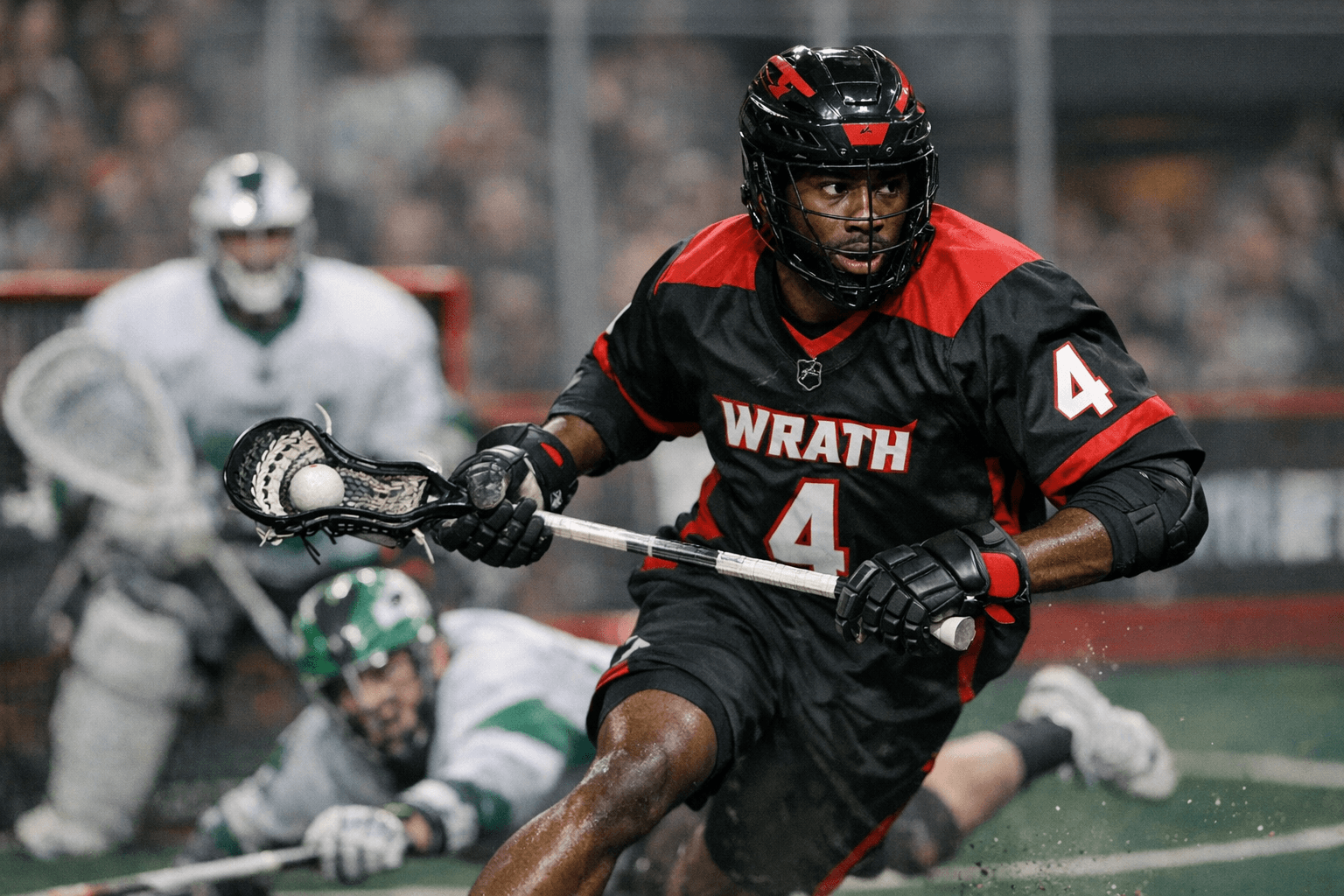
Nick Parks brings track speed and elite recovery to Wrath
Nick Parks gives Wrath a rare edge: straight-line speed, elite recovery, and track-tested discipline that can warp transition possessions before defenses settle.

Track speed can change a SlamBall game before power ever has a chance to dominate it, and Nick Parks gives Wrath that kind of threat. Listed at 6-foot-4 and 200 pounds from Lithonia, Georgia, Parks arrives with the kind of sprint résumé that makes the floor feel bigger for every teammate around him. His grandmother’s nickname for him, “Nick the Quick,” has become a fitting shorthand for a player whose game is built on burst, recovery, and the ability to keep arriving at the next play faster than opponents expect.
Why Parks matters to Wrath
Wrath’s roster already leans into size and force, with Ty McGee, Shawn Stith, Steven Julian III, Greg Helt, Trey Landers, and Darion Slade all giving the group different physical answers. Parks adds something less common: track speed that can stretch possessions in both directions. On a team where Stith and Helt supply interior size and McGee supplies scoring punch, Parks gives Wrath a different athletic trigger, one that can turn a half-second edge into a broken defensive shape.
That matters because SlamBall rewards players who can switch from burst to balance instantly. A player who can get out of a standstill, recover on defense, and then sprint back into the next action can erase mistakes that would otherwise lead to easy points. Parks is listed by Wrath as a gunner, and that role fits the way speed functions in the sport: pressure the ball, race into space, and make every loose possession feel dangerous.
A track résumé built for translation
Parks is not coming in as a novelty crossover. At Purdue University in Lafayette, Indiana, he was a two-time All-American and the Boilermakers’ Male Track MVP, credentials that point to both high-end talent and consistency. He also served in multiple events, competing in the 400, 200, 4x100, and 4x400, which says a lot about the breadth of his sprint profile. He was not just a specialist in one lane; he had the kind of versatility that comes from handling different race demands and different rhythm changes.
His best-known mark remains Purdue’s outdoor 400-meter record of 45.71 seconds, set on May 28, 2016. That time stood as a marker of how difficult it is to separate from the field over a full lap, and it also helps explain why his speed translates so well to SlamBall. A 400-meter runner learns how to launch hard, settle quickly, and then finish under fatigue, which is a useful blueprint for a sport with repeated high-tempo sequences and constant change of direction.
Parks also posted a college-best 21.34 in the 200 meters, another sign that his speed is not limited to endurance alone. That 200-meter ability matters in SlamBall because the game often asks players to cover a short, explosive stretch, then recover again almost immediately. Parks’ combination of short-distance acceleration and longer sprint maintenance gives Wrath a player who can do both without losing shape.
The record that framed his athletic ceiling
Purdue later noted that Edwin Vessat broke Parks’s 400-meter record with 44.94 on April 18, 2026, but that only underscores how rare Parks’ 45.71 actually was. It had taken a serious performance to set the mark in the first place, and it took an even faster run to surpass it. In practical terms, that means Wrath is getting a player whose speed was elite enough to define a major program standard for years.
The record detail also helps place Parks in context as more than a one-dimensional runner. He was sixth in the 4x4 at the 2013 Big Ten Outdoor Championships in 3:14.36, ran 49.03 in the 400 at the Big Ten Championships that year, and recorded a 22.57 in the 200 at the Meyo Invite. Those early marks show a development arc, from a strong collegiate runner to a record-setting one, and that kind of progression usually reflects discipline as much as raw talent.
What speed changes on a SlamBall floor
In SlamBall, the obvious stars are often the biggest athletes and the most explosive finishers, but speed can quietly decide the margins. Parks can make defensive recovery faster after a broken play, chase down a loose sequence before it becomes a layup-equivalent, and apply immediate pressure when a possession flips. That makes him especially valuable in transition defense, where even a fraction of a second can determine whether Wrath forces a reset or gives up a clean look.
His straight-line burst also matters on the offensive end after dead balls or rebounds. A fast first step can turn a routine restart into an advantage before the defense has even organized. In a sport defined by hard stops and sudden accelerations, a player like Parks can become the bridge between a rebound and a fast-moving scoring chance.
The endurance side of his track background may be even more important over the full run of a game. SlamBall is built on repeated bursts, not one isolated sprint, and Parks’s 400-meter foundation suggests he can keep producing those bursts without fading as quickly. That kind of repeatability can change how a team survives long stretches of pace, especially when the game gets chaotic and both sides are forced to make the next sprint count.
Leadership beyond the stopwatch
Parks’ bio also notes that he serves as a mentor for high school and collegiate athletes, and that detail matters in a roster like Wrath’s. Speed gets attention, but composure is what allows speed to stay useful when the game starts to get noisy. A player who has already taken on a mentoring role usually brings a level of steadiness that helps in a sport where momentum can swing in a single possession.
That maturity should fit well beside Wrath’s physical core. McGee brings scoring, Stith and Helt bring size, and Parks adds the kind of athlete who can keep the team connected between those forces. In a roster with multiple big bodies, his job is not simply to run fast. It is to make everyone else’s job easier by arriving in time to clean up mistakes, extend pressure, and keep the pace on Wrath’s side.
Why Parks could matter to the broader SlamBall conversation
SlamBall has long been described through power and verticality, but players like Parks widen that definition. His profile suggests that the sport’s next competitive advantage may come from athletes who can cover ground quickly, recover instantly, and repeat that effort over and over without losing discipline. That changes the way a defense has to think, because speed doesn’t just create highlights. It changes angles, closing windows, and the timing of every response.
For Wrath, that means Parks can help turn an already explosive group into one that feels even more difficult to pin down. For the league, it is a reminder that track-speed athletes bring a different kind of violence to the floor: not collision first, but control of space. Parks does not just add another body to the rotation. He adds a different tempo, and in SlamBall, tempo can be as valuable as size.
Know something we missed? Have a correction or additional information?
Submit a Tip