Justin Holloway’s long road to SlamBall fits the Mob’s physical style
Justin Holloway’s path skips the usual hoops pipeline and lands perfectly in the Mob’s bruising system, where timing and force matter as much as pedigree.
A path built for SlamBall, not drafted from a script
Justin Holloway did not arrive at SlamBall through the usual basketball pipeline, and that is exactly why the Mob could value him so highly. Listed at 6-foot-1, 180 pounds, the Columbus, Ohio native fits the profile of a compact, explosive gunner, but his real edge is the road he took to get here: family obligations kept him out of varsity sports at Beechcroft High School, so he built his game away from the normal high school-to-college track.
That matters in SlamBall, where pedigree often matters less than adaptation. Holloway spent his last three seasons with the Lancaster Thunder in Ohio, where he shared the floor with Rumble handler JaeTuan Williams. That kind of semi-pro repetition gave him game speed, body control, and a feel for pressure before he ever reached the Mob, and in a sport built around chaos, those habits are worth more than a polished résumé.
Why the Mob wanted this kind of gunner
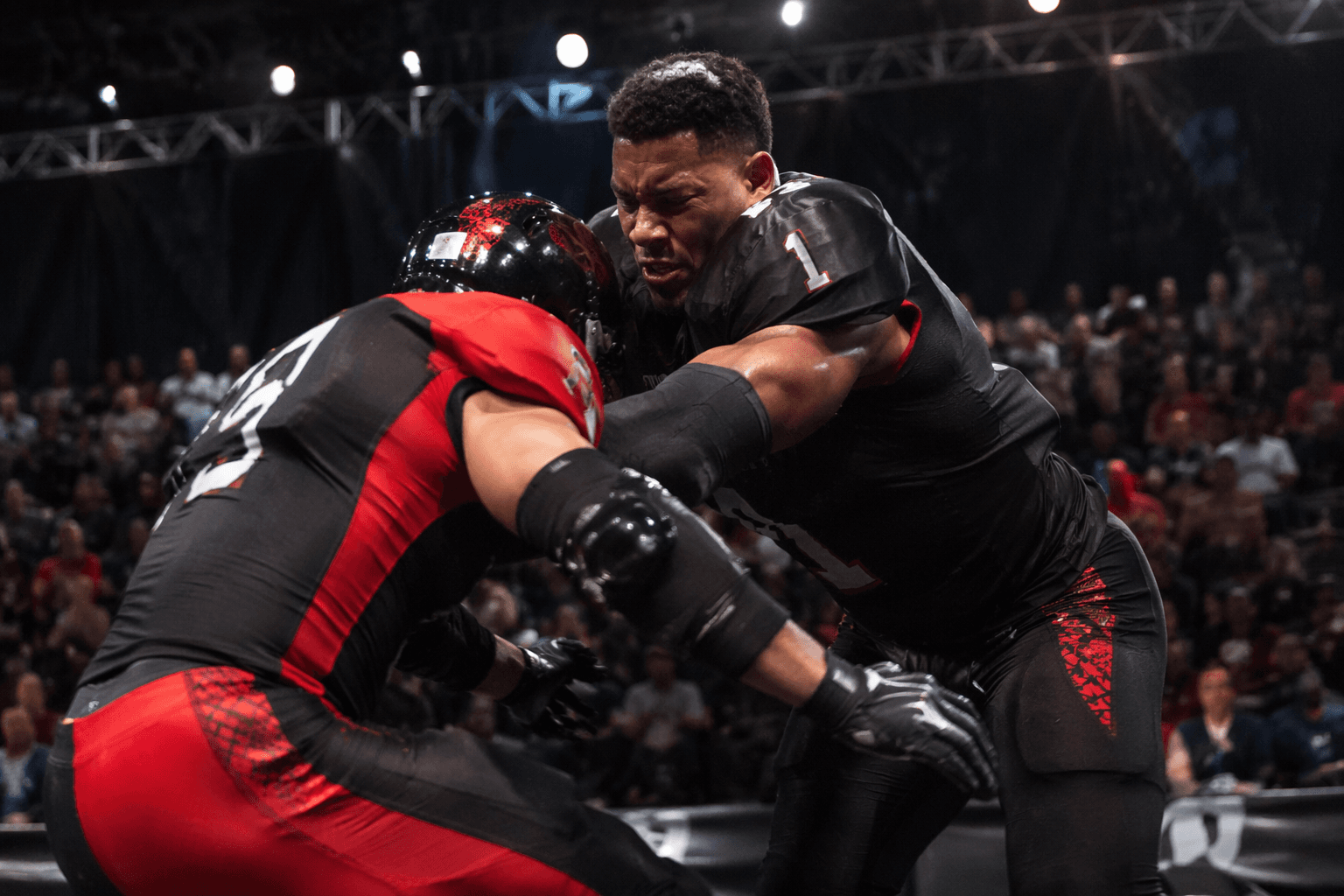
The Mob’s interest in Holloway makes sense once you look at how their roster and identity are built. His official squad listing shows him wearing No. 77 alongside Cameron Horton, Darius Clark, Gage Smith, Brandon Simpson, Cam Hollins, Dionte Byrd, and Jordan Jones, a group that leans into size, collision, and relentless physical pressure. Holloway says he watched SlamBall growing up and wanted in as soon as the sport returned, and he describes himself as a rough, physical basketball player who belongs in the Mob’s style.
That self-scout is not marketing fluff. The Mob do not need Holloway to become a different player, they need him to amplify what already makes them dangerous. A 6-1 gunner who is willing to attack contact, finish through traffic, and keep possessions alive fits a team that wants every trip down the floor to feel like a test of nerves and balance.
What SlamBall actually rewards
SlamBall is not simply basketball on trampolines. It is a contact-heavy hybrid that blends basketball with the force and spatial violence of football and hockey, played on a court built around four trampolines. That design changes the value of a player like Holloway, because the league rewards not just scoring talent, but the willingness to live inside collisions and recover faster than the other side.
The league’s stats language makes that clearer. Rim attacks, slams, loose-ball recoveries, and stops are central measures of success, which means a player can influence a game without looking like a traditional scoring leader. Holloway’s profile as a physical guard matters because the sport asks for players who can absorb contact, create lift at the right moment, and turn broken possessions into momentum. In that system, fearlessness is not a personality trait, it is production.
The Mob’s history raises the bar
Holloway did not join a rebuilding project. SlamBall describes the Mob as one of the league’s legendary teams, with three straight Series titles from the earlier era of the sport. That legacy creates a very specific standard: toughness is expected, not celebrated as a bonus. When a franchise already owns championship muscle memory, every new piece has to fit the same hard-edged identity.
The modern version of that standard showed up quickly. SlamBall’s 2023 draft results list Holloway as a Mob selection in Round 6, placing him among a broader player pool that included 56 players. ESPN’s playoffs preview said the league’s regular season field featured eight teams and identified the Mob as the group to beat after they went 16-0. The championship recap then pushed the story even further, noting the Mob finished 18-0 and that Holloway scored 12 points in the title game.

That is the shareable headline inside the headline: this is not just a late-bloomer story, it is a story about a player who landed on the perfect undefeated team and produced in the biggest game. The Mob did not simply collect depth. They found a role player whose background and temperament matched the championship environment.
The late-bloomer market inefficiency
Holloway’s rise also speaks to a larger trend in niche sports and hybrid leagues: talent can be undervalued when it does not arrive on the standard timeline. Traditional basketball pipelines often prioritize early exposure, travel-ball visibility, and a neat march through varsity and college stages. Holloway missed that route because life got in the way, but SlamBall is built to reward something different, including toughness learned outside the spotlight and instincts sharpened in semi-pro environments.
That makes late-blooming athletes one of the smartest talent market inefficiencies in the league. A sport that values reaction time, edge, and physical confidence can mine players who may have been overlooked by traditional hoops systems. Holloway is useful not because he was hidden, but because he was forced to develop in conditions that made him harder to rattle.
A family name that adds another layer
Holloway’s story also carries a family athletic lineage that fits the speed and explosiveness SlamBall demands. His uncle is Mike Holloway, the long-time University of Florida coach who leads the men’s and women’s track and field and cross country program and has held that role since June 19, 2007. Florida athletics says Mike Holloway was named head coach of the 2020 U.S. men’s Olympic track and field team and has earned USTFCCCA National Coach of the Year honors 14 times.
That connection does not make Justin Holloway a track athlete by default, but it does sharpen the way his ceiling should be viewed. Quick-twitch athleticism, body control, and competitive calm show up across elite sprint and jump environments, and those traits translate neatly into a sport where a half-step can become a dunk, a loose ball, or a stop at the rim. The family tie adds a deeper sports context, but the performance value comes from how those traits show up in Holloway’s game.
Why this story matters beyond one roster spot
Holloway’s path says something important about where SlamBall can grow. The league’s appeal does not come from novelty alone, but from a structure that gives real value to players who know how to handle contact, read chaos, and seize a narrow window at the rim. That is why the Mob can look at a 6-foot-1 gunner from Columbus, one who took the long road through family obligations and semi-pro basketball, and see a clean fit rather than a compromise.
For a league trying to turn spectacle into staying power, that is the real lesson. SlamBall rewards the kind of player traditional pipelines often miss, and Justin Holloway is a sharp example of why the Mob’s physical style can turn overlooked experience into championship value.
This article was produced by Prism’s automated news system from verified source data, official records, and press releases, then run through automated quality and moderation checks before publishing. The system is built and supervised by the people who set the standards it runs under. Read our full AI policy.
Did this article answer your question?