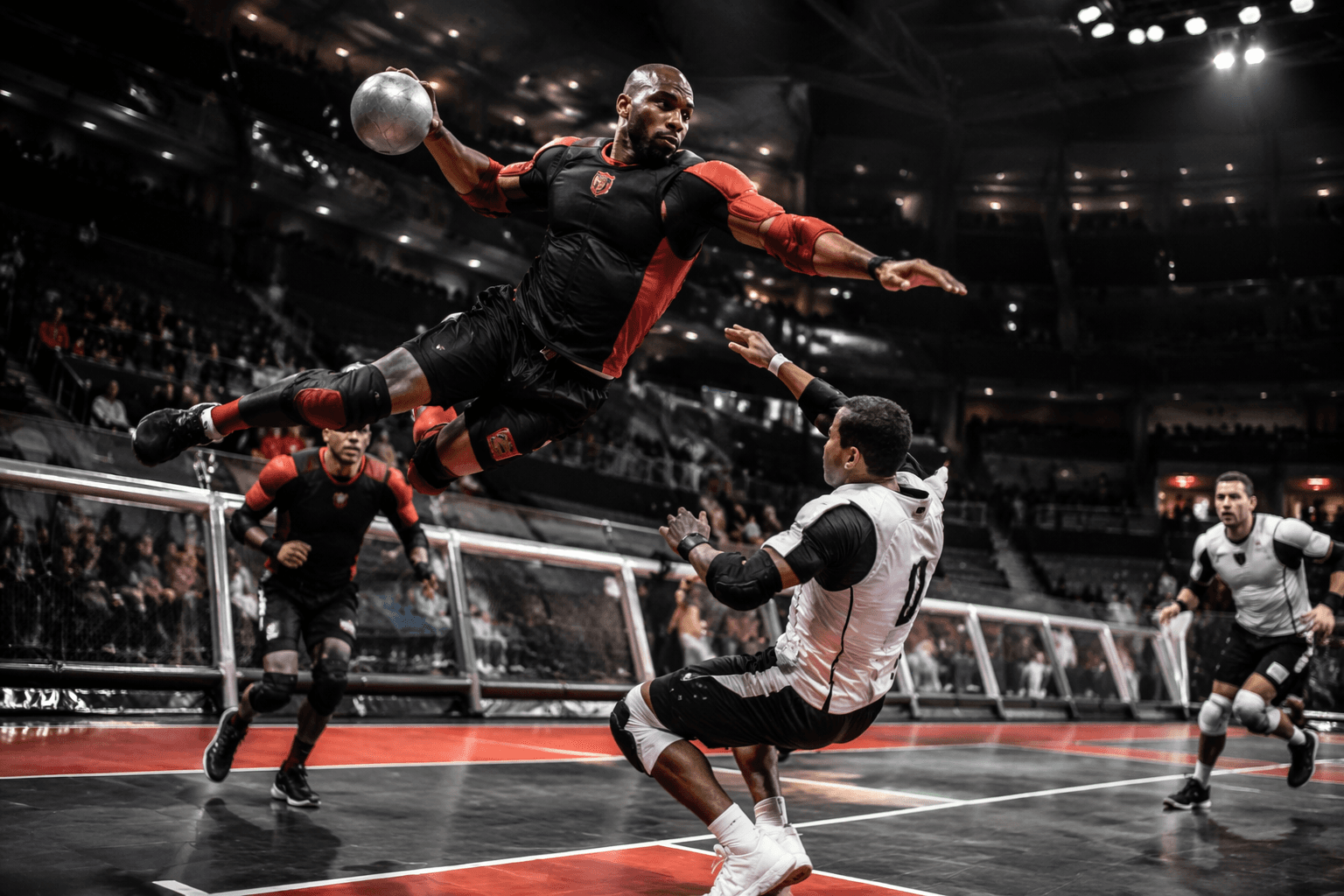
SlamBall's trampoline court turns every possession into a highlight spectacle
SlamBall is built to reward speed, contact, and vertical scoring, which is why its comeback looks less like nostalgia and more like a coherent sport with real staying power.
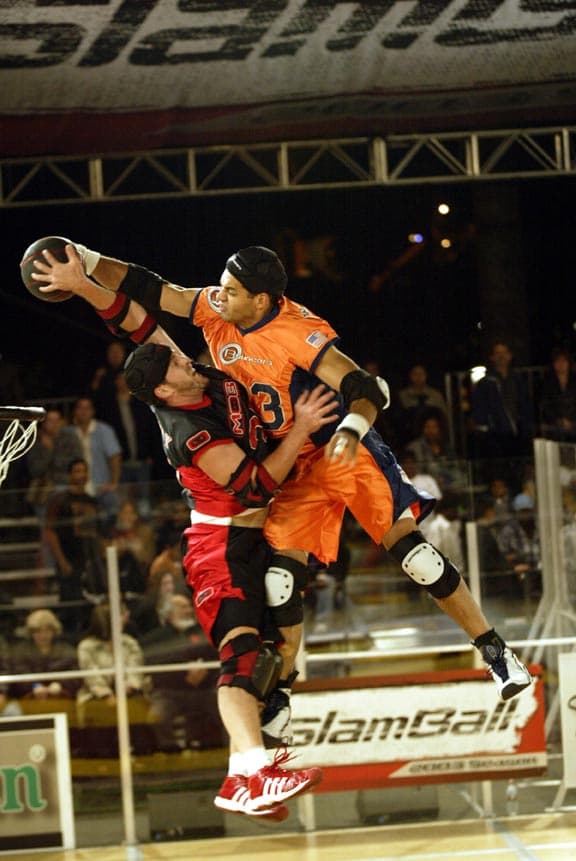
A court that turns every touch into a decision
SlamBall does not ask players to ease into possessions. It compresses the game into four five-minute quarters, puts them on a spring-loaded surface that can launch athletes as high as 20 feet, and rewards the most explosive finish with three points. That design gives every trip down the floor immediate stakes: move fast, hit hard, and finish above the rim or fall behind the logic of the game.
The result is a sport that borrows from basketball, football, and hockey without feeling like a random mashup. Basketball supplies the scoring and spacing, football brings the contact and collision mindset, and hockey contributes the boards and the sense that play can ricochet in any direction. SlamBall’s clear plexiglass walls and reinforced goals are not decorative details. They are part of a system built to keep the action contained, legible, and violent in the best sporting sense of the word.
Why the scoring system matters as much as the spectacle
The biggest clue that SlamBall is more than a stunt is hidden in the point values. Dunks are worth three points, while layups and jump shots are worth two, which pushes players to attack vertically instead of settling for safe perimeter play. That single rule changes the sport’s personality, because a team that can consistently get above the rim is not just collecting style points, it is playing the highest-value version of the game.
That makes SlamBall feel closer to a strategic puzzle than a carnival act. Every possession is a trade-off between risk and reward, and the sport’s pace leaves almost no room for dead time or filler. The condensed format also fits the way modern fans consume sports: short bursts, obvious momentum shifts, and highlight plays that are easy to replay, clip, and share.
How the design creates stars, roles, and repeat value
The court does not merely produce clips. It creates role specialization, which is what separates a real sport from a one-off spectacle. Some players are built to finish through contact, some are better at controlling rebounds off the trampoline surface, and some are valued for timing, positioning, and the ability to read the bounce of the game itself.
That is where SlamBall gains durability. Sports last when viewers can recognize team identities and player types, and SlamBall’s structure gives both. A defender who understands angles on the spring-loaded floor or a scorer who can turn a single touch into three points becomes memorable fast, because the format makes every successful action visible and repeated.
From Mason Gordon’s invention to a league with a history
SlamBall was invented in 1999 by Mason Gordon and first played in Los Angeles, with the league identifying Gordon as its creator and co-founder. Mike Tollin is also credited by the league and reporting as a co-founder who helped finance an early prototype court, which matters because the sport was not born as a casual novelty. It was engineered from the start, with a prototype and a defined competitive purpose.
That origin story helps explain why the league keeps returning to the language of design. Gordon envisioned a hybrid sport that combined the best elements of basketball, football, and hockey, and the modern version still reflects that idea in every surface, rule, and broadcast-friendly burst of action. Even now, the league frames SlamBall as a one-of-a-kind entertainment property with a long history in the United States and abroad, not merely as a curiosity that happened to catch fire once.
The comeback was built for television, and television rewarded it
The 2023 season was described by ESPN as a return after a 20-year hiatus, and the structure of that comeback was as deliberate as the sport itself. Games were played live from Cox Pavilion in Las Vegas, beginning July 21 and stretching across five weekends through the Aug. 17-19 playoffs and championship. ESPN, ESPN2, and ESPN+ combined to air more than 60 hours of coverage, which signaled that the league was not being treated as a one-night experiment.
That broadcast footprint mattered because SlamBall’s value has always been visual. The league has said the product is ideal for live broadcasts, highlights, and social media, and the 2023 relaunch leaned into that reality. Front Office Sports reported that the #BringBackSlamBall campaign generated more than 200 million views, a reminder that the sport’s appeal is as much about virality as it is about physical competition.
Why the relaunch suggested staying power, not nostalgia alone
The strongest argument for SlamBall’s legitimacy is not its nostalgia but its metrics. The league said the 2023 relaunch exceeded expectations in broadcast, social, attendance, and media engagement, which is the kind of broad response that supports future seasons rather than a one-off return. When a sport can move viewers, fill seats, and generate conversation at the same time, it starts to look like a media product with room to grow.
SlamBall’s earlier television life also shows that this is not a new fascination. Pro SlamBall aired on Spike TV in 2002 and 2003, returned in 2008 on Versus and CBS, and at one point aired on Cartoon Network. That history says the audience has long understood what the sport is selling: not just spectacle, but a repeatable format that balances athletic skill with easy-to-grasp drama.
A sport designed for modern attention spans
SlamBall works because its rules turn chaos into structure. The trampoline court makes the vertical game central, the contact rules give it football-like force, and the scoring system rewards the most dramatic ending to each possession. Add the short quarters, the broadcast-friendly pace, and the immediate readability of every rebound and collision, and you get a sport that knows exactly what it is.
Ken Carter leading the Rumble also shows how SlamBall plugs into broader basketball culture, tying the league to familiar sporting narratives while still keeping its own identity. That is the real answer to the gimmick question: SlamBall survives because its design is coherent enough to produce stars, tactical roles, and return visits. The spectacle is real, but so is the system underneath it.
This article was produced by Prism’s automated news system from verified source data, official records, and press releases, then run through automated quality and moderation checks before publishing. The system is built and supervised by the people who set the standards it runs under. Read our full AI policy.
Did this article answer your question?