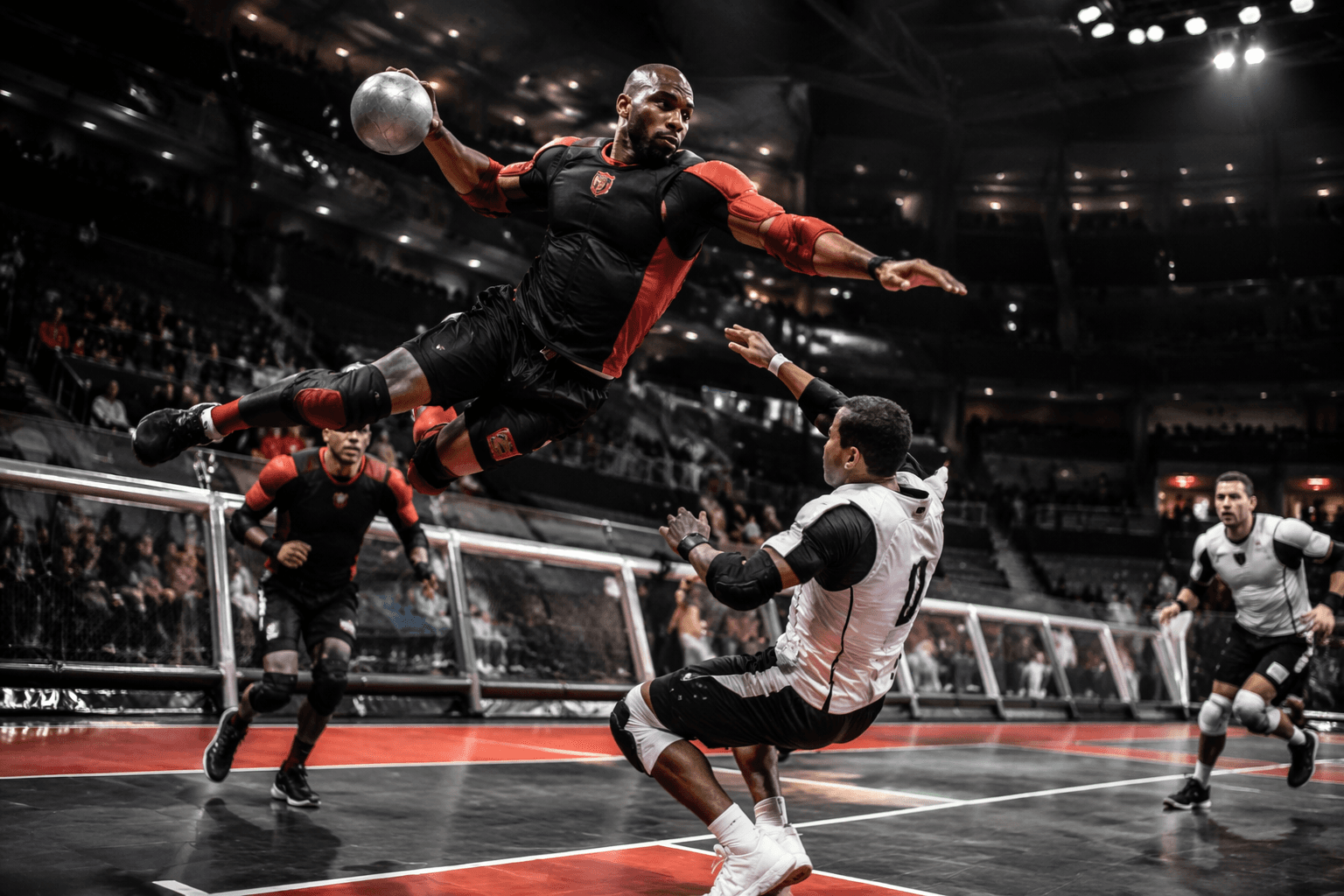
Mason Gordon turned a video game fantasy into SlamBall reality
Mason Gordon did more than add trampolines to basketball. He built the court, the rules and the credibility that let SlamBall become a real sport.

Mason Gordon did not sell SlamBall as a gimmick. He built a system that could survive gravity, contact and television, and that is the real reason the sport lasted beyond the first laugh.
From warehouse experiment to playable sport
The origin story starts in 1999, when Gordon invented SlamBall in Los Angeles and first staged it in an L.A. warehouse. He was not simply chasing spectacle. According to his team bio, he constructed the first court out of discarded gymnastics parts, which says almost everything about the sport’s early logic, improvisation first, polish later.
That early setup mattered because the concept had to do more than look wild. It had to function as a repeatable competition. SlamBall combined basketball and football with trampolines, but Gordon’s larger challenge was turning a video game fantasy into something players could actually run, defend and score on at game speed. The sport became believable only when the machinery around the chaos became precise.
The court was the first proof of concept
SlamBall’s official rules show how carefully the game was engineered. The court is 96 feet long and 64 feet wide, with three springbeds at each end and a larger scoring bed. An 8-foot plexiglass wall surrounds most of the court, which keeps the action contained and turns rebounds, bounces and caroms into part of the design rather than random accidents.
Those dimensions are not trivia. They are the structure that makes SlamBall possible. The court is compact enough to keep the action constant, but the springbeds create vertical lanes that reward timing, spacing and speed. That is why the sport feels so unlike standard basketball and yet still reads as basketball at its core: there is a court geometry, a possession logic and a scoring system built around movement instead of stoppage.
With four players from each team on the court at one time, the game stays crowded without becoming chaotic to the point of confusion. The player count, the wall and the springbeds work together to create repeatable action, not one-off spectacle.
The rules were designed to reward imagination
Gordon’s biggest innovation was not just the floor plan. It was the incentive structure. The description of the recent origin-story episode highlights four-point shots, which give longer-range creativity real value, and the famous popcorn foul, which protects aerial play without stripping away the contact that gives SlamBall its identity.
That balance is the key to understanding why the sport still makes sense. If the rules were too soft, SlamBall would lose the physical edge that separates it from basketball. If the rules were too violent, the game would become unsustainable and difficult to market. The popcorn foul exists in that middle ground, discouraging dangerous contact around airborne athletes while preserving the collision-heavy style fans came for.

The game format reinforces that speed. SlamBall contests are four 5-minute quarters, and the league uses hockey-like substitutions during live play. That creates a constant churn of fresh legs, quick changes and nonstop tempo. Instead of long breaks and half-court resets, the sport pushes toward movement and pressure, which is part of why it feels built for highlights but still rewards tactical discipline.
Legitimacy came through television, not just novelty
SlamBall became more than a warehouse experiment when it started moving through mainstream TV channels. The league first reached national television in 2002 on The National Network, later Spike TV, after former Philadelphia 76ers owner Pat Croce signed on as a partner. That step mattered because it gave the sport a commercial and institutional frame that a purely local stunt never would have had.
The original league also came with a real team structure, not just exhibition branding. The six teams were the Bouncers, Diablos, Mob, Rumble, Slashers and Steal. That lineup gave fans a competitive map and helped the league present itself as a league, not a one-night spectacle. Names like those are part of the show, but they also serve a business purpose: they make the product feel organized, investable and worthy of repeat viewing.
The modern comeback showed that the formula still had traction. After a 20-year hiatus, SlamBall returned in 2023 with a live relaunch from Las Vegas on July 21 at Cox Pavilion. ESPN, ESPN2 and ESPN+ combined to air more than 30 hours of live programming over five weekends, a serious platform commitment for a sport that began as a warehouse experiment. ESPN also pointed to the social lift around the revival, noting that #BringBackSlamBall had more than 200 million views.
Why Gordon’s version of chaos still works
The new episode centered on Gordon’s origin story because that story is the blueprint for the league’s identity. SlamBall is not just trampolines on a basketball court. It is a sport that had to invent its own boundaries, scoring incentives and safety rules before it could ask fans to believe in it. That is what makes Gordon more than a founder. He was the architect of the concept’s legitimacy.
The genius of SlamBall is that every part of it pulls in the same direction. The warehouse court proved the idea could exist. The plexiglass wall and springbeds made the action readable. The four-point shot and popcorn foul gave the sport its strategic and physical identity. Television exposure, first in 2002 and then again in the 2023 relaunch, gave it a reason to matter beyond novelty.
That is why the origin story still carries weight in 2026. SlamBall survived because Gordon kept pressing a ridiculous idea until the rules, the presentation and the business model all lined up. What looked like a stunt became a repeatable sport only after somebody made it structurally viable, and that remains the league’s most important play.
This article was produced by Prism’s automated news system from verified source data, official records, and press releases, then run through automated quality and moderation checks before publishing. The system is built and supervised by the people who set the standards it runs under. Read our full AI policy.
Did this article answer your question?