SlamBall stats hub tracks face-offs, slams, and unique scoring categories
SlamBall’s stats hub values face-offs, penalty points and slams as much as scoring, turning chaos and possession into its own definition of dominance.
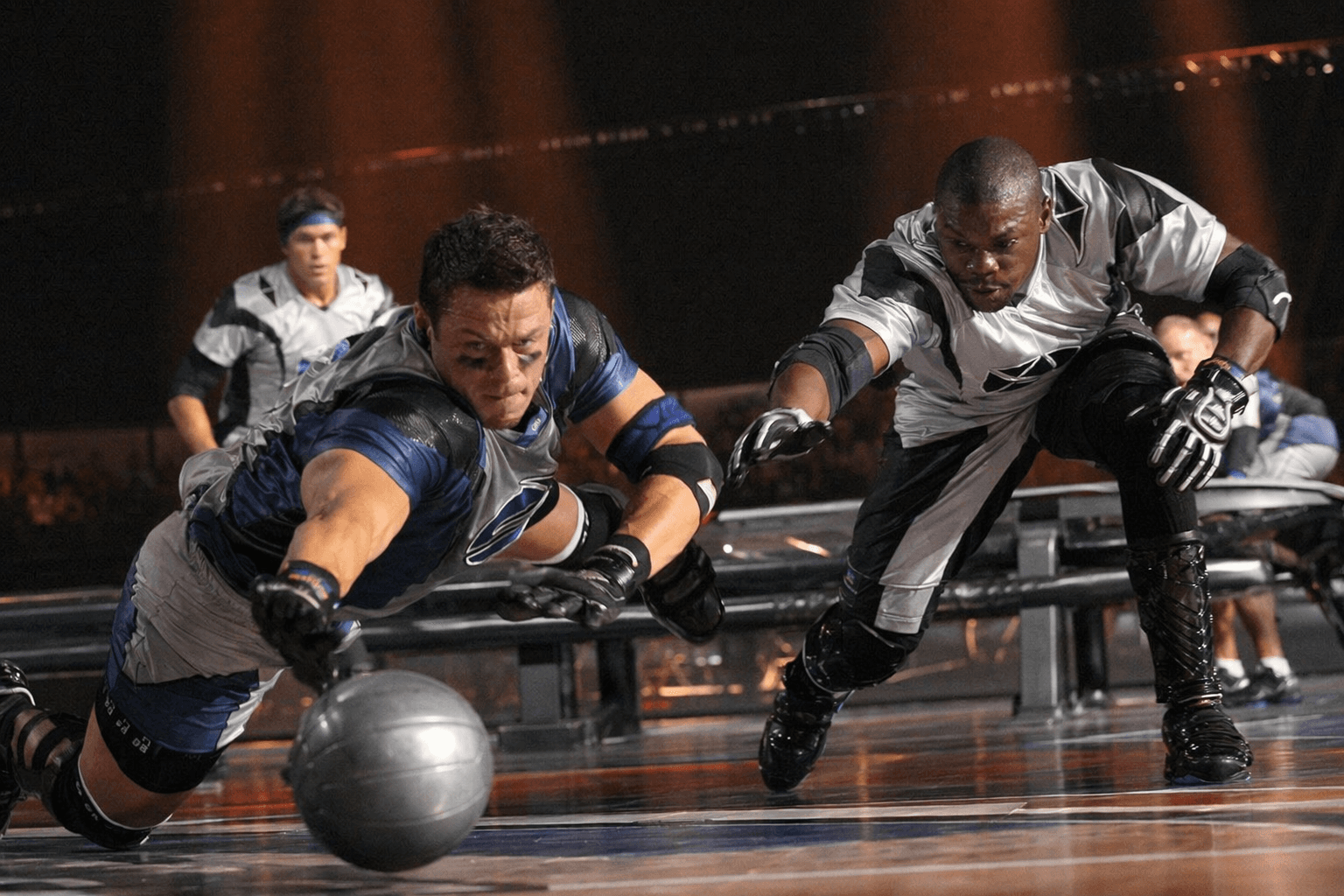
What the hub is really measuring
SlamBall’s stats hub starts from a simple idea with a very different meaning: a team does not win here by piling up points alone. The official page is built around team stats, player stats, league leaders and box scores, but its season table reaches well beyond wins, losses and points to capture the sport’s full chain of events, from possession to punishment to finishing at the rim.
That wider lens fits the game itself. SlamBall is a face-off-heavy sport with aerial scoring layers, constant physical pressure and a rulebook that can swing a possession before the ball ever gets to the basket. The hub updates after every game, so it works like a living record of how control is created, lost and regained, which is a much better fit for SlamBall than a conventional basketball sheet.
How to read SlamBall’s stat language
The easiest way to understand the hub is to translate its categories into basketball terms, then remember that SlamBall keeps adding another layer. Some of the labels look familiar, like field-goal attempts, assists, steals, turnovers and blocks. Others show exactly where the sport breaks from traditional hoops.
A quick read of the key categories:
- 2PT tracks 2-point field goals, the most basic scoring conversion.
- 3PT Opportunity and 4PT Opportunity track the higher-value chances the league wants to measure, not just the made shots.
- RA, or rim attacks, shows how often a team is getting downhill and forcing action near the basket.
- LAYUP records points scored at the rim, while SLAM captures 3-point slams, one of the sport’s defining finishers.
- ASST is assists, the usual sign of ball movement and creation.
- OFO and DFO track offensive face-offs and defensive face-offs, which is one of the biggest reminders that possession matters here in a way it does not in standard basketball.
- LBR means loose-ball recovery, STL means steals, TO means turnovers and STPS means blocks.
- HITS tracks running into an opponent, PPA tracks penalty points and the hub also tracks violations.
Taken together, those numbers do something a standard box score cannot. They show whether a team was winning the collisions, winning the reset and winning the space before it ever got to a shot. A team can look ordinary in raw scoring and still control the game if it keeps generating face-offs, loose-ball recoveries and penalty points while limiting turnovers.
Why the rules make those numbers matter
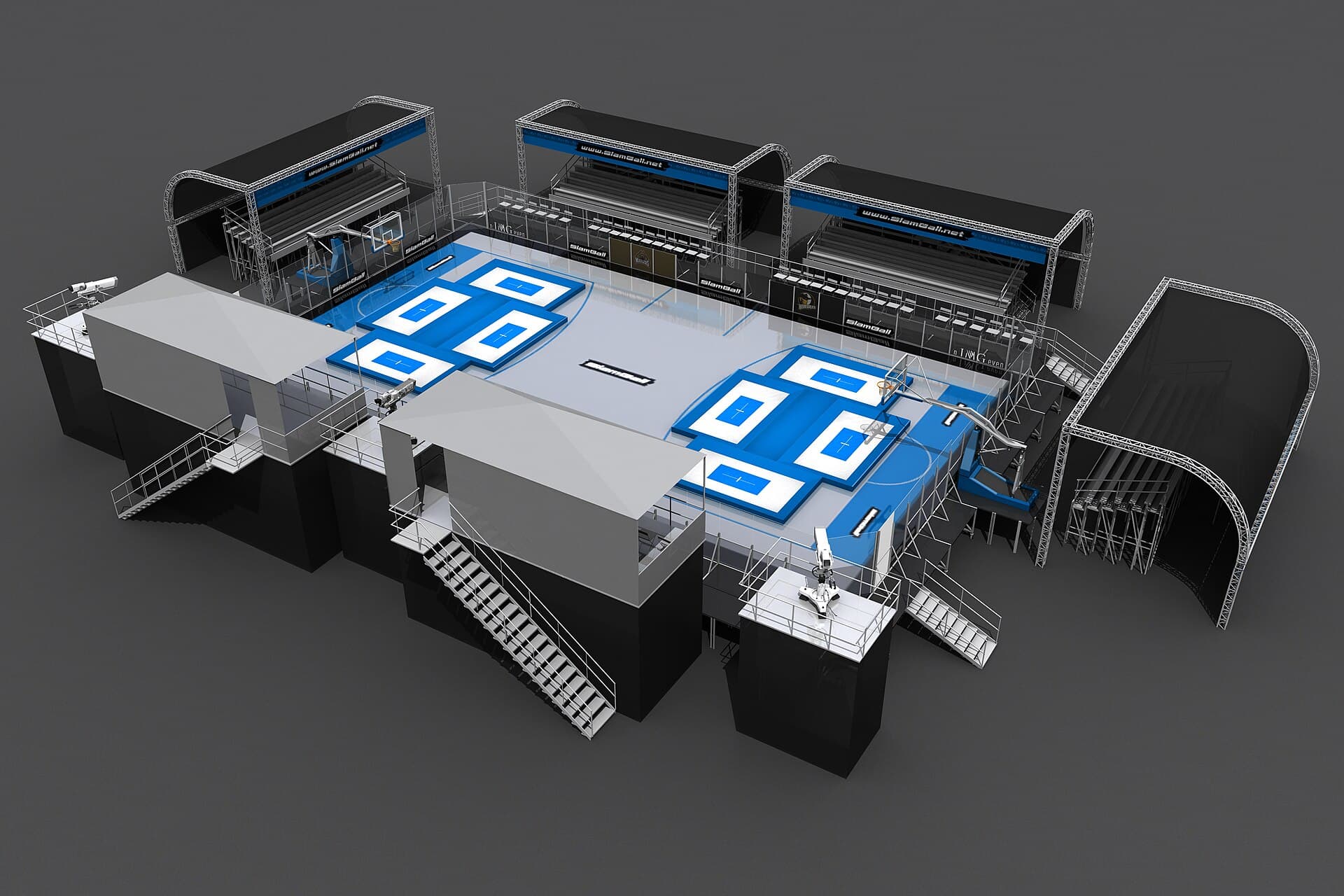
The league’s official rules explain why SlamBall needs this broader statistical language. Games are played in four 5-minute quarters, and the clock runs in all situations except face-offs and timeouts. That means each stoppage carries real tactical value, and every reset can change how a game flows.
The penalty system is just as important. After two bonus fouls, a team goes into the double bonus, and the fouled team receives 3 penalty points and possession. In a sport this short and this fast, that is not a side note. It is a scoring event and a possession event at once, which is exactly why penalty points sit beside field goals and assists in the hub.
Then there is the Island, the horizontal padded area between the four springbeds. The rules say there is no contact on the Island, and if a defender makes more than incidental contact, the result is a face-off. That detail explains why the stats page treats face-offs as core performance data. In SlamBall, contact management is part of defense, and the ability to force an official reset can be as valuable as a clean block.
What dominance looks like here
A player can dominate SlamBall without filling out a normal box score in the way basketball fans expect. A night built around two slams, a handful of rim attacks, a few loose-ball recoveries and a string of defensive face-offs may not scream superstar on a standard sheet, but in SlamBall it can represent total control of the game’s tempo and physical edge.
The same logic applies to teams. One side might win because it keeps forcing offensive face-offs, turns those restarts into transition chances and racks up penalty points when the opponent loses discipline. Another team might look quiet from the arc but still be dictating the game through blocks, hits and defensive face-offs that repeatedly deny clean possessions. SlamBall’s stats hub is built to reveal that kind of dominance, not hide it.
That is especially important because the sport rewards layered scoring. A 3-point slam is not just a highlight play, it is a category the league has chosen to make visible. The same goes for 3-point and 4-point opportunities. In other words, the league is not only tracking what went in, it is tracking the kinds of attacks that create the highest-value shots in the first place.
Why the hub says so much about SlamBall itself
SlamBall has always been a hybrid. The league says Mason Gordon invented it in 1999, and it first played in Los Angeles, a fact that helps explain why the sport has never tried to fit neatly inside basketball’s old vocabulary. It combines basketball and football with trampolines, but the stats model also borrows from hockey-like possession swings and football-like physicality. The numbers are not an afterthought. They are part of how the sport defines itself.
That identity got a bigger platform in the 2023 relaunch, when SlamBall returned with eight teams in Las Vegas and ESPN announced an exclusive two-year broadcast partnership for the 2023 and 2024 seasons. ESPN said opening night was July 21, 2023, live from Las Vegas, and that coverage would span more than 60 hours across ESPN, ESPN2 and ESPN+. Around the same time, SlamBall said it had closed an $11 million Series A round led by IA Sports Ventures and Eberg Capital, a reminder that the league’s data infrastructure, broadcast reach and business plan were all being built together.
The 2023 season ended with a striking shorthand for how the league likes to tell its own story: the Mob went 16-0 in the regular season before the championship stage at Cox Pavilion in Las Vegas. That kind of record matters in any sport, but SlamBall’s stats hub gives it more texture. It shows whether dominance came from slams, face-offs, loose-ball recoveries, penalty points or simply the ability to keep winning the next collision.
In SlamBall, excellence is not just about scoring. It is about controlling the chaos, and the hub is built to measure exactly that.
This article was produced by Prism’s automated news system from verified source data, official records, and press releases, then run through automated quality and moderation checks before publishing. The system is built and supervised by the people who set the standards it runs under. Read our full AI policy.
Did this article answer your question?