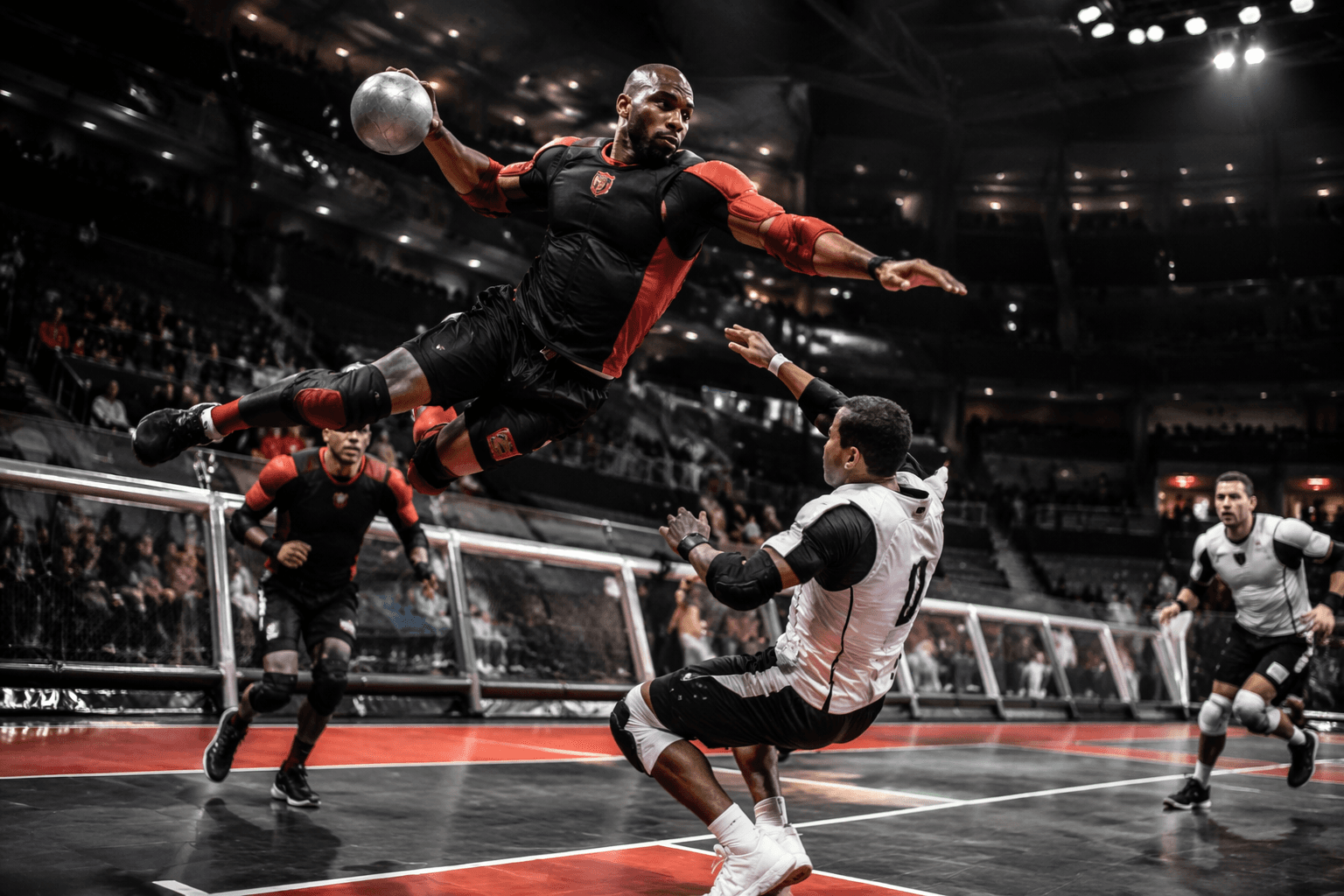
MOB cement legacy as SlamBall's original dynasty, league standard-bearer
MOB’s unbeaten 2023 run revived SlamBall’s founding myth: the league still sells identity through its original teams, star names, and rivalries.

The league’s mythology still runs through the MOB
SlamBall did not come back in 2023 as a blank slate. It came back with an origin story, and the MOB sat at the center of it. The franchise’s three-title stretch, back-to-back Series 4 and Series 5 crowns followed by a Series 6 championship, turned the group into the sport’s standard-bearer and the clearest shorthand for excellence in a league built on identity as much as scorelines.
That matters because SlamBall has always sold more than a ruleset. It sells teams with texture: the kind of squads fans can recognize by style, attitude, and memory alone. The MOB’s brand was built on big hits, suffocating defense, and one-tramp lobs, a profile that fit the sport’s collision-heavy DNA and made the team feel like a true dynasty rather than a short-lived hot streak.
From a Los Angeles warehouse to a dynasty
SlamBall traces its own birth to 1999, when Mason Gordon invented the sport and first played it in Los Angeles. Gordon has described the first court as something assembled in a warehouse from discarded gymnastics parts, which is exactly the kind of scrappy beginning that makes the league’s founding teams feel mythic. The MOB were one of the two original teams born in that warehouse-era environment, and the league still treats that status as foundational.
That early setting gave the sport a permanent edge. It was never just basketball with trampolines, even though Gordon envisioned a hybrid that pulled from basketball, football, hockey, and more. The league’s visual and emotional identity came from the idea that a new game could produce new icons, and the MOB were the cleanest expression of that idea once the championships began to pile up.
How the MOB became the standard
The MOB’s title run began under Handler Noah Ballou, with Series 4 MVP Trevor “Eagle” Anderson anchoring the rise. Shanghai’s Lu Feng also became central to the story, and SlamBall identifies him as the first international SlamBall star, a marker that gave the league a global face long before the current relaunch. Add Sean “Inches” Jackson, LaMonica “The Machine” Garrett, and Kevin Cassidy, and the roster reads like a roll call of the league’s first generation of recognizable names.
The significance of the MOB’s three straight titles is bigger than the trophy count. In a sport still defining itself for new audiences, dynasty status creates a reference point. Fans need a team that explains what greatness looks like, and in SlamBall that team became the MOB, with a style that blended force, discipline, and aerial execution into a distinct competitive identity.
Why the other original teams still matter
The league’s original mythology was never built around one franchise alone. The RUMBLE are presented as another warehouse-era original, and their identity came from leader Jelani Janisse’s description of the team as smart, tough, gritty, and cocky. That mix fit a team that won the inaugural world championship and posted a winning percentage north of 70% across Series 1-5, a record that kept them in the conversation even when the MOB became the sport’s marquee name.
The RUMBLE’s identity is tied to Ken Carter, the real Coach Carter, whose basketball background helped shape the edge associated with the team. That connection gave SlamBall another layer of credibility, linking a new sport to a widely known basketball authority and making the RUMBLE more than a novelty act in the league’s earliest years.
The Slashers added a different kind of appeal. They were known as technically sound and offensively complex, and their defining championship win arrived on CBS in Series 3 after Adam Hooker delivered a last-second stop against Jelani Janisse. That moment gave the team a classic championship image, the kind of sequence that survives because it can be retold in a sentence and still carry weight.
Then there are the Maulers, the franchise that never finished on top but still left a deep imprint on the league’s identity. Stan “Shakes” Fletcher is described as the sport’s most creative player and a widely touted GOAT because of his freestyle, defense-breaking style. Even without a title, the Maulers helped define what the game could look like at its most inventive, and that matters in a sport where style is part of the product.
What the 2023 relaunch was really selling
When SlamBall returned in 2023, it did so with ESPN in the room. The league and ESPN announced an exclusive two-year broadcast partnership covering the 2023 and 2024 seasons, a clear signal that the relaunch was meant to reintroduce the sport to mainstream viewers rather than simply serve a niche fan base. The 2023 season ran for five weekends at Cox Pavilion in Las Vegas and ended with playoffs and the championship game from Aug. 17-19.
The structure of that season reinforced the value of the league’s history. ESPN reported that the MOB finished the regular season 16-0, while the playoffs included eight regular-season teams and gave the top two teams, MOB and Buzzsaw, byes into the semifinals. That setup made the MOB feel less like a relic of the past and more like the living bridge between SlamBall’s founding mythology and its current broadcast era.
Why legacy teams still drive the sport forward
SlamBall’s official Legendary Teams page does something many emerging leagues struggle to do: it turns history into product. The MOB, RUMBLE, Slashers, and Maulers are not presented as old names collecting dust. They are the framework that helps new fans understand who mattered, why it mattered, and what kind of drama the sport can produce when the lights come on.
That is why the MOB’s legacy still lands. Their warehouse-born origin, their three-title run, their star names, and their 16-0 2023 return all tell the same story: SlamBall’s future depends on the credibility of its past. In a league where identity is part of the competition, the original dynasty still sets the standard.
This article was produced by Prism’s automated news system from verified source data, official records, and press releases, then run through automated quality and moderation checks before publishing. The system is built and supervised by the people who set the standards it runs under. Read our full AI policy.
Did this article answer your question?