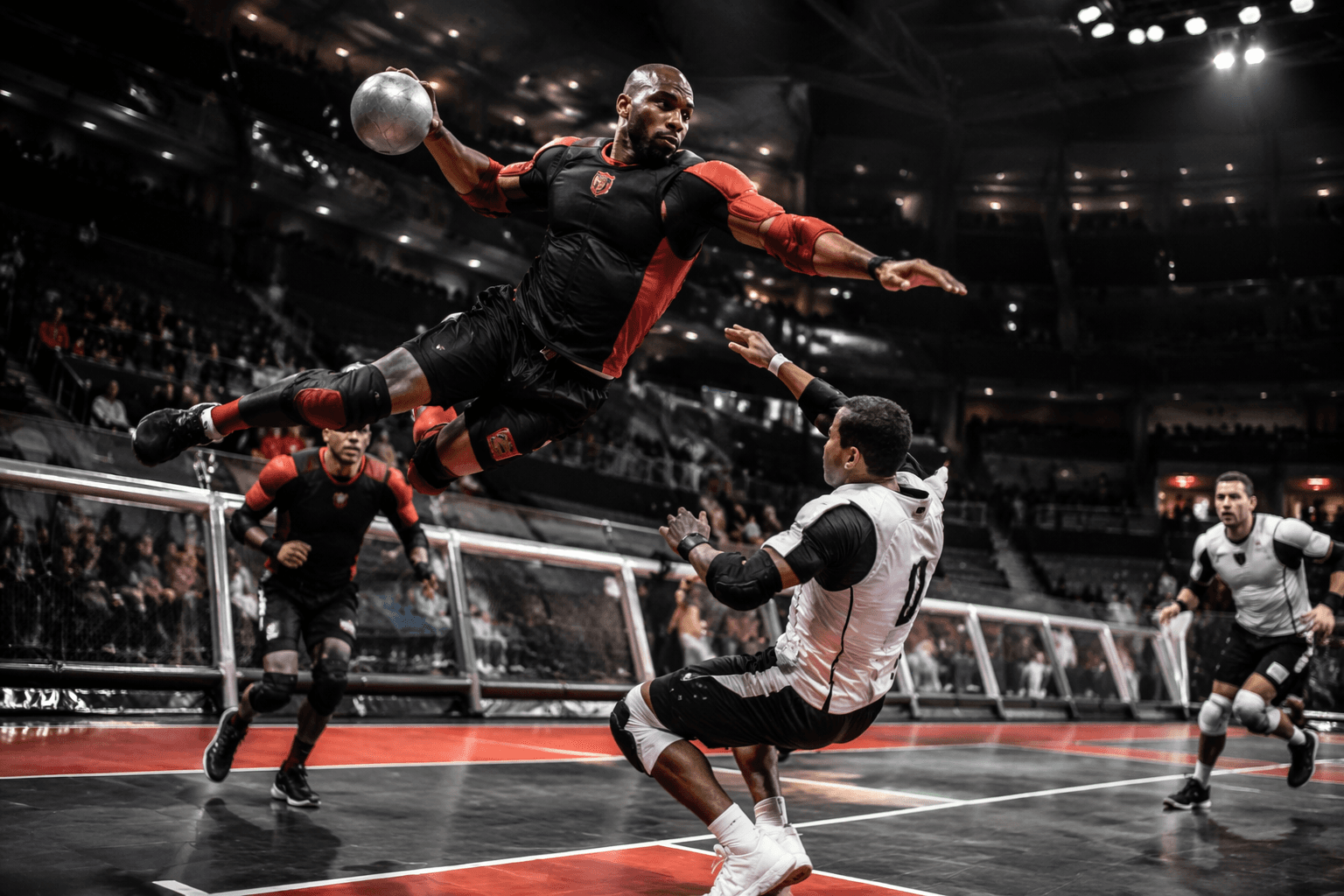
Slamball rewards versatile athletes as league returns to ESPN, ESPN+
Slamball’s return spotlights a sport built for football-basketball hybrids, but the fastest adopters are the athletes who already blend contact, burst, and air control.

Slamball’s biggest edge is that it rewards overlap, not specialization
The sport is back on ESPN and ESPN+, and its selling point is as clear as the trampoline lanes under the basket: Slamball rewards athletes who can do several things at once. Four trampolines sit inside the arc, boards replace out-of-bounds lines, body checking is legal, and the whole game is compressed into five-minute quarters on a 96-foot by 64-foot court. That design turns every possession into a test of collision tolerance, timing, and lift, which is why the best players rarely come from a single-sport background.
That mix is also what gave the 2023 relaunch its buzz. The league returned with eight teams, a four-week regular season, a postseason on August 15, 2023, and a championship game on August 17, 2023. It landed with both nostalgia and novelty, reaching older viewers who remembered the original run and younger fans who had already seen the sport circulate online.
A hybrid game demands hybrid instincts
Slamball was invented by Mason Gordon in 1999 and first played in Los Angeles, and its structure still reflects that original mash-up of basketball, American football, hockey, and gymnastics. It is not just basketball with more jumping. It is basketball played in a setting where the next rebound, block, or transition lane can start with a bounce off a spring bed and end in a full-speed collision.
That is why the league’s modern version was built around “bigger, stronger, more-skilled athletes,” as Gordon put it. The phrase matters because Slamball does not merely value size or vertical leap in isolation. It values players who can absorb impact, reset their balance, and make the next decision instantly, even while the floor itself is helping produce chaos.
Why football players fit so quickly
Football background translates almost immediately because Slamball welcomes controlled violence. Players who have spent years reading traffic, bracing for contact, and using leverage already understand how to survive in space that is shrinking, then exploding again. They also tend to recognize timing windows, which is crucial in a game where a split-second mistime on a trampoline can turn a scoring chance into a turnover.
Nate Robinson is the clearest example of that crossover logic. Before becoming an NBA first-round pick in 2005, he played both football and basketball at the University of Washington, and he described the overlap in direct terms: “The physicality of football, and then basketball, knowing how to finesse, being patient, and finding different ways to score.” That is almost a mission statement for Slamball, where contact and touch have to coexist on the same possession.
Basketball still matters, but it is no longer enough by itself
Pure basketball skill gives a player a foundation in spacing, finishing, passing, and shot creation, and those tools still matter in Slamball. But the league’s design exposes the limits of early specialization, because a polished jumper without collision instincts can struggle as soon as the possession gets messy. A traditional hooper may understand angles, but Slamball asks that player to finish through body checks, land cleanly off a trampoline, and immediately shift from scorer to defender.
That is why the most successful basketball converts are usually the ones who already have other athletic language built in. Gordon’s description of the 2023 group points to that evolution, and the emergence of names like Gage Smith and Tony Crosby II suggests a league now built around athletes who can create above the rim while still handling the physical and tactical demands below it.
Track, gymnastics, wrestling, and volleyball each solve a different part of the puzzle
Track athletes tend to adapt quickly because Slamball rewards burst over long stretches of time. The game’s pace is short and violent, so top-end speed, recovery speed, and repeated acceleration matter as much as raw jumping ability. A sprinter who can reset quickly after a landing is valuable because the next play often starts before the crowd has finished reacting to the last one.
Gymnasts and trampolinists bring a different advantage: body control in the air. That matters in a sport where players are not just jumping, but adjusting, twisting, and finishing after launch. A gymnast’s sense of where the torso, hips, and feet are in space often translates into cleaner landings and more controlled finishes, which can reduce the learning curve dramatically.
Wrestlers fit because they already understand leverage, base, balance, and hand-fighting under pressure. Slamball can feel like a series of half-sealed collisions, and wrestlers are often best prepared for that kind of wrestling match on the move. Volleyball players, meanwhile, bring timing at the net, vertical reading, and the ability to track the ball while off the ground, which gives them a useful starting point in a sport that constantly punishes poor timing.
The fastest adaptation usually comes from athletes who already blend contact and scoring
If you are looking for the quickest path onto a Slamball court, the strongest crossover background is not a single sport but a combination. Football plus basketball is the clearest shortcut because it pairs physical comfort with offensive instincts, and Robinson’s career is the model for that pathway. Track and gymnastics rank just behind because they accelerate the skills that make Slamball look different from ordinary pickup above the rim: burst, lift, control, and landing mechanics.
The bigger lesson is that Slamball is built for athletes who have never been just one thing. The league’s revival on ESPN and ESPN+ makes that more visible than ever, because every run to the rim or collision off the boards now reads like a demonstration of transferable skill. In a sport invented to blur boundaries, the players who adapt fastest are the ones whose backgrounds were already blurred long before they arrived.
This article was produced by Prism’s automated news system from verified source data, official records, and press releases, then run through automated quality and moderation checks before publishing. The system is built and supervised by the people who set the standards it runs under. Read our full AI policy.
Did this article answer your question?