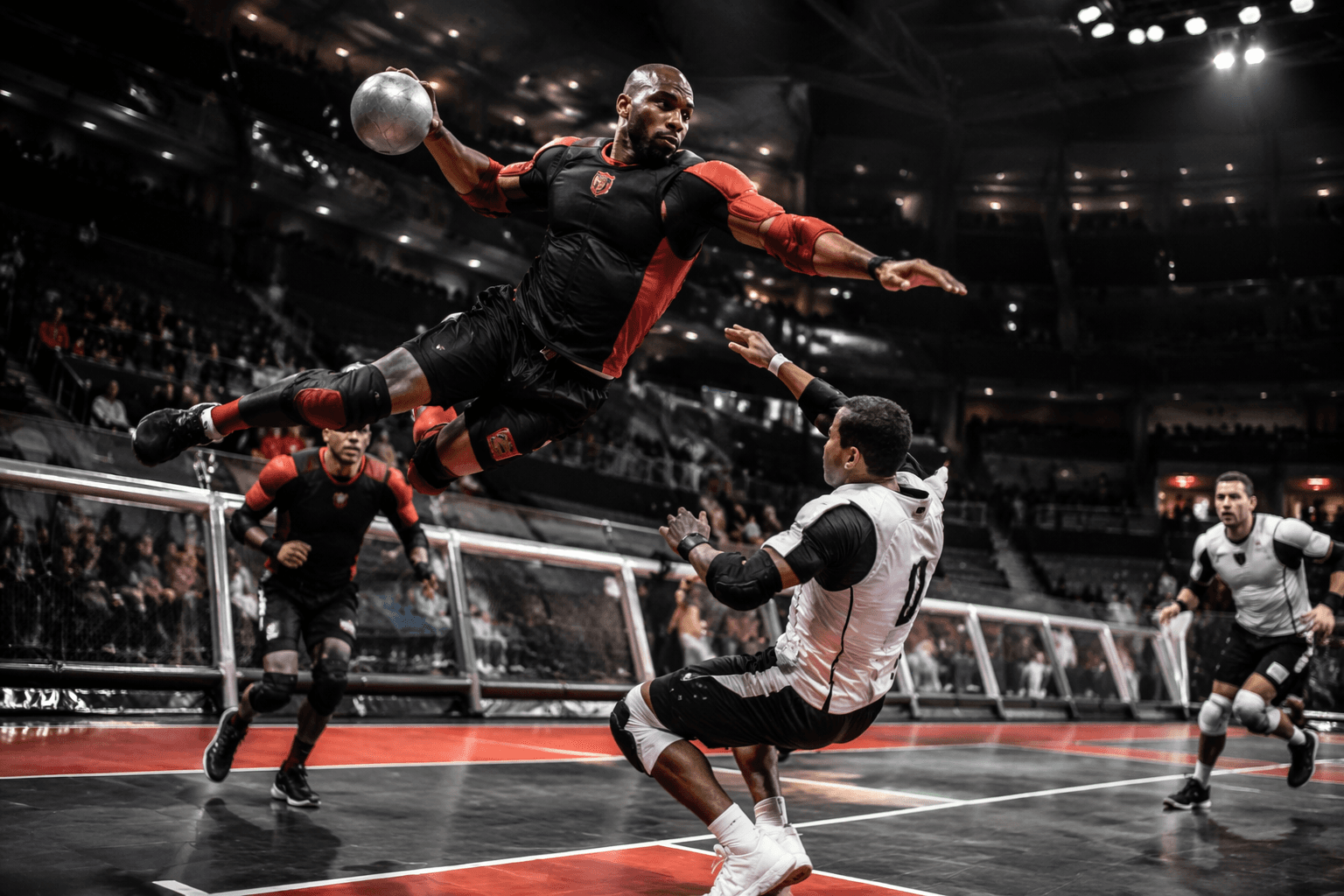
SlamBall team pages spotlight handlers, gunners, and stoppers across rosters
Handlers, gunners, and stoppers are more than labels in SlamBall, they are the map to pace, rim protection, and the live-substitution chess match.

What the roster card tells you first
SlamBall’s team pages do something the NBA almost never needs to do: they tell you how to read the game before the ball even goes up. The current club pages pair schedules and team news with compact lineup cards that label players as handlers, gunners, and stoppers, and that role-first structure is the clearest clue to how SlamBall actually works. When the Gryphons, Mob, and Rumble pages all present personnel this way, the league is signaling that function matters more than familiar basketball position tags.
That framing is not cosmetic. It is the best entry point for understanding why a SlamBall possession feels so fast, so physical, and so specialized. A handler is there to start the action and manage tempo, a gunner is built to attack open space and finish, and a stopper is the anchor who takes contact, protects the rim, and helps turn defense into a quick break the other way. If you watch the game through those jobs, the sport stops looking like chaotic aerial basketball and starts reading like a tightly engineered system.
How to read a SlamBall lineup
The clearest example sits on the Gryphons page. On the starter list, Adam Stanford is tagged as a handler, Kyshawn Jones and Justin Holmes as gunners, and Connor Hollenbeck as a stopper. The squad page goes further, listing eight players total, including Stanford, Holmes, Hollenbeck, Jones, Jace Bass, Matthew Wilkerson, Deshawn Kelly, and Jordan Grant, while also attaching hometowns, heights, weights, and birth dates to each player.
That extra detail matters because it shows how the league wants fans to evaluate personnel. Stanford, listed at 6-foot-4 and 200 pounds and from Fontana, California, reads like a player built to initiate rather than merely survive contact. Jordan Grant is also listed as a handler, which tells you the role pool is broader than a one-player designation, while the repeated gunner and stopper tags show how the team page organizes the roster around tactical jobs rather than generic basketball slots.
Handlers
Handlers are the tempo-setters. They are the players who are most likely to organize the first touch, identify the angle, and decide whether a possession is built for speed or control. In a sport with only four players on the court per team and seven active players on the roster, the handler role becomes even more valuable because each possession begins with a narrow margin for error.
When you watch a handler, you are watching the game’s decision point. The best handlers do not simply dribble, they create the first leverage in a possession, which is why the role is central to substitution planning as well. If a coach wants to slow a run, manage a matchup, or reset a broken sequence, the handler is usually the player who makes that possible.
Gunners
Gunners are the pressure release. They are there to attack space, move quickly into scoring positions, and punish the smallest defensive breakdown. In SlamBall, where the action is compressed and the court design rewards instant advantage, gunners shape shot selection by forcing defenses to react before they are set.
That makes them essential in transition and in late-clock pressure situations. A gunner changes the way a defense has to retreat, and that in turn changes the way a coach thinks about substitutions. If the pace needs to spike, a gunner is the natural answer, because the role is built around acceleration, not patience.
Stoppers
Stoppers are the defensive backbone, and in SlamBall they are just as important as the players who score. The role is built around absorbing contact, protecting the rim, and turning a stop into sudden offense, which is a major reason the sport feels so different from standard basketball. A stopper is not simply a shot blocker in the traditional sense; the role is part safety valve, part wrecking ball, part transition trigger.

That matters even more because SlamBall uses live-play substitution language, so coaches can adjust on the fly when a possession demands more resistance at the hoop. When a stopper is on the floor, the game tends to feel more controlled defensively, but also more dangerous in the opposite direction because every clean stop can become a sprint the other way.
Why substitutions change everything
SlamBall’s roster limits make every swap meaningful. Each team can have four players on the court at one time and carry seven active players on the roster, so a substitution is not just a fresh body, it is a tactical redefinition of the lineup. One change can turn a possession from methodical to explosive, or from aggressive to containment-oriented, in a matter of seconds.
That is why the game rewards coaches who understand matchup timing. The league’s rules framework includes live-play substitutions and penalty-triggered face-offs, so personnel decisions are part of the action rather than a pause from it. In practical terms, that means coaches can chase a better defensive look with a stopper or a faster scoring look with a gunner without waiting for a dead-ball rhythm to solve the problem.
The opening sequence is part of the strategy
Even the start of each half reflects SlamBall’s role-driven identity. Each half begins with a throw down, described as an inverse tip-off, and the rules also say teams must position three players at mid-court with the stoppers under their respective hoops for the bounce-off. That structure turns the opening sequence into a designed contest of spacing, timing, and initial leverage rather than a simple jump-ball echo from basketball.
The island rule pushes the strategy even further. The island is a contact-limited offensive area, and two offensive players cannot be stationed there at the same time. That one restriction shapes shot selection and spacing immediately, because it limits how teams crowd the scoring area and forces them to think about timing, lanes, and entry angles instead of just brute-force interior play.
From invention to relaunch to broadcast property
SlamBall’s current identity grew out of a long arc. The league says the sport was invented in 1999 by Mason Gordon and first played in Los Angeles, and Gordon’s official bio identifies him as the creator and co-founder behind the concept. His original idea blended basketball, football, hockey, and trampoline-based aerial play, which explains why the sport feels both familiar and unlike anything else on a standard basketball card.
The 2023 relaunch gave that identity a cleaner public face. SlamBall returned for its sixth season in Las Vegas after 15 years dormant in the United States, and the league featured eight teams: the Mob, Rumble, Slashers, Buzzsaw, Gryphons, Lava, Ozone, and Wrath. The league also said the revival came with an exclusive two-year national broadcast partnership with ESPN for the 2023 and 2024 seasons, a sign that the sport was being positioned not as a novelty, but as a repeatable broadcast property.
Why the numbers matter beyond the spectacle
The championship run underlined that the structure works on the floor as well as on the page. The Mob won the 2023 title and finished 18-0, beating the Lava 49-36 in the semifinal and the Slashers 72-42 in the final at Cox Pavilion in front of a sold-out crowd. The league later said the season exceeded expectations across social, broadcast, attendance, and media engagement, which is exactly what a role-based sport needs if it wants to keep widening its audience.
That is the deeper appeal of the team pages. They are not just bios and schedules; they are a tactical translation layer for a sport that depends on specialization, substitution timing, and a constant tug-of-war between aerial offense and physical defense. Once you know how to read handlers, gunners, and stoppers, every SlamBall possession becomes easier to follow and far more revealing.
This article was produced by Prism’s automated news system from verified source data, official records, and press releases, then run through automated quality and moderation checks before publishing. The system is built and supervised by the people who set the standards it runs under. Read our full AI policy.
Did this article answer your question?