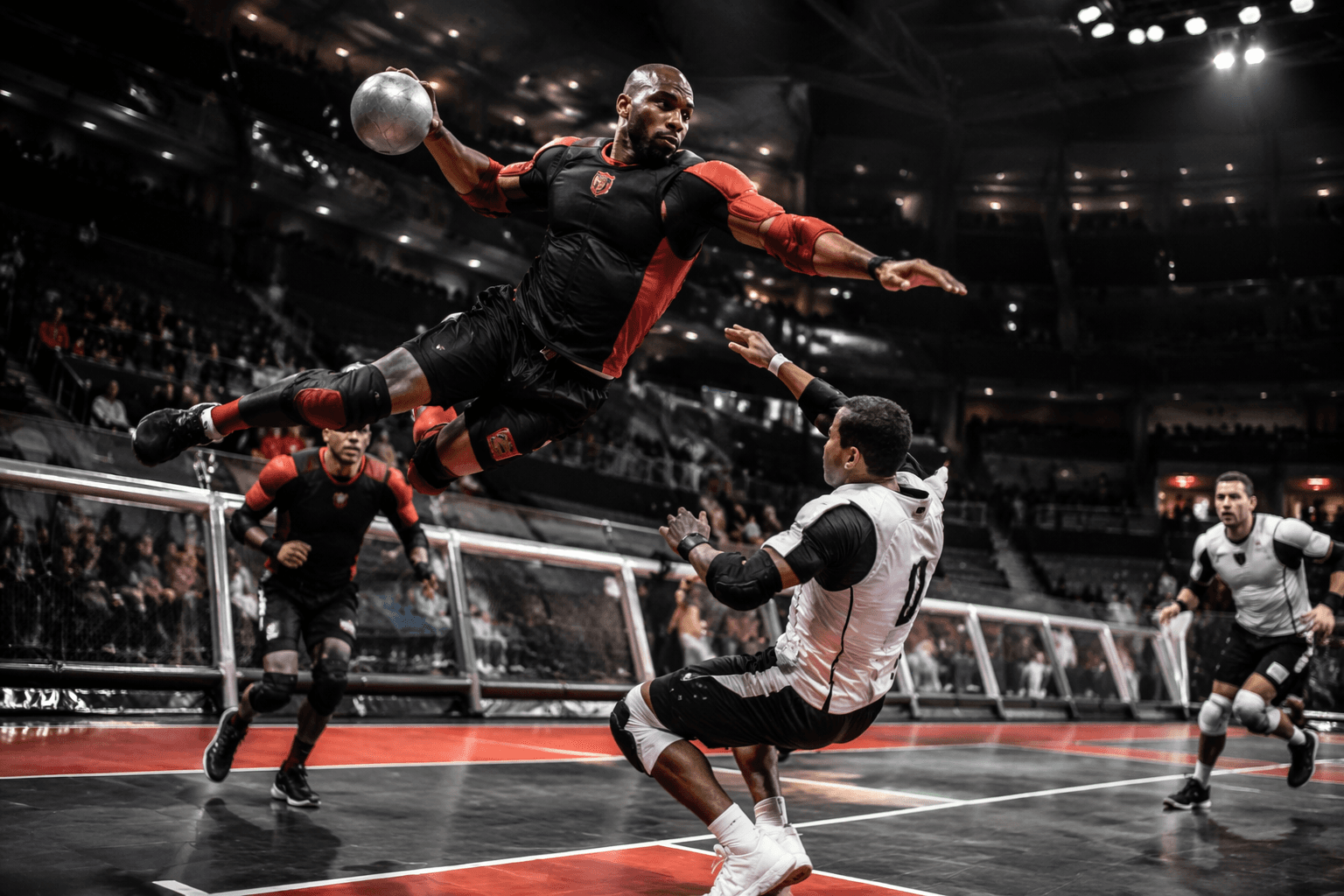
Slashers lean on defense, interior depth in balanced SlamBall roster
Tony Crosby II gives the Slashers a true handler, while three listed stoppers let them win the ugly possessions that decide SlamBall. That balance could be the league’s smartest roster bet.

The roster shape tells the story
The Slashers do not look built for flash first. They look built to survive the kind of possessions that turn SlamBall from a scoring sport into a contact test, and that is the point. Tony Crosby II is the smallest player on the roster at 5-foot-6 and 175 pounds, and that size gap is not a flaw so much as a clue: he is there to control tempo, connect the pieces, and let the bigger bodies attack on schedule.
That matters because SlamBall rewards teams that can keep their shape when the floor gets crowded and the rebounds turn into collisions. A roster that can stay organized after contact, then still protect the rim and run the next possession, has a real edge. The Slashers have built toward that idea with a clear balance of roles: one handler, three gunners, and three stoppers.
Crosby is the hinge point
Crosby’s job is not to overwhelm anyone physically. It is to make the rest of the roster functional. In a league where possessions are short and the margins are compressed, an undersized handler who can set timing is more valuable than a high-usage scorer who needs everything to break right.
That is why Crosby’s profile matters so much. His size tells you the Slashers want a player who can organize, advance the ball, and create the first advantage before the defense fully loads up. When the offense starts on time, the gunners can attack with momentum instead of improvising out of chaos, and the stoppers can save their energy for the next defensive stand.
Three stoppers change the math
This is where the Slashers separate themselves from the typical highlights-first build. Amir Smith, Nathan Karsjens, and Brian Gentry are all listed as stoppers, and that gives the roster three players whose defined purpose is to absorb contact, cover the rim, and keep the team upright when the game turns messy.
In SlamBall, that is not a luxury. It is roster insurance. One stopper can have a bad matchup; three stoppers let a team rotate, recover, and still protect the paint without asking scorers to do work they are not built for. With the court narrow and the action compressed, interior size and defensive instinct can do as much to decide a possession as a clean finish at the rim.
The best way to understand the value is through transition defense. When a team misses or turns it over, the first three steps backward are everything. A stopper-heavy roster is better equipped to stop the leak before it becomes a layup, a collision, or a highlight against. That is how the Slashers can keep the game in front of them instead of letting every empty possession become a sprint.
The gunners give the structure its ceiling
The Slashers are not defense-only. Alonzo Scott Jr., Bradley Laubacher, and Naradain James give the roster scoring outlets that keep the defense honest and prevent the team from becoming too one-dimensional. Their presence matters because Crosby does not need to manufacture everything himself; he only needs to get the ball moving to the right spots and at the right pace.
That balance is what makes the roster interesting. Scott Jr. is from Waverly, Virginia, Laubacher from Bend, Oregon, and James from Kalamazoo, Michigan. Along with Crosby, who is from Long Beach, they give the Slashers a mix of backgrounds that fits SlamBall’s multi-sport recruitment profile, where players arrive with different athletic instincts but have to solve the same violent geometry on the court.
The interior trio carries the same geographic spread. Smith is from Missouri City, Texas, Karsjens from Ackley, Iowa, and Gentry from Winston-Salem, North Carolina. That kind of national footprint is part of the league’s identity, but for the Slashers it also reinforces the roster build: different athletes, same job, same demand for toughness.
Why this build can beat a more offense-first roster
A more offense-first team usually wants to win by outrunning mistakes. It loads up on scorers, trusts the pace, and accepts that some defensive possessions will leak because the goal is to outscore the problem. That can work when shots fall and the game stays open.
The Slashers are built to punish that approach. With three stoppers on the roster and Crosby setting the table, they can narrow the game, reduce easy paint looks, and force opponents to spend more of their energy trying to create clean shots in a crowded space. In a league where the highlight is often a collision as much as a basket, that kind of roster has a hidden edge: it does not need the game to become pretty.
Here is the key comparison. An offense-first roster with four gunners and only one true interior anchor can look explosive until the first wave of misses starts piling up. Then every possession becomes a footrace back to the rim. The Slashers have built the opposite problem for opponents. They have enough scoring to keep pressure on, but enough defensive bodies to make every fast break, every second-chance chance, and every rim attempt feel earned.
The page itself reflects a live team, not a static chart
The official squad page does more than list names. It also connects to schedule, highlights, and full-game archives, which turns the roster into a working reference point for how the Slashers actually perform. That matters because this team is easiest to understand by watching how the pieces fit once the game starts: Crosby initiating, the gunners finishing, and the stoppers cleaning up the chaos.
That is why the Slashers read like a market inefficiency in a league built for spectacle. Everyone notices the aerial stuff first. The smarter bet is often the team that can keep the possession alive long enough to make the spectacle count. The Slashers look designed to do exactly that.
This article was produced by Prism’s automated news system from verified source data, official records, and press releases, then run through automated quality and moderation checks before publishing. The system is built and supervised by the people who set the standards it runs under. Read our full AI policy.
Did this article answer your question?