AgencyPro report shows AI and discipline reshaping agency growth
AI is no longer an experiment for agencies; the real test is whether tighter service mix and sharper pricing can protect margins in a harder market.

The benchmark that matters
The clearest signal in AgencyPro’s State of Agencies 2026 is not that agencies are talking about change, but that they are being measured against it. The report was last updated on April 18, 2026 and pulls together more than 50 verified statistics, 12 key findings, and eight categories covering market structure, financial health, client dynamics, workforce and remote work, technology and AI adoption, and growth and scaling patterns.
That matters because this is not a cheerleading piece about the future of agencies. It is a working benchmark for owners who need to compare their own books, staffing, pricing, and service mix against where the market is actually moving. The report’s own framing says the post-pandemic normalization phase is over, which means agencies can no longer rely on demand rebounds or loose positioning to carry growth. Execution quality, specialization, and operational discipline are now the real differentiators.
AI is now part of the operating model
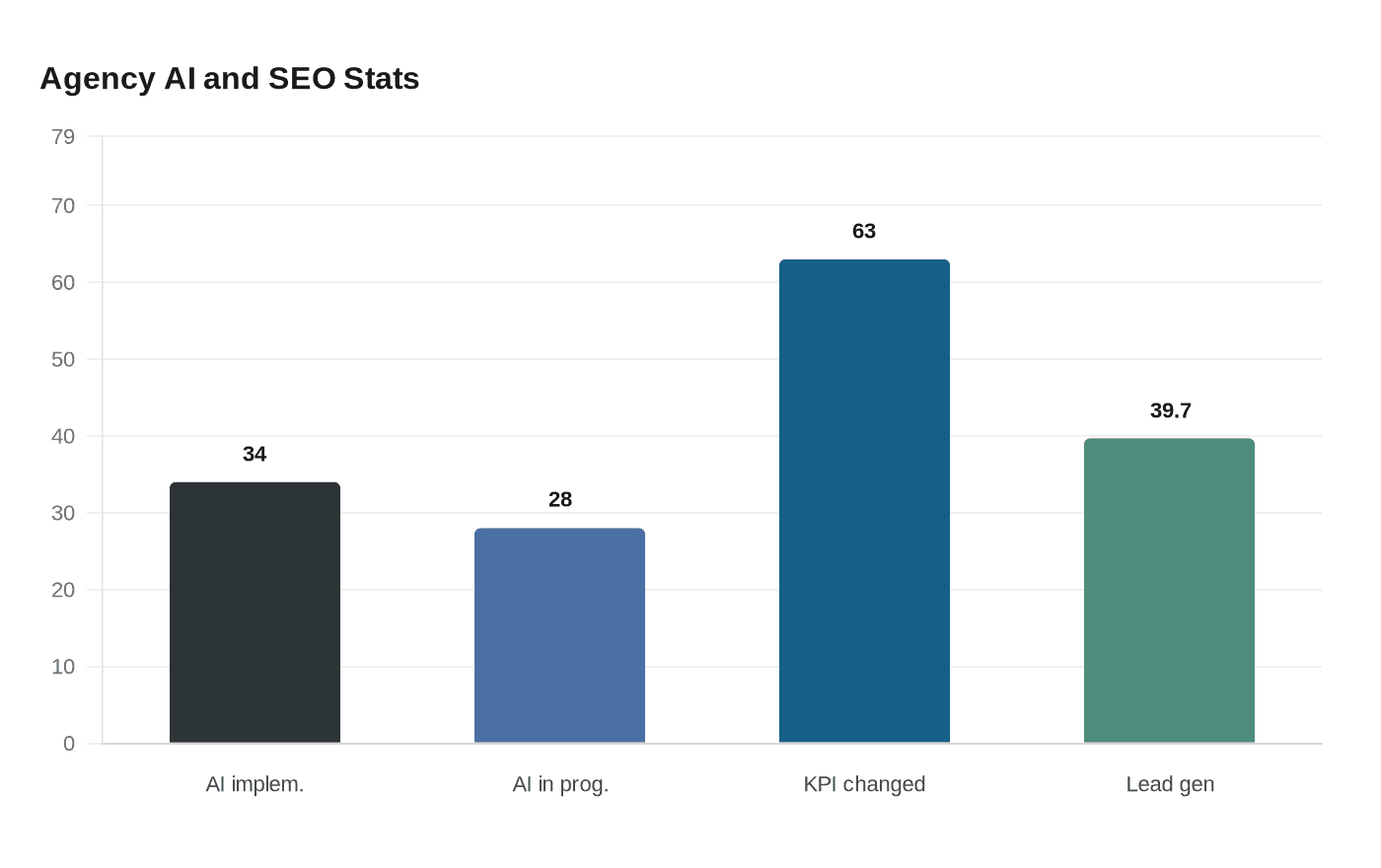
The most important number in the report is also the simplest: 34% of agencies have already implemented AI across the business, and another 28% are actively implementing it. That puts AI well beyond the “let’s test this in one workflow” stage. It is showing up in delivery, pricing, hiring, and how agencies justify their value to clients.
For SEO and digital-marketing shops, that shift is not abstract. AI changes how quickly work can be produced, which in turn changes what clients expect to pay for, how teams are structured, and what gets counted as premium expertise. Agencies that use AI only to speed up routine tasks will probably see short-term efficiency gains; agencies that use it to standardize research, reporting, content ops, and QA without dulling quality are the ones building a more defensible model.
Margins are rewarding focus, not sprawl
The strongest proof that discipline is beating breadth comes from Promethean Research’s 2026 digital agency benchmark, based on 119 agency leaders. Agencies that reduced their service mix grew 13% on average and posted 30% net margins. That is the kind of result that should make any owner look hard at the menu board. A narrower offer is not automatically safer, but the data suggest it is often more profitable.
The same research found large agencies grew 2.7 times faster than small agencies, which reinforces a familiar but uncomfortable truth: scale still matters, and size can amplify both sales reach and operating leverage. For smaller firms, the lesson is not to imitate large agencies line for line. It is to cut the noise, define the strongest revenue engine, and build the kind of repeatable delivery model that makes growth less dependent on heroics.
Promethean’s findings also show where pressure is building. Sales, profit margins, and lead generation were the biggest concerns heading into 2026. That combination is revealing. Agencies are not just fighting to win more work; they are fighting to win the right kind of work at margins that survive the current cost structure.
SEO agencies are being squeezed from both sides
Sitechecker’s March 11, 2026 study of 73 SEO agencies makes the pressure much more concrete. Seventy percent said they make under $50,000 in monthly recurring revenue, which tells you how many SEO firms are still operating at a relatively small scale. That alone would be enough to keep pricing discipline front and center, but the study goes further: 63% have already changed their SEO KPIs because of AI Overviews and shifting search behavior.
That KPI shift is a big tell. When agencies change the measurement system, they are admitting that the old one no longer captures value cleanly. Organic traffic alone is no longer enough, especially when Google is answering more queries directly on the results page. Sitechecker found that lead generation is the top growth constraint for 39.7% of SEO agencies, while 24.7% said AI’s impact on the perceived value of SEO is a major constraint. In plain English, agencies are having to sell harder, prove outcomes faster, and explain why SEO still matters when the click is no longer guaranteed.
The search market is less click-dependent
The broader search data explains why those agency concerns are intensifying. Semrush found Google AI Overviews appeared for 6.49% of keywords in January 2025, rose to nearly 25% in July, and still sat at 15.69% in November. The mix of queries triggering those summaries also changed: informational queries fell from 91.3% in January to 57.1% by October, while commercial and transactional use cases gained share.
That is a meaningful structural shift for SEO work. Informational content has long been the easiest way to build traffic at scale, but if AI Overviews are absorbing more of that demand, agencies have to move clients toward more commercial intent, stronger brand demand, and better conversion paths. The old content treadmill is a weaker bet now. Measurement, attribution, and client education matter more because the market itself is less dependent on the pageview.
Independent research points in the same direction. A January 30, 2026 working paper from the Marketing Science Institute found that exposure to Google AI Overviews reduced daily traffic to English Wikipedia articles by about 15% in a matched difference-in-differences analysis of 161,382 article-language pairs. That does not mean every site will see the same result, but it does underline the core problem: when answers appear earlier in the journey, downstream traffic becomes harder to earn and easier to lose.
Where agencies are outperforming, lagging, and misreading the market
Put the reports together and one pattern stands out. Agencies are outperforming when they are simplifying the offer, tightening delivery, and using AI to remove friction rather than to masquerade as strategy. They are lagging when they try to sell breadth, rely on traffic as the only proof of value, or treat AI as a cosmetic add-on instead of a business model reset.
The market is also exposing a common misread: many agency owners still talk as if growth is mainly a marketing problem. The data suggest it is just as much a product problem, a pricing problem, and a focus problem. If 34% of agencies have already implemented AI across the business and another 28% are mid-implementation, then the competitive gap is no longer about who has heard of AI. It is about who has turned it into better margins, better positioning, and a cleaner promise to clients.
That is the real benchmark AgencyPro is pointing toward. The agencies that will look strongest over the next 12 months are not the ones doing the most things. They are the ones doing fewer things better, proving value in a search environment that keeps getting noisier, and building a business that can defend its margins without pretending the market has gone back to normal.
This article was produced by Prism’s automated news system from verified source data, official records, and press releases, then run through automated quality and moderation checks before publishing. The system is built and supervised by the people who set the standards it runs under. Read our full AI policy.
Did this article answer your question?