Ahrefs says 1% to 2% whole-site CTR is healthy for organic search
Ahrefs’ 422,421-site benchmark says 1% to 2% whole-site CTR can be healthy, but only if you read it by query type, ranking band, and SERP context.
Ahrefs is making the case that most CTR reporting starts from the wrong question. Instead of obsessing over rank-one curves, the better client conversation is whether a site’s whole-search footprint is behaving normally for its industry, Domain Rating, and site size. Using anonymized Google Search Console data from 422,421 real websites, Ahrefs says a whole-site organic CTR in the 1% to 2% range is generally healthy, and that is the kind of benchmark agencies can actually use when expectations need resetting.
Why whole-site CTR is the right starting point
Ahrefs defines whole-site CTR as total clicks divided by total impressions for the latest complete month. That is a very different animal from the familiar rank-one slide deck that treats every query like it lives on the same SERP, under the same layout, with the same mix of features. Ahrefs reports the median, not the average, because huge properties such as Wikipedia or Amazon can drag the mean upward and make a mediocre site look worse than it really is.
That distinction matters in account reviews. A page can rank well for a few valuable queries and still sit inside a site whose overall click distribution is soft, because the rest of the footprint is buried under answer boxes, rich results, or plain old low-intent queries. If you only look at a handful of vanity keywords, you miss the bigger story: whether search visibility is turning into visits at a healthy rate across the full account.
What Google’s own reporting actually measures
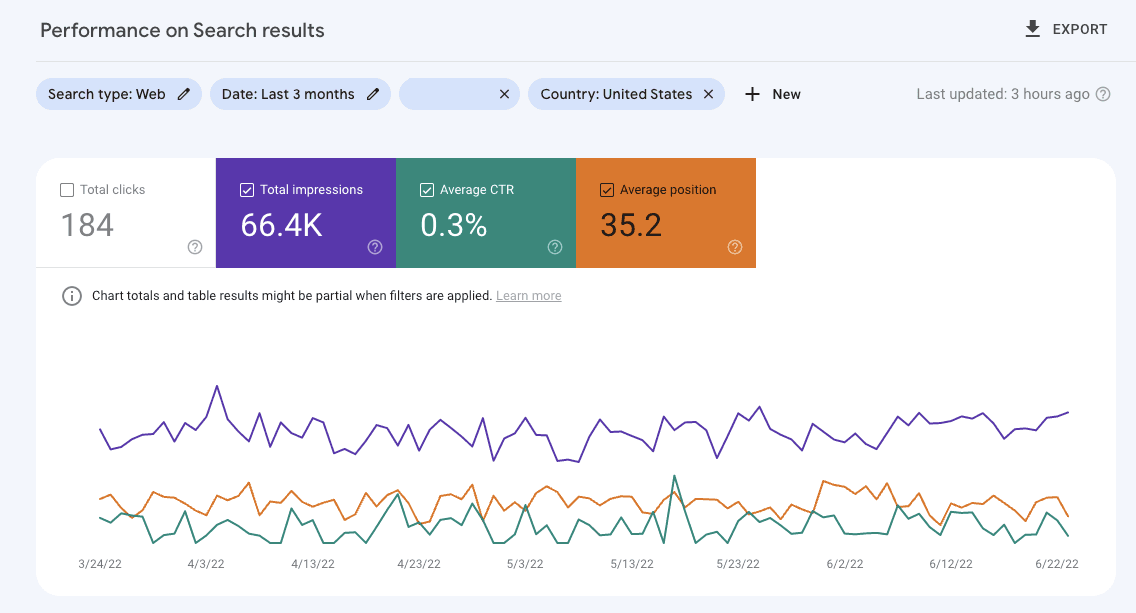
Google Search Console defines CTR the same way Ahrefs does, as click count divided by impression count. The Performance report adds another wrinkle that gets ignored far too often: the chart shows the average position of the topmost result from the entire site, while the table can break results down by queries, pages, countries, devices, search appearance, and dates.
That is useful because it gives account managers a clean way to separate site-wide health from page-level performance. If a client wants to know why traffic slipped, you can move from a vague complaint to a specific diagnosis: did CTR fall across query groups, did a device segment underperform, did search appearance change, or did the page simply lose ground on the queries that mattered most? The benchmark becomes actionable only when you use those slices.
What the 1% to 2% range really means
The headline number is helpful, but it is not a universal pass-fail grade. Ahrefs says whole-site CTR varies a lot by industry, Domain Rating, and site size, which is exactly why a single benchmark chart can mislead more than it helps. A large site with broad informational coverage may look very different from a focused niche property, even if both are executing well.
For forecasting, that means you should build expectations around the client’s own search mix, not a generic curve. If the account has lots of informational queries, a lower CTR may be entirely normal. If the site leans into commercial queries with stronger intent, then the same 1% to 2% range may understate the opportunity. The benchmark is a floor for sanity, not a ceiling for ambition.
Why AI Overviews changed the conversation
The old assumption in SEO was simple: more impressions should eventually produce more clicks. That assumption is getting weaker as Google layers in AI Overviews and other answer-first formats. Google said on May 14, 2024 that AI Overviews would begin rolling out to everyone in the U.S., with hundreds of millions of users getting access that week and more than a billion expected by the end of 2024.
Google now says AI Overviews are being made available to more users, in more languages and regions. It also says the feature cannot be turned off entirely, although users can choose the Web filter to show only text-based links. Google Search Central says there are no special optimizations required to appear in AI Overviews or AI Mode beyond foundational SEO best practices, which is another way of saying the same old technical checkbox mindset will not save a weak search strategy.
Ahrefs’ own February 2026 analysis sharpened the point. Looking at 300,000 keywords, split into 150,000 with AI Overviews and 150,000 informational keywords without them, it found that AI Overviews correlated with a 58% lower average clickthrough rate for the top-ranking page. That does not mean SEO is dead. It means the SERP is doing more of the answering before the click ever happens.
How to use CTR benchmarking with clients
The practical move is to turn CTR from a vanity line into a diagnostic tool. When an account is under pressure, segment the data by query type, ranking band, and SERP context before you start rewriting pages or blaming content quality. If the drops line up with AI Overviews, answer boxes, or richer search features, you have a SERP problem first and a content problem second.
A useful reporting stack looks like this:
- Benchmark whole-site CTR against the 1% to 2% healthy range, then break it by industry, Domain Rating, and site size.
- Compare performance by query class, especially informational versus commercial intent.
- Watch ranking bands separately, because a page sitting at position 3 behaves very differently from one sitting at position 9.
- Review search appearance and device mix, since those can change click behavior without any change in content quality.
- Track title-tag tests against the queries that matter, not just against site-wide averages.
That last point is where agencies can win real trust. If you are testing title tags, compare them against the query set and SERP layout they actually live in, because a title rewrite that works on a clean SERP may do almost nothing on a crowded one. CTR testing only becomes useful when it is attached to the right ranking band and the right search features.
The broader zero-click reality
Ahrefs’ benchmark lands in a search environment that is already sending fewer clicks outward than the old model assumed. SparkToro’s July 1, 2024 zero-click study found that for every 1,000 Google searches in the U.S., only 360 clicks went to the open web. That is the backdrop every account manager is working in now: more answers are being handled inside search, and the click is no longer the default outcome.
That is why the smartest reporting now sounds less like, “Why aren’t we getting rank-one CTR?” and more like, “What kind of clickthrough is realistic for this query mix in this SERP?” Ahrefs’ benchmark gives agencies a much better answer, because it replaces theoretical curves with real account data. Once you frame the work that way, low traffic is no longer automatically a sign of weak execution. Sometimes it is just the market, the SERP, and Google’s own answer layer doing what they do now.
This article was produced by Prism’s automated news system from verified source data, official records, and press releases, then run through automated quality and moderation checks before publishing. The system is built and supervised by the people who set the standards it runs under. Read our full AI policy.
Did this article answer your question?