Ahrefs says AI keyword research works best with real search data
AI can speed keyword research, but only when it’s fed real search data. Ahrefs’ warning is simple: without live metrics, chatbots can confidently invent SEO facts.
The fastest way to break keyword research is to let a chatbot improvise. Ahrefs’ guide makes the warning plain: if the model cannot see live keyword data, it can still sound certain while inventing the numbers, intent, and opportunity signals that teams actually need.
Why chatbot-only research falls apart
Ahrefs frames the problem as a trust issue, not a novelty issue. General AI tools are good at language, pattern matching, and summarizing what you give them, but they do not naturally know what is ranking, what is searched, or what is worth targeting unless they are connected to a real database. That matters because keyword research is supposed to reduce uncertainty, not add polished guesses to the pile.
The practical failure mode is easy to recognize. A chatbot can produce plausible keyword clusters, suggest search intent, and even describe a competitive landscape, but those outputs are only useful if they are anchored to actual volume, difficulty, and SERP data. Ahrefs’ point is that AI should accelerate the repetitive work around research, not replace the evidence that makes the research worth doing in the first place.
The three setups that actually work
Ahrefs lays out three useful ways to build AI into keyword research, and the difference between them is whether real data is present when the model is asked to think.
General AI assistants, used with your own data
Tools like ChatGPT, Claude, Gemini, and Copilot are strongest when you already have exports from keyword tools, SERPs, or analytics platforms. In that setup, AI can sort ideas, clean up noisy spreadsheets, cluster terms by intent, and surface patterns that would take a human much longer to see by hand.
That is the right role for a language model in research: analysis at speed. It is not the source of truth. It is the assistant that helps you move from raw lists to decisions faster.
AI-powered SEO tools with databases built in
The second setup is more integrated. Ahrefs describes tools that combine keyword databases with AI assistance, which means the model is not freelancing in the dark. It can work with the numbers already inside the platform, which makes idea generation and prioritization much more reliable.
Ahrefs’ own product language points to the scale of that approach. Keywords Explorer says it can tap into 28.7 billion topics for keyword research, generate thousands of keyword ideas, and use instant clustering and reliable metrics to help pick winners. That changes the job from hunting for keywords one by one to choosing among properly structured opportunities.
AI plus MCP, where the model can query live data mid-conversation
The newer model Ahrefs highlights is the AI plus MCP workflow. Ahrefs says its MCP lets AI agents securely access its API and enrich answers with live Ahrefs data, and its help center says the server works with ChatGPT, Claude, Copilot, and other tools without code.
That matters because it solves the most awkward part of chatbot research: the moment when a model needs fresh data but does not have a direct path to it. Ahrefs launched a remote MCP server in October 2025, and that gives agencies a way to keep the conversation fluid while still grounding the answer in live SEO and marketing information.
A repeatable workflow for agencies
The real value here is not a clever prompt. It is a process that turns AI into a speed layer on top of verified data.
1. Start with live keyword data from a tool like Keywords Explorer.
2. Feed the exported ideas, SERPs, and metrics into your AI assistant.
3. Ask it to cluster by intent, identify overlaps, and flag gaps.
4. Check the competition and the current SERP before deciding what belongs on the same page.
5. Use the output to shape content plans, messaging, and roadmap priorities.
That workflow keeps the creative parts of research fast while preserving the parts that have to stay true: search volume, difficulty, and the actual layout of the results page. It also makes the output usable beyond content planning, because agencies can translate the same research into retainer scoping, client opportunity discovery, and broader account strategy.
Why clustering is the quiet superpower
Ahrefs gives keyword clustering a central role, and for good reason. Clustering groups keywords with the same or similar intent so they can often be targeted on the same page. That saves time immediately, but it also keeps teams from building separate pages for terms that belong together.
This is where AI does some of its best work. Once it is given real keyword lists, it can sift through variations, spot theme-level overlaps, and help decide where one page can cover several related queries. Instead of manually wrangling spreadsheets all afternoon, a team can move straight to page mapping and content prioritization.
Why SERPs now matter even more than before
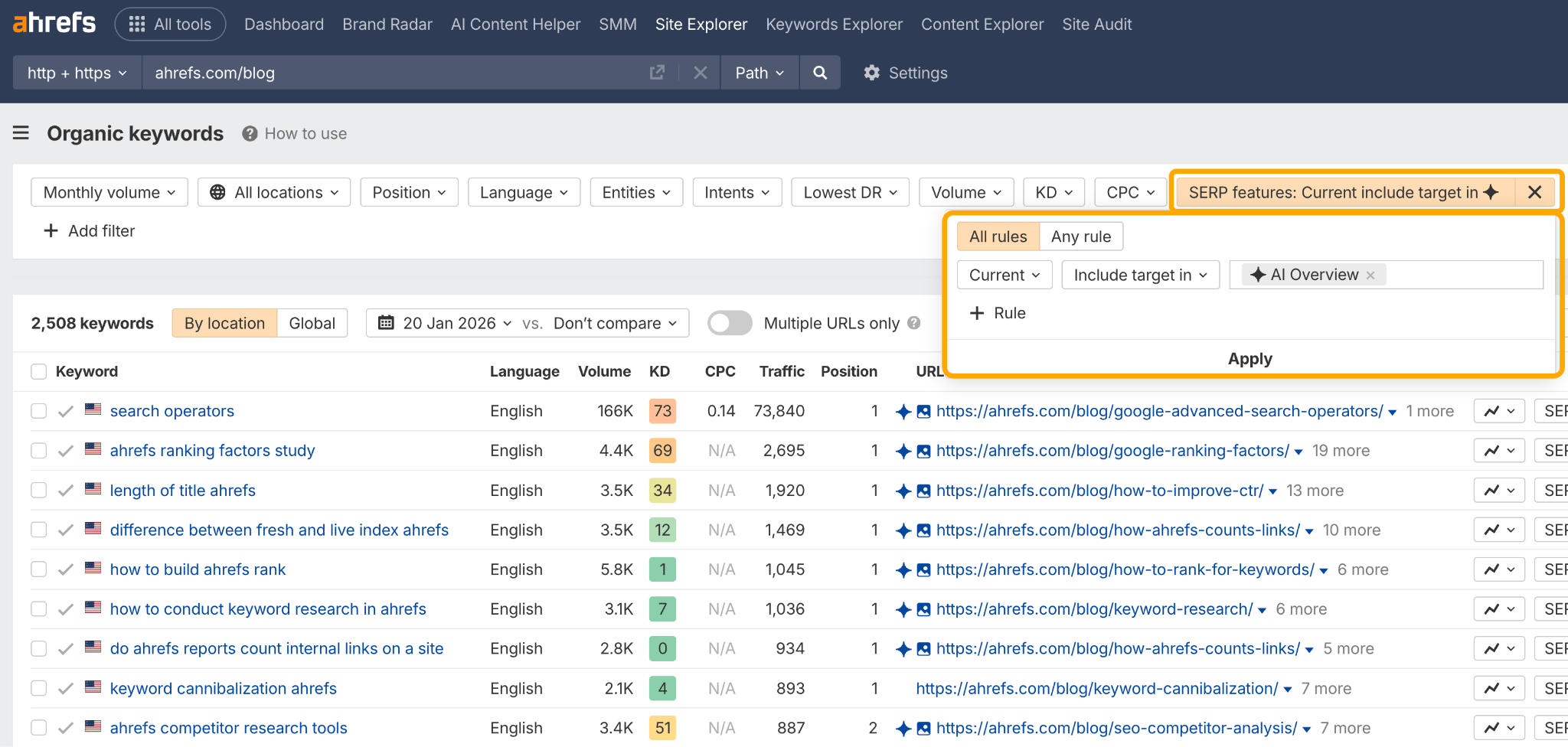
Ahrefs’ March 2026 study adds a bigger warning for anyone still treating organic rank as the whole story. Looking at 863,000 keyword SERPs and about 4 million AI Overview URLs, it found that only 38% of pages cited in Google AI Overviews also ranked in the top 10 organic results for the same query. Seven months earlier, that figure was 76%.
That gap changes how research has to work. If AI-generated search features are citing pages that do not always sit in the classic top 10, then ranking alone is no longer enough to predict visibility. Agencies now need to account for query intent, topic coverage, and citation behavior, not just blue-link position.
The takeaway is bigger than any single tool. AI can help you move faster, but only if the inputs are real enough to trust. Ahrefs’ broader AI stack is built around that idea, with support for reporting, keyword research, content creation, brand tracking, technical SEO, and localization. Its Agent A pushes the concept further, using an indexed dataset of 170T+ pages and connecting analytics, ads, and CMS data so recommendations stay tied to actual business context.
That is the standard AI keyword research has to meet now. Speed is useful, but speed without search data just creates cleaner hallucinations. The agencies that win will be the ones that let AI handle the heavy lifting, then force every recommendation back through live keywords, SERPs, and the realities of the market.
This article was produced by Prism’s automated news system from verified source data, official records, and press releases, then run through automated quality and moderation checks before publishing. The system is built and supervised by the people who set the standards it runs under. Read our full AI policy.
Did this article answer your question?