Semrush guide links Claude Code to Google data for live SEO analysis
Claude Code becomes far more useful when it sits on top of Search Console, GA4, and Semrush data, turning scattered exports into live SEO analysis.
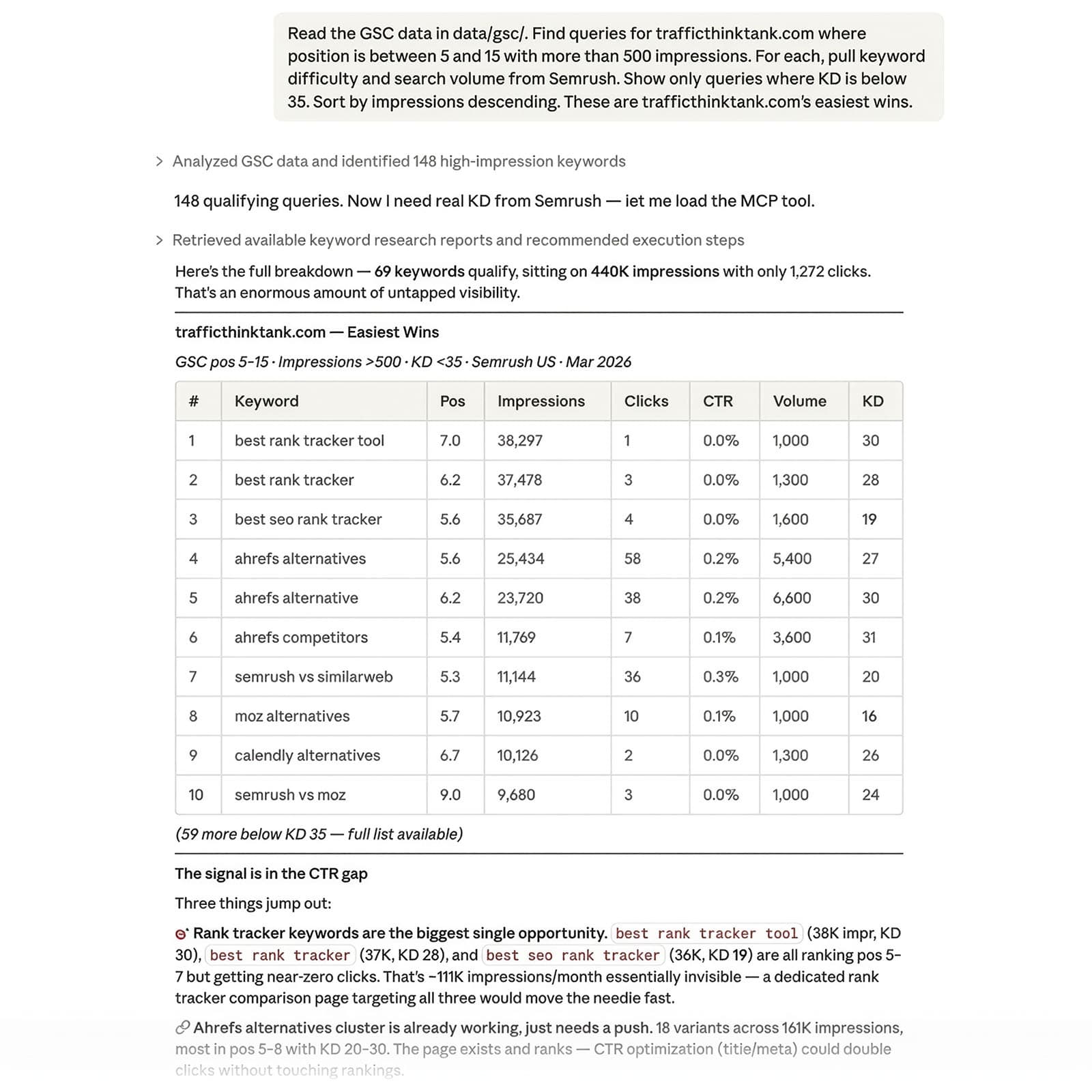
Claude Code turns scattered SEO data into one working analysis layer
The real shift in Semrush’s latest guide is not that AI can write faster reports. It is that Claude Code can sit on top of Google Search Console, Google Analytics, and Semrush competitive data and turn those separate feeds into something an agency can actually use in the middle of a client workflow. Instead of moving between dashboards, CSV exports, and one-off queries, the guide shows a setup where the model reads the data in plain English and helps generate a live dashboard that answers the questions teams already ask every day.
Semrush published the guide on April 30, 2026, and it lands squarely on a pain point any agency recognizes: the problem is rarely the absence of data, it is the friction of making sense of data that lives in too many places. The article frames Claude Code not as a replacement for analysis, but as a faster interpreter for trusted sources, especially when those sources include first-party Google data and Semrush’s own competitive intelligence.
Why Semrush is putting Claude Code in the analyst seat
Anthropic describes Claude Code as an agentic coding system built to read codebases, make changes, run tests, and deliver committed code. That matters here because Semrush is positioning it less like a chat box and more like a command layer for analysis. In the guide, the model is not asked to invent strategy from scratch. It is asked to help organize, query, and surface insight from structured SEO data so that the human strategist can move faster.
Semrush’s own MCP server is the bridge. The company says it gives AI agents secure access to Semrush’s public APIs and can be used with Claude, Claude Code, ChatGPT, Cursor, VS Code, Gemini, and Perplexity. That broader compatibility matters for agencies that already work across different environments, because the workflow is not locked to one interface. The underlying idea is consistent: let the AI agent pull live competitive and performance data, then present it in a way that is easier to act on.
The Google data layer is what makes the workflow practical
The Google side of the setup is what keeps the whole thing grounded. Google’s Search Console API allows performance data to be queried and grouped by dimensions such as page, query, country, and device. That gives teams the raw building blocks for audits that are more than surface-level dashboards. Instead of simply seeing traffic totals, an analyst can ask where visibility is changing, which pages are gaining or losing traction, and which devices or markets are behaving differently.
Google also says that linking Search Console to GA4 helps teams see how search queries and clicks translate into on-site behavior. That connection is what turns an SEO report into an operational one. It lets an agency trace the path from search performance to user engagement, which is exactly where a lot of reporting gets stuck when the data lives in separate systems. Semrush’s guide leans into that integration because it makes Claude Code useful for more than summarizing charts. It becomes a way to ask better questions about what is happening after the click.
Traffic Think Tank gives the guide a real-world anchor
The example site, TrafficThinkTank.com, keeps the guide from feeling abstract. Semrush acquired Traffic Think Tank on February 22, 2023, and said at the time that the business had more than 300 hours of content from over 90 industry experts, along with a members-only Slack community. The site still describes itself as an accelerator for SEO skills, network, and career, and as a private community for SEO professionals.
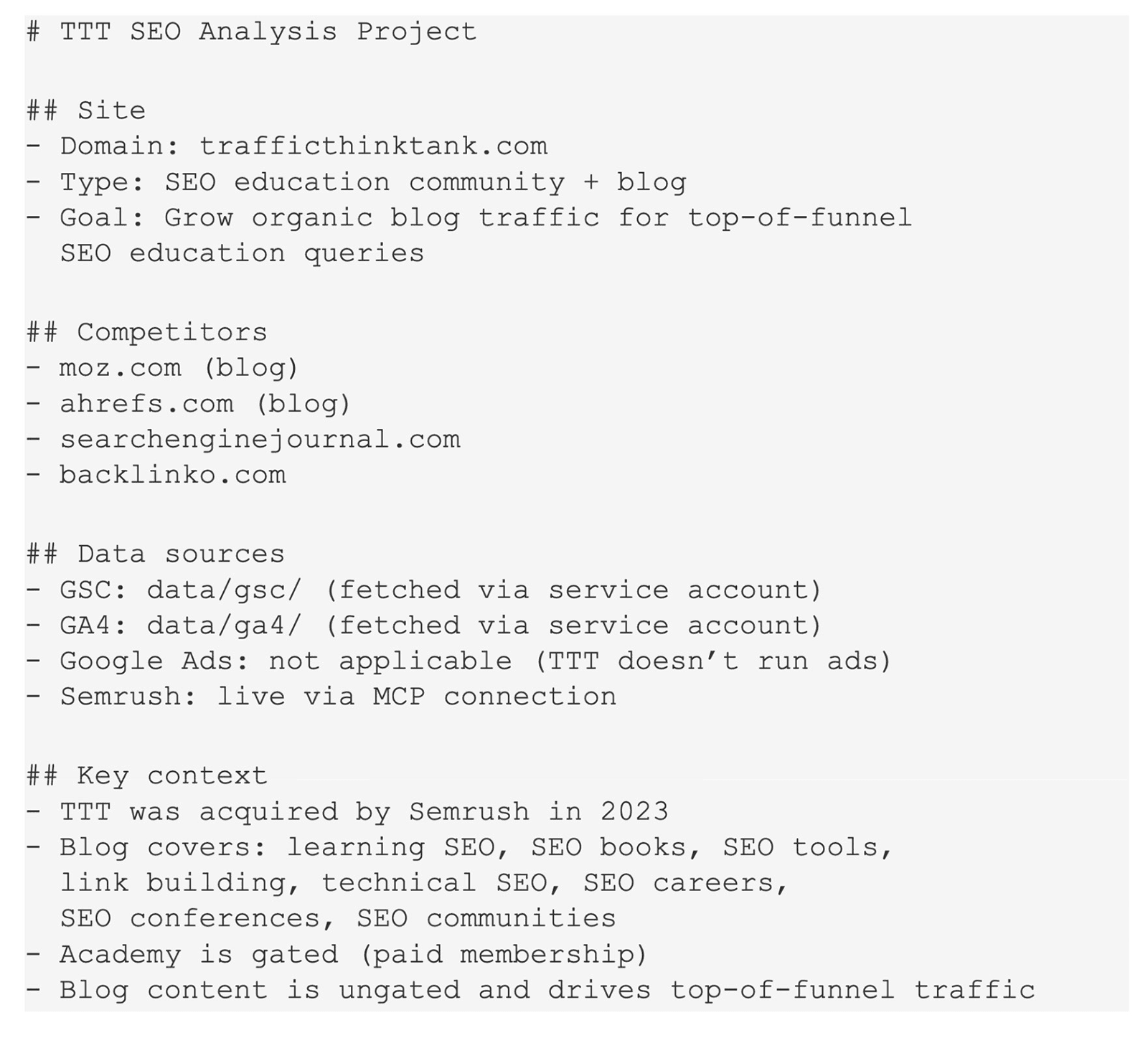
That history matters because the example comes from a property Semrush already knows intimately. It is not a random demo site chosen for convenience. Traffic Think Tank sits at the intersection of education, community, and practitioner training, which makes it a smart test case for showing how Claude Code can analyze content performance, audience behavior, and competitive context in one place. The guide’s practical edge comes from that familiarity: it is demonstrating an internal-style workflow on a site that lives inside the same broader ecosystem.
What agencies gain when the reporting layer gets thinner
The value here is not novelty. It is leverage. When Claude Code can summarize performance, identify issues, and help build dashboards that combine internal and competitive data, agencies spend less time stitching reports together and more time making decisions. That is a meaningful operational change, especially for teams that are trying to move from reactive reporting to faster audits and clearer recommendations.
Semrush’s SEO guidance already makes the business case for that kind of monitoring. The company says tracking results helps prove ROI to stakeholders, spot technical problems early, identify which content performs best, and watch competitors for new growth opportunities. Claude Code fits neatly into that framework because it compresses the time between data collection and interpretation. A strategist can move from raw query data to a prioritized action list without rebuilding the entire analysis by hand.
For client work, that can change the rhythm of a review. Instead of a report that merely describes what happened, the workflow can produce a sharper read on what deserves attention now: pages that are slipping, queries that need stronger landing pages, countries or devices showing unusual patterns, and competitors that are pulling ahead in visible areas. The agency still owns the judgment. Claude Code just clears away some of the manual labor that slows the judgment down.
The larger story is about AI visibility, not just AI writing
Semrush’s recent publishing around search has increasingly centered on AI visibility, including AI search optimization and generative engine optimization for systems like ChatGPT, Perplexity, Google AI Overviews, and Claude. That framing shows where the company sees the market heading. Search is no longer just about ranking pages; it is also about understanding how AI systems interpret, surface, and summarize information.
That is why this guide matters beyond the specific tools involved. It suggests that the next stage of SEO efficiency may come from analysts and strategists using AI as an interface to first-party and competitive data, not simply as a content generator. Claude Code becomes useful precisely because it can interpret trusted datasets instead of replacing them. For agencies, that is the kind of shift that improves audits, speeds up opportunity analysis, and makes client recommendations easier to defend.
The enduring takeaway is straightforward: the strongest SEO teams will not be the ones with the most data, but the ones that can turn Search Console, GA4, and Semrush exports into decisions quickly. Claude Code, in Semrush’s setup, is built to help make that leap.
This article was produced by Prism’s automated news system from verified source data, official records, and press releases, then run through automated quality and moderation checks before publishing. The system is built and supervised by the people who set the standards it runs under. Read our full AI policy.
Know something we missed? Have a correction or additional information?
Submit a Tip