AI Automation Threatens Agency Execution Roles, Strategy Becomes Survival Key
Forrester now projects a 15% cut to the US ad workforce by year-end as AI automates execution; agencies that productize strategy into audits, sprints, and governance can survive and multiply their worth.
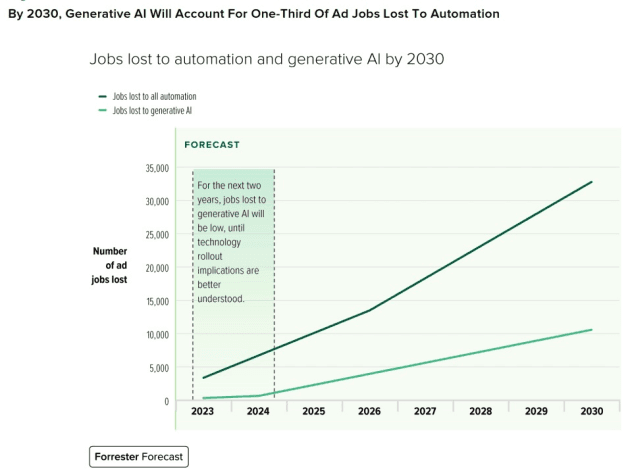
The number that should keep agency principals awake is 15. That is the percentage by which Forrester, the research and advisory firm, now projects the U.S. advertising workforce will shrink by the end of 2026, up from its earlier estimate of 7.5% by 2030. The revision did not happen because the original forecast was wrong; it happened because automation moved faster than anticipated. For SEO agencies built on a foundation of deliverables, the implication is blunt: execution is becoming a commodity, and commodity pricing is a race to the bottom that no human team can win against a machine running at scale.
The Execution Layer Is Already Gone
The tools displacing junior agency roles are not hypothetical. Google's AI Overviews, which synthesize search answers above organic results, appeared for just 6.49% of queries in January 2025, peaked at nearly 25% in July, and settled at around 15.69% by November. AI agents now account for roughly 33% of organic search activity. Meanwhile, platforms like Surfer SEO, Jasper, and ChatGPT have reduced content drafting, keyword clustering, and on-page optimization from billable hours to a matter of minutes. The tasks that once justified a three-person content team, producing briefs, generating drafts, running technical audits, can now run as automated workflows while the team sleeps.
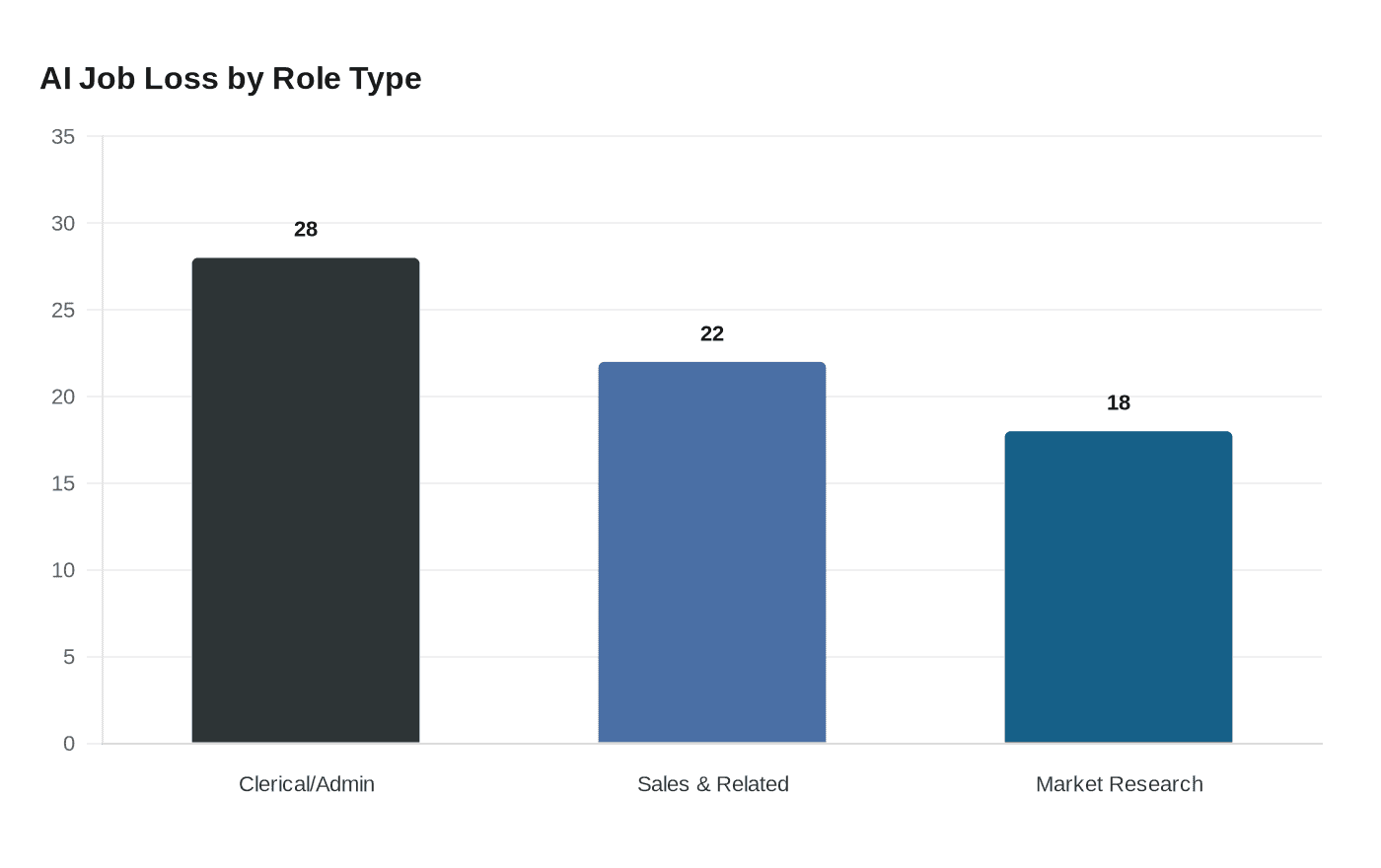
Forrester's analysis finds that clerical, secretarial, and administrative roles carry the heaviest burden, representing 28% of projected job losses, followed by sales and connected roles at 22%, and market research and connected roles at 18%. The roles most people assumed would be first on the chopping block, creative writers and editors, are actually forecast to survive, because Forrester finds that originality is the most significant factor separating human output from machine output. The irony is sharp: the agency headcount most exposed is not the creative team but the operational backbone that processes, publishes, and reports.
AI educator and consultant Britney Muller put the strategic confusion directly: "The biggest risk to our industry in 2026 isn't AI; it's that we're trying to fit a baseball bat through a keyhole by applying SEO ranking logic to probabilistic systems." The agencies still optimizing for keyword density in a world governed by AI citation and retrieval-augmented generation are not just inefficient; they are selling a product the market no longer needs.
The Programmatic Parallel
This is not the first time automation has forced an agency identity crisis. In the early 2010s, programmatic advertising eliminated entire trading desks and media-buying roles that had been built on manual negotiation and insertion orders. Agencies that survived did not do so by buying more efficient ad-buying software; they survived by becoming indispensable advisors on audience strategy, brand safety governance, and media mix modeling. The agencies that insisted on competing with the machines on execution simply could not sustain margins. The current AI disruption follows the same structural logic, only faster and across more service lines simultaneously.
What Strategy Actually Means Now
Enterprises must establish internal governance and alignment on AI use for SEO and content, which means using AI for insights, creation, optimization, and scale automation while maintaining human oversight for strategy, quality control, and brand voice. That distinction, governance and oversight versus production, is the precise gap that agencies need to occupy. It is not enough to say "we do strategy." The agencies that will command premium rates are those that can operationalize strategy into a product a client can buy, evaluate, and renew.
Forrester forecasts that digital marketing and strategy specialists will expand headcount by more than 20% by 2028, and 56% of U.S. B2C CMOs have already used generative AI in marketing, with another 40% exploring it. Those CMOs do not need an agency to run the tools. They need an agency to tell them which tools to run, in what configuration, against which business objective, and with what governance guardrails in place.
Productizing the Strategy: Packages That Sell
The strategic pivot only generates revenue if it is packaged into something a client can actually purchase. Four formats have emerged as the most defensible and scalable:
- Strategy Sprint (Fixed-Fee): A two-to-four-week engagement, priced as a flat project fee, that delivers a prioritized roadmap rather than ongoing execution. Typical scope includes a competitive audit, AI-readiness assessment, and a 90-day action plan. The fixed-fee structure removes the billable-hour race-to-the-bottom dynamic and lets the agency price on value delivered rather than time spent. Based on current AI consulting benchmarks, setup projects of comparable scope are priced between $2,500 and $15,000 depending on business complexity and competitive landscape depth.
- Quarterly Growth Planning Session: A recurring workshop format where the agency facilitates strategic alignment between the client's marketing, product, and leadership teams. Structured as a half-day or full-day session, this format prices well as a group offering. A one-day workshop priced at $497 per seat for 20 attendees generates nearly $10,000 in a single engagement, with the added benefit that participants self-select as high-intent buyers of downstream advisory work.
- AI Governance Audit: A standalone audit product that evaluates how a client's existing content and SEO workflows interact with AI-generated search features, citation systems, and retrieval-augmented generation layers. Delivered as a written memo with scored findings and remediation priorities, this is the agency equivalent of a legal compliance audit: clients buy it because the cost of not knowing exceeds the cost of the engagement.
- Decision Memo Retainer: A monthly advisory retainer, structured not around deliverables but around access to strategic judgment. The agency produces a fixed number of written decision memos per month, each addressing a specific business question (channel allocation, content investment, technical priority). Monthly retainers for this model range from $5,000 to $25,000 depending on seniority and scope, benchmarks that reflect current AI consulting advisory rates.
The Proof Problem: What Justifies Premium Rates
Packaging strategy is necessary but not sufficient. Clients have been burned by consultants who repackage common sense as proprietary methodology and disappear after the invoice clears. Commanding rates at the high end of the advisory spectrum requires three categories of proof:
Case studies with business outcomes. Not traffic graphs. Revenue impact, pipeline growth, or cost-per-acquisition improvement attributable to a strategic recommendation. Building workflows that combine AI speed with human expertise and storytelling is the operational model, but the proof layer is the business result that followed when a client executed the recommendation. Agencies without outcome-linked case studies are selling credentials, not proof.
Benchmarks that clients cannot generate themselves. Proprietary data, aggregated across client engagements, is the clearest moat an agency can build. If an agency can say "across 40 e-commerce clients, brands that invested in AI-citation optimization saw a 22% increase in branded search volume within six months," that benchmark is impossible for a solo CMO with one data set to replicate or refute. Building that benchmark library is a long-term investment, but it is precisely what separates a $2,500 strategy sprint from a $15,000 one.
Forecasting, not reporting. The reporting layer, dashboards, monthly traffic summaries, keyword ranking exports, is the first casualty of automation. Clients can generate those reports themselves with any number of off-the-shelf tools. What they cannot easily generate is a forward-looking model that projects the revenue impact of a proposed strategy shift, or quantifies the risk of inaction. Agencies that build simple but credible forecasting frameworks into their deliverables reposition themselves as decision-support partners rather than backward-looking scorekeepers.
The 10x Argument
The framing that agency leaders are using internally, that strategy-led positioning can multiply an agency's effective worth by a factor of ten compared to execution-based billing, is rooted in a straightforward math. An SEO content writer billing at $75 per hour competes against AI tools that produce a comparable draft for under a dollar. An AI governance consultant billing at $300 per hour, backed by a proprietary benchmark set and a documented track record of business-outcome improvements, has no machine competitor. The labor economics do not overlap. The ceiling on strategy-led pricing, with retainers reaching $25,000 per month for senior advisory roles, exists in a different market than the race-to-the-bottom content treadmill. Getting there requires dismantling the deliverable-first identity that most agencies were built on, which is the harder problem. But the agencies that moved first after programmatic disrupted media buying are the holding companies and independent powerhouses still standing today. The pattern is already written.
This article was produced by Prism’s automated news system from verified source data, official records, and press releases, then run through automated quality and moderation checks before publishing. The system is built and supervised by the people who set the standards it runs under. Read our full AI policy.
Did this article answer your question?