AI search becomes measurable, forcing agencies to prove customer discovery
AI search is moving from visibility theater to pipeline proof, and agencies now have to connect AI-driven discovery to calls, CRM tags, and revenue.
AI search is forcing agencies to prove that discovery turns into customers, not just impressions. A June 29 Search Engine Land piece backed by CallRail data makes the shift plain: nearly 30 million inbound calls and leads now show AI search leaving a measurable trail, even if the channel still represents a small slice of total volume.
From visibility to attribution
The real change is not that ChatGPT, Perplexity, Gemini, or Claude are entering the research journey. It is that marketers can no longer treat those touchpoints as invisible background noise and still claim a complete funnel view. CallRail says AI search can create attribution blind spots because people who research in AI tools often appear later as direct traffic or as unattributed visits in analytics.
That is where agencies earn or lose trust. If a client hears that AI search is helping discovery but the reporting deck stops at mentions, citations, or visibility, the story stays fuzzy. If the same agency can connect AI exposure to calls, leads, branded search lift, and revenue, the conversation changes from speculation to proof.
The numbers are small, but they are moving
CallRail’s January 27, 2026 analysis looked at nearly 20 million inbound leads and found that AI search tools were already affecting which businesses consumers chose to contact. By late June, that dataset had expanded to nearly 30 million inbound calls and leads, and the company said AI-generated leads still made up a small share of total volume while growing steadily.
The trend line matters more than the absolute share. CallRail said the share of inbound calls influenced by AI search rose from 0.073% in November to 0.095% in March, a 30% increase in four months. That is still a narrow channel, but it is narrow and rising, which is exactly the kind of pattern agencies should be building into monthly reporting before clients start asking why the leads they are seeing do not match the traffic they are counting.
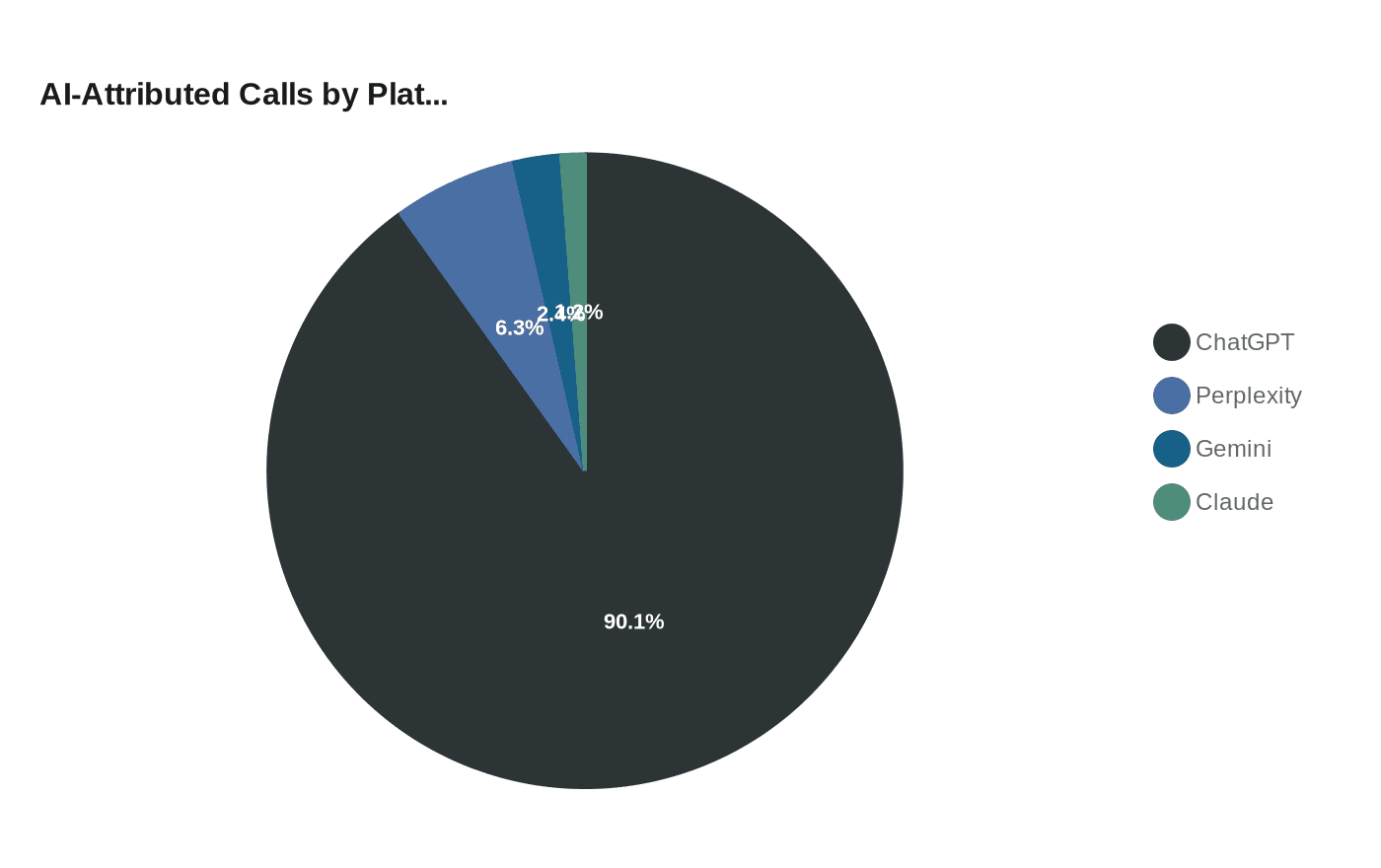
Platform mix matters too. In CallRail’s January 2026 analysis, ChatGPT accounted for 90.1% of AI-attributed calls, Perplexity 6.3%, Gemini 2.4%, and Claude 1.2%. That distribution tells agencies where the behavior is concentrated today, and it also makes clear that the channel is not monolithic. Each platform shapes search behavior differently, so a single AI-search line item in a dashboard is too blunt to explain what is actually happening.
Consumer behavior has already moved ahead of reporting
The demand side is not waiting for measurement models to catch up. A June 2026 Search Engine Land and Fractl survey of 1,008 consumers and 150 marketers found that 70% of consumers said they were using AI tools for search more than they did last year. In the same survey, 54% still said AI search was more helpful than traditional search, down from 82% a year earlier.
That drop matters because it shows the channel is being normalized, not celebrated. People are using AI more often, but they are also becoming less willing to crown it as a replacement for traditional search. For agencies, that means AI search should be treated as part of the discovery stack, not as a standalone miracle that replaces SEO, paid search, or branded demand capture.
McKinsey’s October 2025 research pushes the same point further. It said 50% of consumers already use AI-powered search, projected that 20% to 50% of traffic could be at risk from traditional search as decisions move earlier in the journey, and estimated that $750 billion in U.S. consumer spend could flow through AI-powered search by 2028. Those figures are large enough to justify a new reporting discipline, even if the current AI-attributed call share is still small.
Google has visibility data, but not the whole answer
Google’s June 3, 2026 rollout of dedicated Search Generative AI performance reports in Search Console gives agencies a first-party place to start. The reports surface impressions, pages, countries, devices, and dates for AI Overviews and AI Mode, which is a real step forward from guessing how often AI surfaces content in search.
But the reports stop short of the number agencies actually need to defend budget: click data. That leaves a gap between exposure and outcome, and it pushes the burden back onto the agency to connect Search Console visibility to downstream evidence from call tracking, CRM source fields, and revenue attribution.
What agencies should measure now
If AI search is going to live in client reporting, the stack has to widen. The goal is not to create a vanity metric for AI visibility. The goal is to show when AI-assisted discovery becomes a sales conversation, a booked call, or a closed deal.
The reporting model should include:
- Assisted conversions, not just last-click conversions
- Branded search lift after AI visibility increases
- CRM source tagging that captures AI-influenced paths
- Call tracking tied to landing pages and lead records
- AI-referral patterns that separate direct traffic from research-driven visits
- Search Console exposure data for AI Overviews and AI Mode
- Revenue attribution that connects leads to opportunities and closed business
That mix turns a fuzzy channel into something a client can actually manage. A branded search lift after a spike in AI visibility is not proof by itself, but it is a useful signal. So is a pattern of more direct visits that later match booked calls in the CRM, especially when Search Console shows the page appearing in AI-driven results on the same dates.
The agency opportunity is in the plumbing
The agencies that win here will not be the ones talking loudest about AI search. They will be the ones who can show a clean chain from exposure to call to pipeline, using Search Console, call tracking, CRM source fields, and revenue reporting in the same view. That is a service line, not just an analytics task.
It also changes how account teams talk to clients. Instead of selling a vague promise that AI search is "important," the agency can show the exact pages surfaced in Search Console, the dates they appeared, the call patterns that followed, and the leads that reached the CRM. In a market where AI search is becoming measurable, the agencies that can prove customer discovery will be the ones that keep the budget.
This article was produced by Prism’s automated news system from verified source data, official records, and press releases, then run through automated quality and moderation checks before publishing. The system is built and supervised by the people who set the standards it runs under. Read our full AI policy.
Did this article answer your question?