SEO agencies win AI citations by mapping buyer evidence gaps
SEO agencies can win AI citations by closing evidence gaps the buying committee never spells out. The winning work is stakeholder mapping, not keyword volume.

Google says AI Overviews are available in more than 200 countries and territories and more than 40 languages, and that in its biggest markets they drove over a 10% increase in usage of Google for query types that show AI Overviews. For SEO agencies selling into complex B2B accounts, that changes the assignment: map the buyer roles, identify the missing gatekeeper, and build the proof that both search systems and human approvers can trust.
Why keyword targeting is no longer enough
Google Search Central says generative AI features in Search are rooted in core ranking and quality systems, and that they use retrieval-augmented generation plus query fan-out. AI visibility is not detached from classic SEO; it is layered on top of it.
Pages that merely repeat common category language will not carry enough weight. Google’s guidance to create valuable, non-commodity content, and to focus on unique, satisfying content, pushes teams away from mass-produced filler and toward material that adds something specific, defensible, and difficult to copy.
The buying committee is the hidden distribution channel
Forrester’s December 2024 B2B research found that 86% of B2B purchases stall during the buying process, 81% of buyers are dissatisfied with their chosen providers, and almost 95% expect to use genAI to support their decision and purchase process in the next 12 months. The same research found that the average B2B buying decision involves 13 people and that 89% of purchases involve two or more departments.
The unit of persuasion is no longer a single persona page. Gartner’s May 2025 research found that 74% of B2B buyer teams demonstrate unhealthy conflict during the decision process, based on a survey of 632 buyers conducted in August through September 2024. Gartner found that buying groups range from five to 16 people across as many as four functions, and that consensus-relevant content can improve buying-group consensus by 20%, while content focused on individual-level relevance can have a 59% negative impact on consensus. Buying groups that reach consensus are 2.5 times more likely to say the deal was high-quality.
| Buying reality | What the research shows | Agency implication |
|---|---|---|
| Purchase motion | 86% of B2B purchases stall | Content has to help the deal move, not just attract clicks |
| Buyer satisfaction | 81% are dissatisfied with chosen providers | Trust signals and proof points matter before and after selection |
| Decision structure | 13 people on average, 89% across two or more departments | Build for multiple approvers, not one champion |
| Group dynamics | 74% of buyer teams show unhealthy conflict | Content must reduce disagreement across functions |
| Content effect | Consensus content improves agreement by 20% | Assets should align the group around shared evidence |
| Content risk | Individual-level relevance can hurt consensus by 59% | Persona-only content can backfire in complex deals |
If finance, security, procurement, operations, and the eventual users all need different proof, the content system has to supply those proofs in a coordinated way.
What stakeholder co-citation gap analysis does
Stakeholder co-citation gap analysis starts with a different question than keyword research: which experts, brands, standards, and proof points need to appear together before a market will trust the answer? Instead of asking only whether a page can rank, it asks whether the brand is already embedded in the evidence network that AI systems and human reviewers treat as credible.
Citation Labs has been running co-citation analysis on the link graph for 15 years and points back to a six-step co-citation method published in 2011. That reframes SEO from anchor text and page-by-page optimization to anchor context, the surrounding network of sources that tells a search system what belongs together.
For agencies, the missing gatekeeper is often invisible until you map the room. The blocker may be the security reviewer who needs technical validation, the finance approver who needs commercial proof, or the operations leader who needs implementation detail. If the evidence for those roles never appears alongside the brand in search and AI ecosystems, the deal can stall long before a formal vendor evaluation begins.
How agencies turn the idea into a commercial offer
1. Map the buying group by function, not just by persona.
Use the Forrester and Gartner numbers as the baseline assumption: multiple departments, multiple approvers, and a lot of room for conflict.
2. Audit the evidence gaps.
Identify which experts, brands, standards, and third-party references already sit near the category in search and AI answers, and which ones are missing. That missing space is where agency work creates value.
3. Build consensus-relevant content.
Gartner’s data rewards content that helps the group agree, not content that only flatters one role. In practice, that means cross-functional proof, implementation detail, and clear tradeoff analysis.
4. Design for AI retrieval as well as human reading.
Google says AI features rely on core ranking systems, retrieval-augmented generation, and query fan-out, so the material has to be useful, specific, and difficult to dismiss as commodity copy.
5. Test the citation landscape in more than one mode.
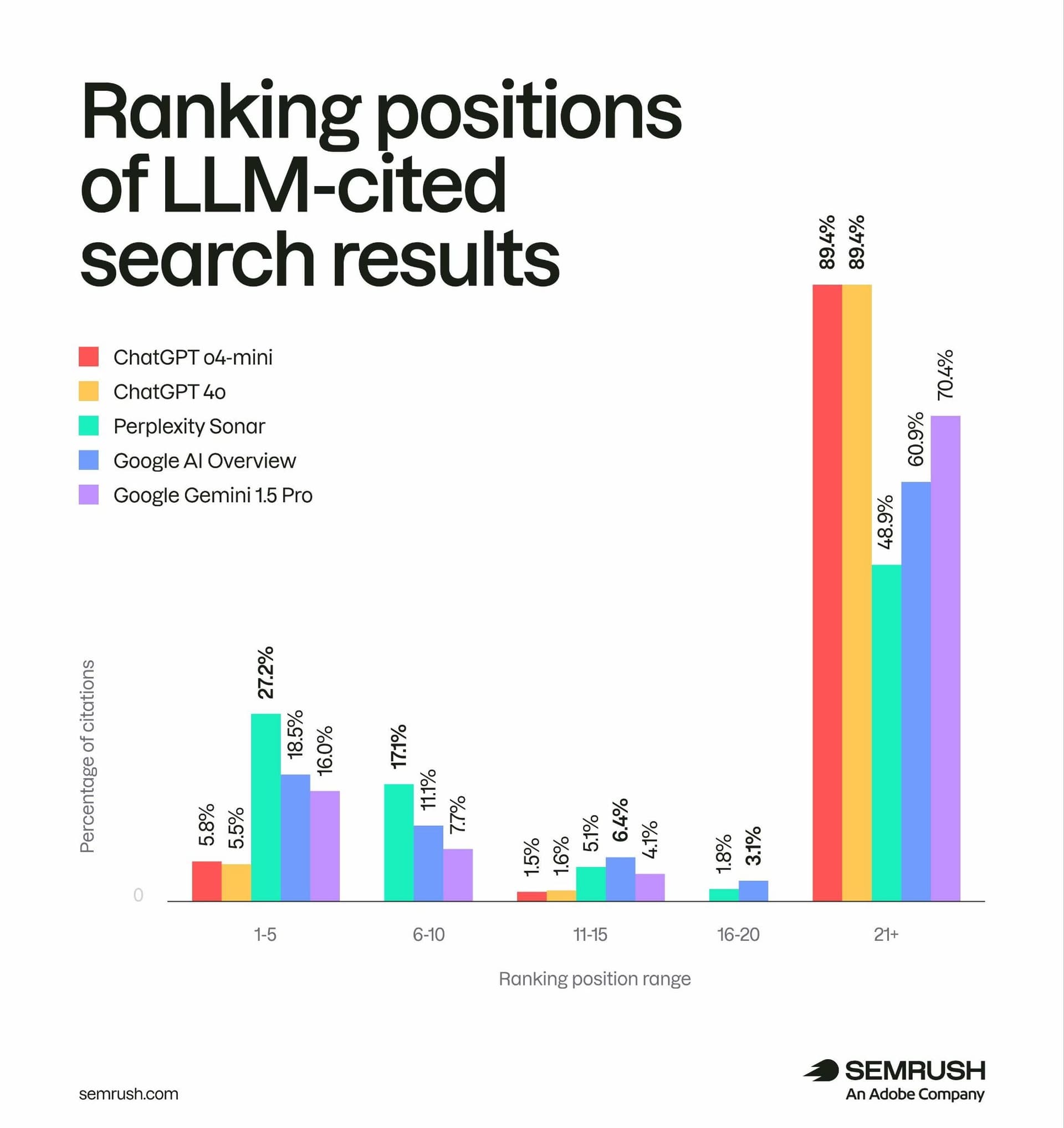
Semrush found that ChatGPT’s minimal and high-reasoning modes had only 25.6% overlap in cited domains across the same prompts, while citation rates rose from 50% to 68% in high-reasoning mode. It also found a shift toward government, academic, and official documentation.
This article was produced by Prism’s automated news system from verified source data, official records, and press releases, then run through automated quality and moderation checks before publishing. The system is built and supervised by the people who set the standards it runs under. Read our full AI policy.
Did this article answer your question?