AI search forces agencies to move beyond the old SEO bargain
Great content still matters, but AI search no longer pays it off automatically. Agencies now have to sell distribution, authority, and owned attention.
The bargain broke
The old SEO bargain is broken: great content no longer guarantees traffic, and AI search is making that painfully clear. If a page can be scraped, summarized, and answered away before a click happens, then publishing more articles is not a growth strategy. It is just more inventory in a market that is steadily rewarding influence over volume.

That is the strategic reset agencies need to internalize. The job is no longer to produce a pile of informational pages and hope rankings do the rest. The job is to build assets, audiences, and offers that still matter when the click never comes.
Why “good content” stopped being enough
Rand Fishkin made the argument bluntly in his May 25, 2026 SparkToro post, “Inimitable Product is the New ‘Make Great Content.’” His point was simple and uncomfortable: the old advice was incomplete, because marketers should be shifting away from great content on their own sites and toward great marketing on the platforms where their audience already pays attention.
That is a hard pill for agencies that still sell content production as the center of the universe. If your deliverable is just another article that explains a topic already covered 100 times, AI can flatten it into a summary and move on. The value now comes from work that is difficult to replicate, difficult to summarize away, and useful even when the reader never lands on your page.
Fishkin sharpened the point again in May 2026 with “5 Strategic Features that Predict Survival in the Zero-Click Era,” which drew on Cyrus Shepard’s analysis of 400 websites that did not collapse during what Fishkin called “the great traffic apocalypse of 2024-2026.” That language matters because it captures the shift agencies are living through: this is not a temporary dip in traffic, it is a structural change in how discovery works.
The click problem is not theoretical
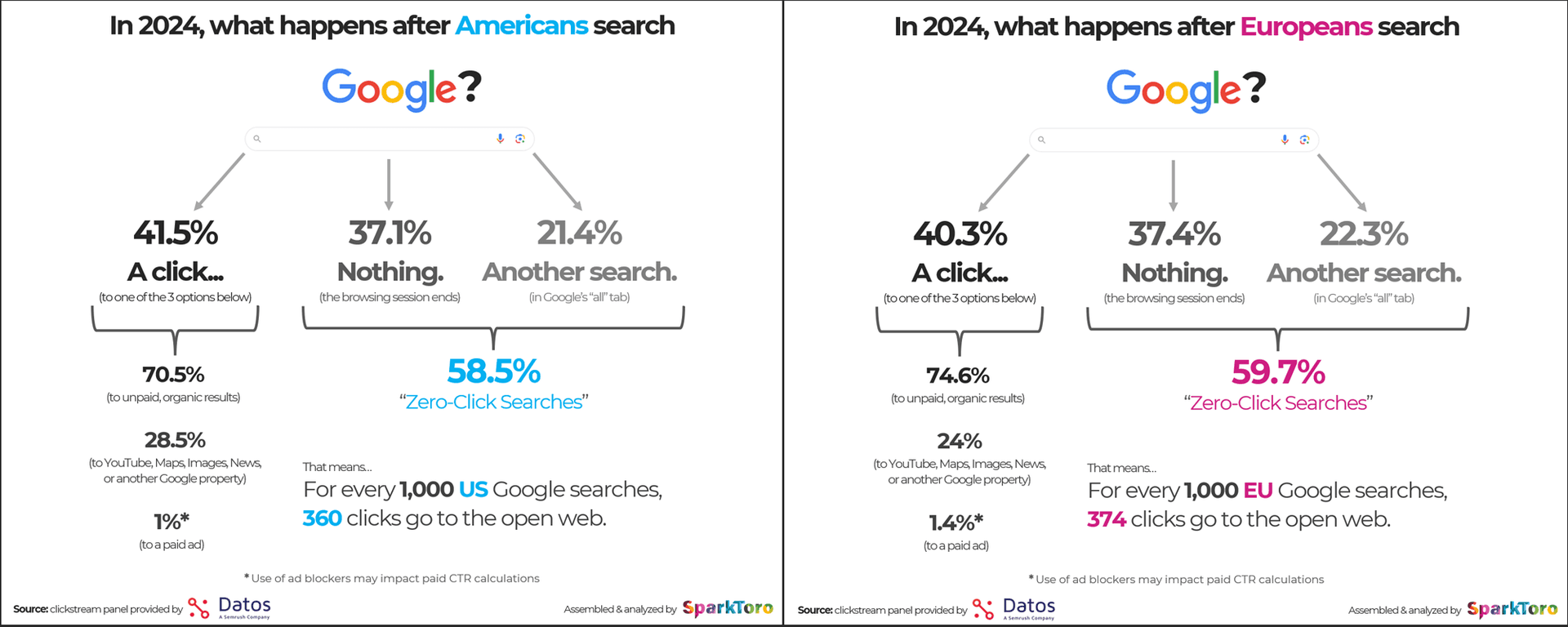
The traffic warning signs have been visible for a while. SparkToro’s 2024 zero-click study said that in the United States, only 360 of every 1,000 Google searches sent clicks to the open web. That means the majority of searches never reached an outside publisher in the first place.
The newer AI Overviews data only makes the pressure more concrete. Ahrefs reported in April 2025 that AI Overviews reduced clicks to top-ranking content by 34.5 percent, then later updated that figure to 58 percent as the feature expanded. Seer Interactive found that informational queries with AI Overviews saw organic CTR drop 61 percent and paid CTR fall 68 percent, while organic CTR was still down 41 percent even on queries without AI Overviews. Search Engine Land has also tracked the broader rise in zero-click behavior and the continuing loss of clicks across search.
For agencies, that combination is the real wake-up call. Ranking is no longer the same thing as reaching people, and visibility is no longer the same thing as value.
MIT’s labor maps point to the same shift
The search story lines up with what MIT is seeing on the labor side. The MIT Center for Transportation and Logistics says its AI Labor Exposure Map uses U.S. labor data and leading AI model capabilities to break work into activities and measure exposure across professions and regions. MIT Media Lab’s Project Iceberg goes even broader, modeling 151 million workers, 32,000 skills, 3,000 counties, and 13,000 AI tools, while its Iceberg Index estimates that about $1.4 trillion in U.S. wage bill could be affected if current AI capabilities reached full adoption.
That sounds ominous, but MIT Sloan adds an important corrective: exposure does not automatically mean layoffs. In one study, high-wage roles exposed to AI still saw their share of total employment grow by about 3 percent over five years, because AI improved productivity and helped firms grow.
That is the useful comparison for agencies. AI does not just erase work, it redistributes value toward organizations that can use it without becoming interchangeable. The agencies that survive will not be the ones producing the most pages. They will be the ones building judgment, differentiation, and distribution around work AI cannot easily commoditize.
What agencies should sell instead
The cleanest response is to stop selling SEO as a content treadmill and start selling it as a business-building system. Editorial strategy has to connect to original research, proprietary frameworks, brand voice, community building, and consultative offers. If the market can summarize your article in a search result, then the article itself is only one small part of the asset.
The practical shift looks like this:
- Build inimitable products, not generic explainers.
- Publish where the audience already spends time, not just on your own domain.
- Use third-party platforms to create demand for work that cannot be commoditized.
- Tie content to a point of view, a method, or a dataset that only your team owns.
- Treat owned audience growth, email lists, communities, and direct relationships as core SEO outcomes, not side projects.
That is how agencies reframe the value proposition. You are not promising more traffic for traffic’s sake. You are promising influence, which includes rankings when they still matter, but also attention, brand recall, and the ability to create demand outside the search results page.
Brand authority and entity building matter more now
This is where a lot of SEO shops still sound dated. They talk about volume, keyword coverage, and publishing cadence as if the web were still mainly a library catalog. AI search is turning it into a synthesis layer, which means recognizable entities, defensible expertise, and consistent brand signals carry more weight than a pile of near-duplicate articles.
That means agencies need to think like publishers and operators at the same time. Original research becomes valuable because it gives AI something harder to paraphrase cleanly. A distinctive voice matters because it helps people remember who said it first. Community matters because audiences who know you by name are not waiting for a search result to hand them an answer.
The agencies that get this will stop asking, “How many pages should we ship?” The better question is, “What do we own that no summary can replace?” That is the difference between feeding the machine and building a business.
The new SEO bargain
SEO is not dead, but the old bargain is. Publishing strong content on its own no longer guarantees traffic, growth, or even a fair shot at being seen. In the AI search era, the agencies that win will be the ones that can create defensible value: products, platforms, audiences, and authority that survive even when the click never arrives.
This article was produced by Prism’s automated news system from verified source data, official records, and press releases, then run through automated quality and moderation checks before publishing. The system is built and supervised by the people who set the standards it runs under. Read our full AI policy.
Did this article answer your question?