AI service firms command 30x valuations as agencies pivot to outcomes
AI-native service firms are being priced like software, while SEO agencies still trade like labor. The gap closes when the business sells outcomes, not hours.
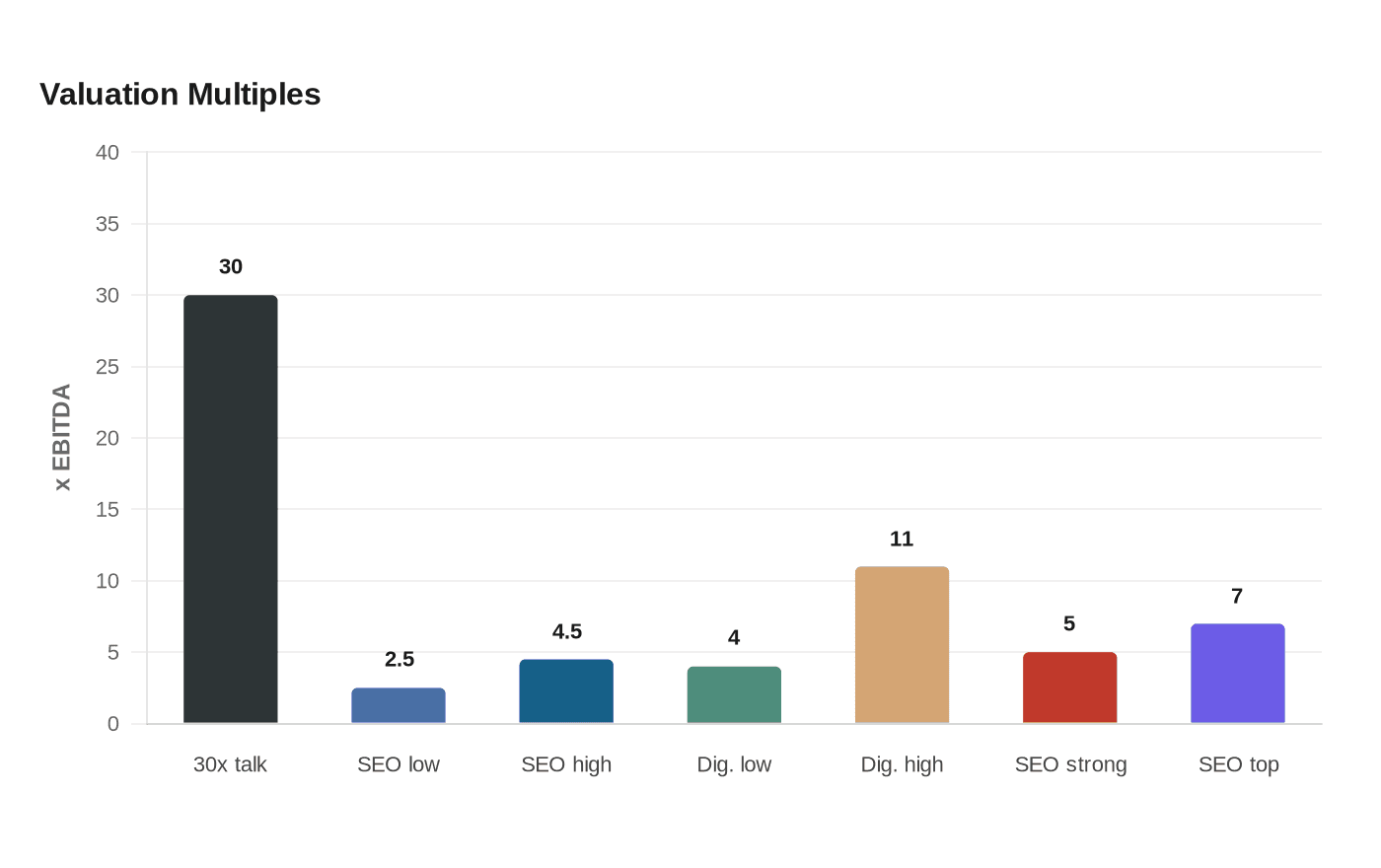
Eric Siu’s 30x valuation talk is not just another agency headline. It is a clean read on where capital is headed: software-like multiples for AI-native service firms, and old-school EBITDA math for traditional SEO shops that still sell time, staffing, and retainers. The difference is not hype. It is about whether the business can be packaged into a repeatable outcome, run through intelligent workflows, and scaled without adding headcount at the same pace as revenue.
Why the valuation gap is opening
The market is rewarding service businesses that start behaving like software companies. Andreessen Horowitz argued in December 2024 that AI is pushing pricing toward outcomes because customer support, sales, marketing, and back-office finance can be automated and sold around results instead of seats or hours. That is a very different model from the agency world most operators still know, where billable labor remains the engine and every new client tends to mean more people.
Y Combinator has been making the same case from another angle. Diana Hu’s framing is blunt: AI should be the operating system a company runs on, not just a tool bolted onto the side. In that model, the important workflows become intelligent closed loops, with every decision, handoff, and feedback signal captured inside the business rather than left to ad hoc management. Investors can underwrite that far more like software, because the revenue path is clearer and the margin expansion is more believable.
Why 30x is such a big number
Thirty times is a venture-style multiple, not a normal agency M&A benchmark. Recent SEO agency valuation guides generally put lower-middle-market SEO firms around 2.5x to 4.5x EBITDA, with stronger shops sometimes reaching 5x to 7x. Broader digital marketing agencies are often cited at 4x to 11x EBITDA, which is still nowhere near 30x. That gap tells you the market is not paying for the agency label itself. It is paying for a business that looks less like labor and more like a product.
That is why the structure of the offer matters as much as the tools behind it. A shop that simply adds AI drafting, AI media research, or AI reporting on top of hourly or retainer work is still being valued like a services firm. A shop that turns those same capabilities into a repeatable system with measurable outcomes has a shot at escaping the old multiple range.
What changes actually drive the rerating
The biggest shift is from hours to outcome-based pricing. If you are selling SEO, paid media, or demand generation, the buyer cares less about how many people touched the account and more about what the engine produces: pipeline, qualified leads, booked meetings, or revenue lift. That is where managed growth loops become powerful. You are no longer delivering isolated tasks; you are building a system that continuously learns, tests, and improves across acquisition and conversion.
The second shift is productization. Investors like it when an agency offer becomes easier to understand, easier to buy, and easier to repeat. Instead of an open-ended service menu, the firm has a defined package, a narrower problem statement, and a clearer success metric. That does two things at once: it improves close rates with buyers who want certainty, and it makes the operating model more forecastable for anyone trying to value the business.
The third shift is proprietary workflow. AI is not itself the moat. The moat is the process you encode around it: the prompts, data sources, feedback loops, QA checks, and handoffs that produce a better result than a generic team with generic tools. When a firm can show that its workflow is hard to copy and gets stronger as it runs more accounts, the market starts treating it less like a bench of consultants and more like a compounding system.
Why agency owners are paying attention to Single Grain
Single Grain is the kind of origin story that makes agency owners stop scrolling. The company says Eric Siu bought it for $2 in 2014 when it was a distressed SEO agency, then rebuilt it into what it now calls a modern AI-driven digital marketing agency. That arc matters because it captures the exact transformation the market is pricing: from fragile labor business to something more structured, more repeatable, and closer to a software-like operating model.
Today, Single Grain says it helps clients with pipeline-focused SEO, paid media, and AI growth. That positioning is important because it suggests the firm is not selling vanity metrics or channel output for its own sake. It is tying work directly to business results, which is exactly the kind of repositioning that can support better multiples if the economics back it up.
The market backdrop is doing its part
This is not happening in a vacuum. A 2026 U.S. digital marketing and advertising M&A report says the industry generated about $70 billion in U.S. revenue in 2023, yet Omnicom and WPP together hold only about 11% of market share. That kind of fragmentation is a classic M&A setup. There are plenty of agencies, plenty of subscale operators, and not much concentration, so buyers keep looking for businesses that can stand out on process, niche expertise, or growth efficiency.
The same report says U.S. advertising spend grew about 5.9% in 2023 to around $874.5 billion excluding political ads. It also notes that post-pandemic demand, then inflation and higher rates, have all affected dealmaking. In other words, the market has been active, but capital has become more selective. That makes the difference between a commoditized agency and an AI-native, outcome-led operator even more important, because buyers are hunting for margin durability and scalable growth, not just revenue.
What to build if you want the higher multiple
If you want your firm to be valued more like software than labor, the operating changes are not subtle:
- Replace hourly billing with outcome-based offers tied to pipeline, conversion, or revenue lift.
- Narrow the offer until it is easy to explain in one sentence and easy to repeat across accounts.
- Build closed-loop workflows so every campaign, channel, and handoff feeds the next decision.
- Document the proprietary parts of your process so the business does not depend on one founder’s memory.
- Use AI to reduce delivery drag, but keep the pricing story anchored to business results, not tool adoption.
That is the real lesson behind the 30x chatter. Investors are not suddenly falling in love with agencies. They are paying up for service businesses that have crossed the line into scalable systems. The firms that keep selling hours will keep getting labor multiples; the ones that sell outcomes, run closed loops, and look increasingly like software will keep drawing the higher valuation conversation.
This article was produced by Prism’s automated news system from verified source data, official records, and press releases, then run through automated quality and moderation checks before publishing. The system is built and supervised by the people who set the standards it runs under. Read our full AI policy.
Did this article answer your question?


