Core Web Vitals data shows page weight misses real user experience
Core Web Vitals are a revenue lever, not a vanity score. The latest platform data shows page weight alone can miss the user experience that actually drives retention and conversions.
Core Web Vitals are a sales conversation, not just a technical checkbox
If you run SEO for clients, Core Web Vitals is one of the cleanest ways to turn “site speed” from a developer complaint into a business case. Google says these metrics measure real-world user experience, and it recommends good Core Web Vitals for Search success. That matters because its core ranking systems aim to reward content that provides a good page experience, which means slower, jumpier, less responsive sites are fighting uphill in both discovery and conversion.

The latest platform comparison makes the point bluntly: page weight and Lighthouse-style lab scores do not always predict how a site behaves for real users. That is exactly why this topic matters to agencies. A client can obsess over a lighter homepage and still lose money if the site feels sluggish in the field, or if a template creates layout shift and interaction lag where it counts.
Why the numbers do not tell the whole story
The useful distinction here is between lab data and field data. Chrome UX Report, often called CrUX, reflects how real-world Chrome users experience popular destinations on the web. HTTP Archive adds technology detection by crawling websites, so the comparison can look at both what a site is built on and how it performs in practice.
That difference is the whole trick. A page can look heavy or light in a test and still behave differently once it is served to actual visitors, on actual devices, on actual networks. For an agency, that means “the homepage is under 2 MB” is not a strategy. It is a number, and one that can hide bad template decisions, bloated scripts, or layout behavior that only shows up after the page has started rendering.
What the comparison says about platforms
The Search Engine Journal comparison puts WordPress and Astro on opposite sides of the performance spectrum, which is useful because it forces a more honest platform conversation. The headline lesson is not that one CMS magically fixes Core Web Vitals. It is that platform choice, template design, and page architecture shape the odds before a single blog post is published.
Duda stands out as the clearest benchmark in the comparison. It ranked first with roughly 85 percent of sites earning a good Core Web Vitals score and a median page weight of about 1.78 MB. That is a concrete reference point for agencies that want to show clients what a performant publishing environment can look like when the stack is doing more of the heavy lifting.
The pattern also held in an earlier comparison. In July 2025, Duda posted 84.96 percent passing Core Web Vitals, which suggests that it has stayed a strong performer across multiple report cycles. For an agency, that kind of consistency matters more than a one-off win, because it points to repeatable platform behavior rather than a lucky implementation.
How to use this in audits
Treat Core Web Vitals as an audit layer, not a line item. When you inherit a client on a slower stack, you are not just checking a speed box. You are trying to figure out whether the platform, the theme, and the page structure are creating drag that content alone cannot overcome.
A practical audit should separate the symptoms from the cause:
- Check the actual Core Web Vitals outcome first, not just the lab score.
- Compare those results with page weight, because a light page can still underperform and a heavier one can sometimes be more stable.
- Look for template patterns, especially on pages that share a layout, because platform-wide problems usually show up there first.
- Use the gap between field data and lab data to explain why “it feels fine on my machine” is not enough.
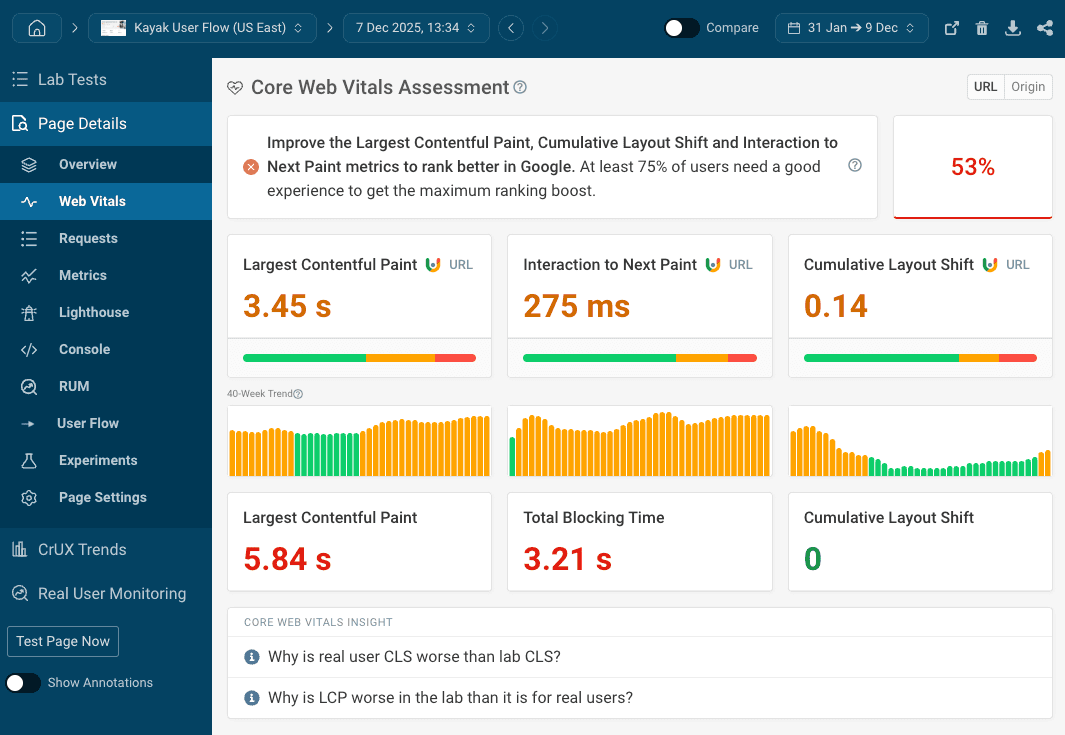
This is where Search Console becomes especially useful. Its Core Web Vitals report is based on actual user data and uses LCP, INP, and CLS, which gives you a field-level view of loading, responsiveness, and visual stability. That is a much stronger briefing tool than a single Lighthouse screenshot.
Why INP changed the conversation
The metric set itself has evolved, and that evolution matters for client expectations. Google announced in May 2023 that Interaction to Next Paint, or INP, would replace First Input Delay in March 2024. That shift made responsiveness harder to fake, because the focus moved from the first tap or click to the broader interaction experience.
That is useful in agency work because it moves the conversation away from one-time loading tricks and toward real usability. If a site loads quickly but hesitates when a visitor opens a menu, submits a form, or filters results, the experience still fails. Core Web Vitals now better reflect that kind of friction.
How to turn the data into migrations and upsells
This is where the business case gets sharp. If a client is stuck on a slower stack, the platform comparison gives you language for a migration recommendation that is about revenue, not vanity. Better Core Web Vitals can support better conversion rates, fewer abandonment problems, and cleaner ad performance, which makes the case for a rebuild much easier to defend.
Use the Duda benchmark as a proof point when clients want to know what “good” looks like in the real world. Then compare that with the site they already have, especially if the current CMS produces heavier templates, more layout instability, or weaker field results. If WordPress is the client’s home base, the conversation should be about whether the current implementation is helping or hurting, not about the logo in the footer.
For upsells, the angle is simple: performance is part of the agency value proposition. It is not something to leave to the developer after the SEO work is done. When you can show that platform choice and architecture affect Core Web Vitals outcomes, you can sell audits, migrations, and performance cleanup as revenue protection, not technical polish.
The real takeaway for agencies
The cleanest lesson from the comparison is that page weight is only one piece of a much messier picture. Core Web Vitals are meant to reflect how the page works for real people, and Google’s own guidance makes that clear. The agencies that win here will be the ones that stop treating performance as a score to chase and start treating it as the foundation of search visibility, conversion, and retention.
That is why the WordPress versus Astro comparison matters beyond the CMS debate. It is a reminder that the stack sets the ceiling, and that the fastest way to improve client outcomes is often to fix the platform before you try to squeeze another few points out of the content strategy.
This article was produced by Prism’s automated news system from verified source data, official records, and press releases, then run through automated quality and moderation checks before publishing. The system is built and supervised by the people who set the standards it runs under. Read our full AI policy.
Did this article answer your question?