Do press releases still help SEO? what agencies should tell clients in 2026
Press releases still matter for discovery and authority, but agencies should stop selling them as ranking shortcuts and start pricing them as digital PR.
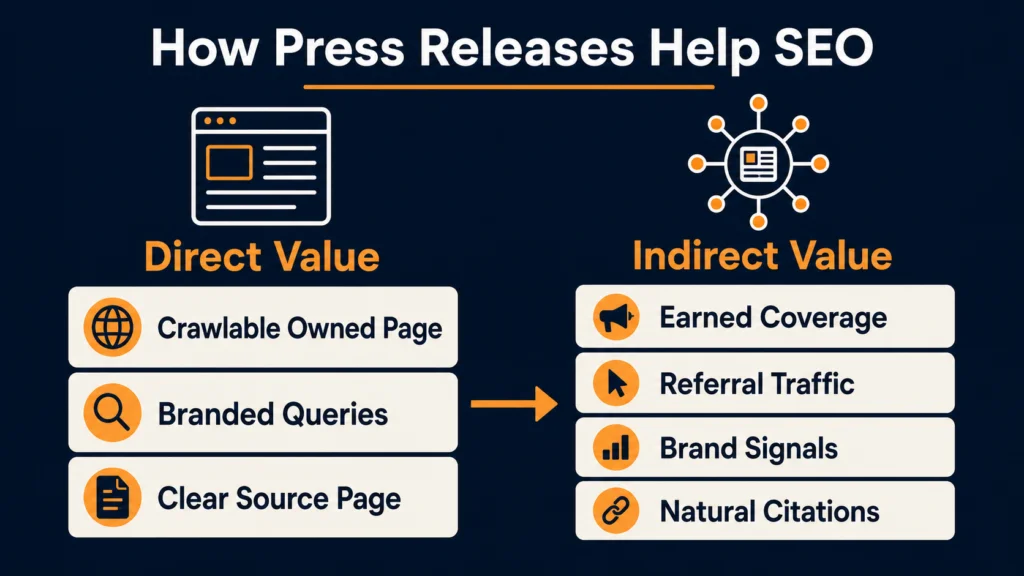
On July 30, 2013, Google described links in press releases as unnatural and said they should be nofollowed. Press releases do not buy reliable rankings, but they can still buy attention, discovery, and the kind of brand evidence search systems use to judge whether a company exists beyond its own site. Agencies need to tell clients that the tactic still has value, but the value sits mostly outside direct link equity.
What Google has already told the market
Links help Google find new pages to crawl, but publishers should qualify links when they reflect a relationship such as paid or sponsored content. That guidance sits on top of an older warning: in February 2013, Google said selling links that pass PageRank violates its quality guidelines.
Then, in September 2019, Google changed how it handles link annotations, introducing the `sponsored` and `ugc` attributes and shifting `nofollow` from a directive to a hint. A press release is not a dependable “link juice” machine, even if it can still help search engines discover names, pages, and stories.
| Myth | Reality | What agencies should say |
|---|---|---|
| Press releases reliably boost rankings | Direct ranking impact is limited | They are better used for visibility and discovery |
| Every release link helps SEO | Paid or relationship-based links should be qualified | Treat release links as distribution, not authority transfer |
| Syndication creates value by volume | Duplicate copy rarely creates durable search value | Focus on pickup, mentions, and original coverage |
| Press releases are dead | They still support brand and entity signals | Use them selectively around newsworthy events |
Where the tactic still works
Press releases still earn a place in an SEO program when the goal is broader than a single keyword move. Product launches, executive announcements, partnerships, awards, funding news, and local expansion stories are the cleanest fits because they create a real editorial reason for other sites to reference the company. Those references can produce earned links, referral traffic, and branded search lift, which are more defensible than promising a ranking jump from the release itself.
In an AI-influenced search environment, Google’s March 5, 2024 core update was designed to show less content made to attract clicks and more helpful content, and Google’s November 19, 2024 site reputation abuse policy targeted manipulative third-party content designed to game rankings. In that setting, a syndicated release with the same copy copied across many outlets is not a strategic substitute for original reporting, expert commentary, or coverage that earns a citation because it contains something worth citing.
The strongest version of the press release argument is not “it ranks” but “it creates a searchable proof point.” A release can help a brand surface in news, populate an entity graph with new facts, and give journalists, analysts, and AI systems a consistent signal that a company launched something, hired someone, or entered a new market. That is why agencies that sell multi-channel retainers still use the format, especially when the release is part of a larger digital PR push that includes outreach, follow-up pitching, and owned content on the company site.
What agencies should stop promising
The problem is usually not the tactic. It is the pitch. Client disappointment tends to start when a press release is sold as a shortcut to rankings instead of a distribution asset with secondary SEO benefits.
- Do not frame the release as a link-building campaign if the links are clearly relationship-based or syndicated at scale.
- Do not promise that a wire pick-up will move a competitive commercial term.
- Do not treat every company announcement as press-release worthy. If the story would not interest a trade editor, the SEO upside is usually thin.
- Do measure the things a release can realistically influence: branded queries, pickup quality, referral sessions, new mentions, and whether the release supported a larger campaign that later earned authoritative coverage.
Exceptions exist. In a February 1, 2026 YouTube case study, Edward Sturm described an $80 press release that ranked No. 1 for a non-branded keyword and affected Google’s AI Overview. That is not a model to sell as a standard outcome.
How to position press releases inside an agency retainer
For agencies, the cleanest positioning is to separate three jobs: announcement distribution, authority building, and ranking work. Press releases belong in the first two. They are useful when a company needs to document a real event and push it into circulation, but they should not be the core of an SEO forecast.
The most persuasive way to explain this to clients is to connect the release to downstream effects they can understand. A strong release can create media pickup that brings in earned links later. It can generate branded search demand when prospects hear the name elsewhere and search for it directly. It can also support entity visibility by putting the same company, product, and executive names into multiple trusted contexts.
Search Atlas published a press release SEO guide on June 20, 2025. OuterBox, BrandPush, and 24-7 Press Release published 2026 guides.
This article was produced by Prism’s automated news system from verified source data, official records, and press releases, then run through automated quality and moderation checks before publishing. The system is built and supervised by the people who set the standards it runs under. Read our full AI policy.
Did this article answer your question?