Search Engine Land frames SEO benchmarking as proof of agency value
Search Engine Land treats SEO benchmarking as proof of agency value: the right baseline turns rankings, share of voice, and competitor gaps into renewal-ready reporting.
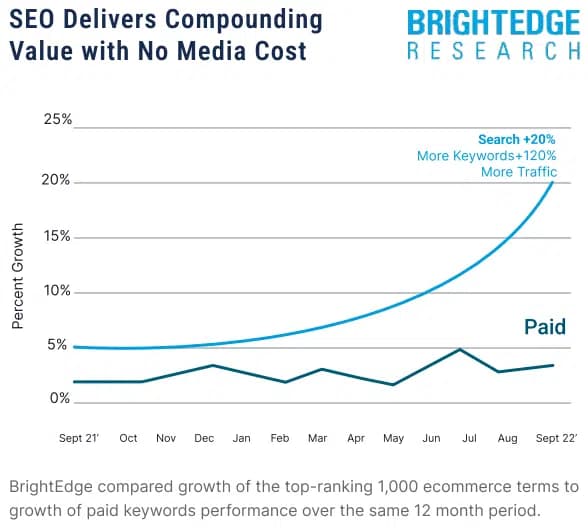
BrightEdge’s click-curve research shows click-through rate drops by roughly half as rankings move from 1st to 2nd, 3rd, and 4th position. That is why SEO benchmarking works as a commercial asset, not a housekeeping task. If you can show where a site started, how it moved against its own baseline, and how it performed versus rivals, you can make monthly reports and QBRs do real retention work.
Benchmarking is the bridge between performance and renewal
The value of benchmarking shows up first in the client conversation. Search Engine Land pairs “SEO Benchmarking: Measure Performance & Outrank Rivals” with “SEO Reporting: How to Track, Prove & Improve Performance.” Reporting has to prove progress, not just describe activity. Agencies are increasingly judged on whether organic work changes business outcomes, not whether a dashboard has more lines.
A usable benchmark gives an agency a before-and-after story for the full account. It turns technical SEO fixes, content updates, and link acquisition into evidence that the site moved in the right direction.
The metrics that carry the most weight in client reporting
Share of voice is the metric that best captures competitive context. Search Engine Land’s “What Is Share of Voice? Measure Visibility & Outrank Rivals” centers on that metric. BrightEdge defines SEO share of voice as the percentage of search traffic a brand gets on the SERPs compared with competitors.
That is why a strong benchmark usually centers on a small set of measures that can be tied to revenue and pipeline rather than vanity. In agency reports, the most persuasive view is usually built around:
- Share of voice versus category competitors
- Non-brand rankings that show demand capture beyond branded traffic
- Conversions by page group, so content performance is tied to leads or sales
- Local competitor gaps, especially where a brand has market share but weak visibility in specific geographies
Visibility is relative, not isolated. A keyword ranking can rise while market share stays flat if competitors rise faster or capture more clicks on the same SERP.
AI search makes the baseline broader, not looser
The measurement challenge has widened as search surfaces change. Search Engine Land now includes pages on brand visibility in AI search and measuring GEO performance. The definition of visibility is expanding beyond a standard blue-link ranking chart. For agencies, that means the benchmark has to hold up across traditional search results and newer answer-driven surfaces.
That shift does not replace classic SEO reporting. It makes it more important. If a brand is gaining visibility in AI results, the agency still needs a historical baseline, a competitor set, and a consistent way to compare performance over time. Otherwise, the story becomes anecdotal, and anecdotal reporting is hard to defend in a renewal meeting.
The wider reporting stack around agency growth
Benchmarking is the starting point, and competitor discovery is the next operational step. Search Engine Land’s pages are also cross-promoted with Semrush, including prompts to identify traffic-stealing competitors and find untapped keyword opportunities. Once you know who is taking share, you can prioritize topics, pages, and markets with the clearest upside.
The broader vendor ecosystem makes the same case from different angles. Factors.ai’s “SEO Benchmarking: Metrics, Competitors & Reporting That Drive Growth” treats benchmarking as a growth system rather than a one-off audit. Swydo’s “10 Key SEO Metrics Marketing Agencies Must Track” centers on the recurring reporting layer. Databox’s “SEO Industry Benchmarks to Evaluate Your Organic Performance” compares organic results against market expectations. SE Ranking’s “Share of voice: What it is and how to increase it” treats visibility as a competitive measure, not a static rank.
Talkwalker’s “Share of Voice: Definition + How to Measure and Grow It in 2025,” published on April 28, 2025, extends the concept beyond SEO alone. Clients increasingly expect a unified visibility story across search, media, and broader digital channels. When the measurement model is consistent, the agency can show how organic search contributes to the larger mix instead of treating SEO as a silo.
What agencies actually use benchmarking to prove
The strongest reporting setups do not try to measure everything. They isolate the metrics that help a client understand whether the agency is moving the needle against named competitors and whether that movement is likely to hold. In practice, that means a benchmark should answer three questions in every monthly report and QBR: where the account started, where it moved, and where it stands versus the market.
This article was produced by Prism’s automated news system from verified source data, official records, and press releases, then run through automated quality and moderation checks before publishing. The system is built and supervised by the people who set the standards it runs under. Read our full AI policy.
Did this article answer your question?