Google Ads adds Gemini dashboards for conversational reporting
Google turned Ads reporting into a prompt box, but the real test is whether Gemini cuts agency reporting hours or just repackages the same charts.
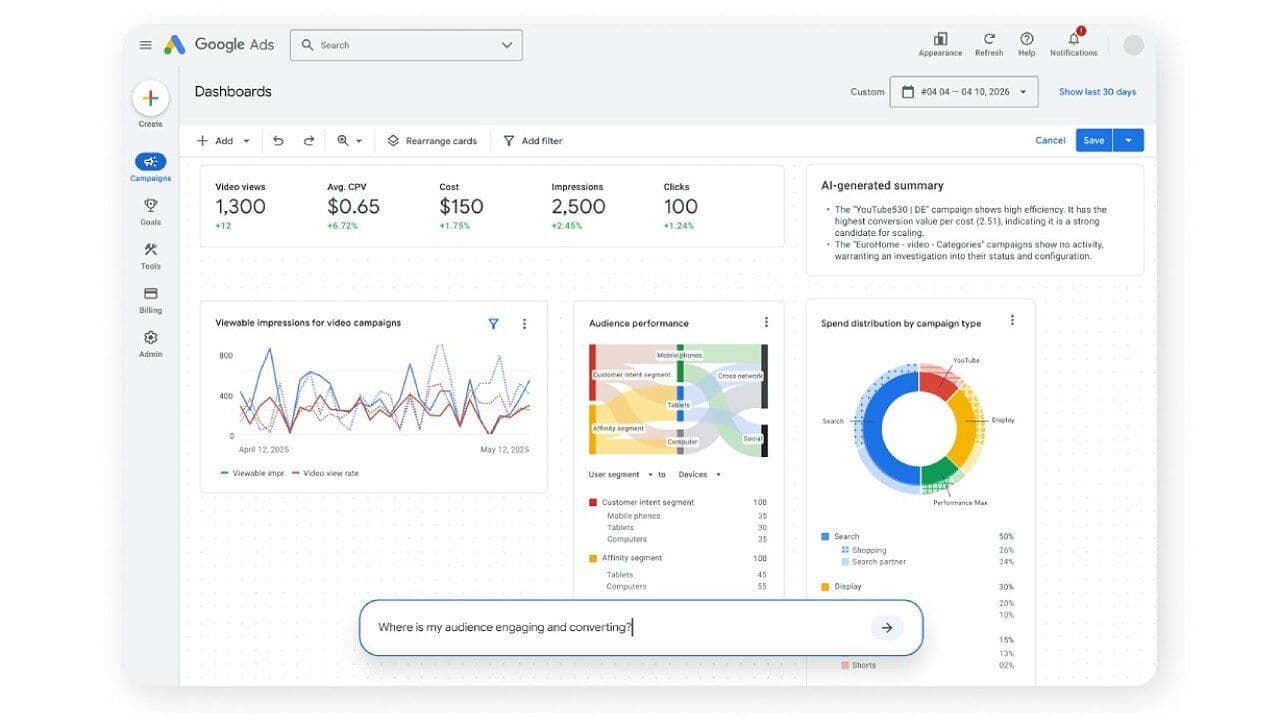
Google Ads is moving reporting toward a prompt-driven workflow, and that is the part agencies will care about first. The new Gemini-powered dashboards let advertisers ask questions in plain language and watch charts, graphs, and tables update in real time, instead of building every view by hand through standard reporting paths.
That sounds small until you think about the daily grind inside an agency account team. Google Ads reporting has long meant jumping between reports, setting filters, stitching together views, and then translating the numbers for clients. Google’s new dashboard layer is meant to compress that work. The system can surface impressions, clicks, video views, and cost, then break performance down by devices, audiences, and campaign types. In practice, that makes the dashboard behave less like a static report and more like an analyst sitting beside you.
The key detail is that Google did not invent dashboards from scratch. Google Ads Help says dashboards already provide a single place to review consolidated performance statistics across an account, with scorecards, charted reports, tabular reports, and notes. They can also be shared, downloaded, annotated, and used across manager accounts for cross-account views. Gemini appears to sit on top of that existing reporting layer, which means Google is changing the interface more than the underlying product. That matters, because agencies are not being handed a brand-new measurement system. They are being handed a faster way to interrogate one they already use.
This is also part of a much longer push. Google introduced Gemini-powered conversational chat in Google Ads in January 2024, first making it fully available to English-language advertisers in the United States and United Kingdom before rolling it out more broadly. Google has since expanded the idea with Ads Advisor, an agentic Gemini-built experience that can answer performance questions, troubleshoot policy or billing issues, and suggest text and image creatives. At Google Marketing Live 2025, Google also leaned hard into AI across Performance Max, AI Max for Search campaigns, Demand Gen, and measurement. In May 2026, Google said advertisers using the Google tag gateway saw an average 14% conversion lift, while also pushing Data Manager, Meridian GeoX, and Meridian Studio as part of its measurement stack.
For agencies, the upside is obvious: less time spent assembling client-facing reports, faster answers when performance shifts, and a cleaner path from raw data to action. The risk is just as clear. If Gemini is summarizing and visualizing inside Google Ads, account teams may start relying on the machine’s framing before they have tested the assumptions underneath it. Google said more details would follow at Google Marketing Live, but the direction is already clear. Reporting is becoming an AI product, and agencies will have to win on interpretation, experimentation, and strategy, not just report building.
This article was produced by Prism’s automated news system from verified source data, official records, and press releases, then run through automated quality and moderation checks before publishing. The system is built and supervised by the people who set the standards it runs under. Read our full AI policy.
Did this article answer your question?


