Google Ads adds lead dashboard to boost Smart Bidding data
Google Ads added a lead dashboard that shows qualified and converted leads in one place, giving Smart Bidding a cleaner signal than raw form fills.

Google Ads added a built-in lead management dashboard that puts lead tracking, qualification, and follow-up in one place instead of scattering it across exports, CRMs, and inboxes. The practical shift is simple: media buyers can now see total leads, new leads, qualified leads, lost leads, and funnel progression without leaving Google Ads, while sales teams get a cleaner handoff when Google-hosted forms are doing the front-end capture.
The bigger change is underneath that interface. Google has replaced the old imported leads conversion goal with two newer goal types, Qualified leads and Converted leads, and the lead funnel report now tracks conversion volumes from interactions to leads, qualified leads, and converted leads. In Google’s own framing, a qualified lead is a Google-generated lead that has been further vetted offline in a CRM or internal lead system, while a converted lead is one that has completed a later step in the sales process, such as a sale or closed deal.

That matters most for agencies running lead-gen accounts where form fills are only the first stop. The new dashboard is built for the kind of workflow that usually gets messy fast: Search and Performance Max campaigns feeding Google-hosted lead forms, then someone on the client side downloading CSVs, checking email alerts, or pushing records into a CRM through a webhook. Google says lead forms can be downloaded, sent by email, or routed directly into a CRM, and the Google Ads API can automatically export up to 60 days of lead form data. Direct downloads, by contrast, cover only the last 30 days.
Google also keeps tightening the screws on qualification. Its help docs say qualifying responses are available for Search campaigns only, and those responses can automatically mark a submission as a qualified lead while adding lead stage data to CSV, webhook, and API outputs. For some lead form formats, advertisers that spend more than $1,000 per account or more than $15,000 across all accounts may be eligible, subject to advertiser verification and account standing.
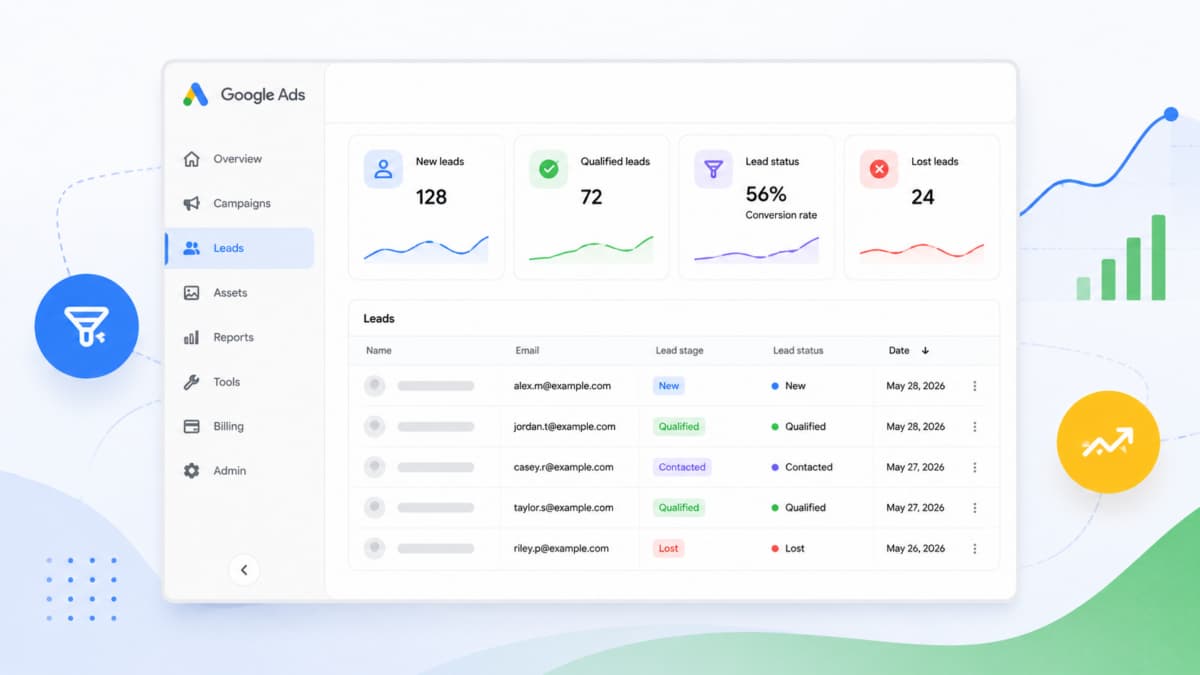
This is not just a nicer reporting screen. Google’s May 2026 Marketing Live materials said journey-aware bidding is in beta and is meant to better understand the full lead-to-sales process. Google also said in March 2026 that high-volume form fills can still leave advertisers with unqualified hand-raisers, which is exactly the problem this dashboard is built to attack. The agencies that benefit most are the ones with real sales-process plumbing: B2B shops, performance agencies tied into client CRMs, and teams already optimizing for lead quality instead of cheap volume. For them, the new dashboard is less a convenience feature than a missing operational layer between the click and the closed deal.
This article was produced by Prism’s automated news system from verified source data, official records, and press releases, then run through automated quality and moderation checks before publishing. The system is built and supervised by the people who set the standards it runs under. Read our full AI policy.
Did this article answer your question?


