Google Ads sets new 37-month limit on historical reporting data
Google Ads is capping granular history at 37 months on June 1, forcing agencies to export, warehouse, and back up client data before it disappears.
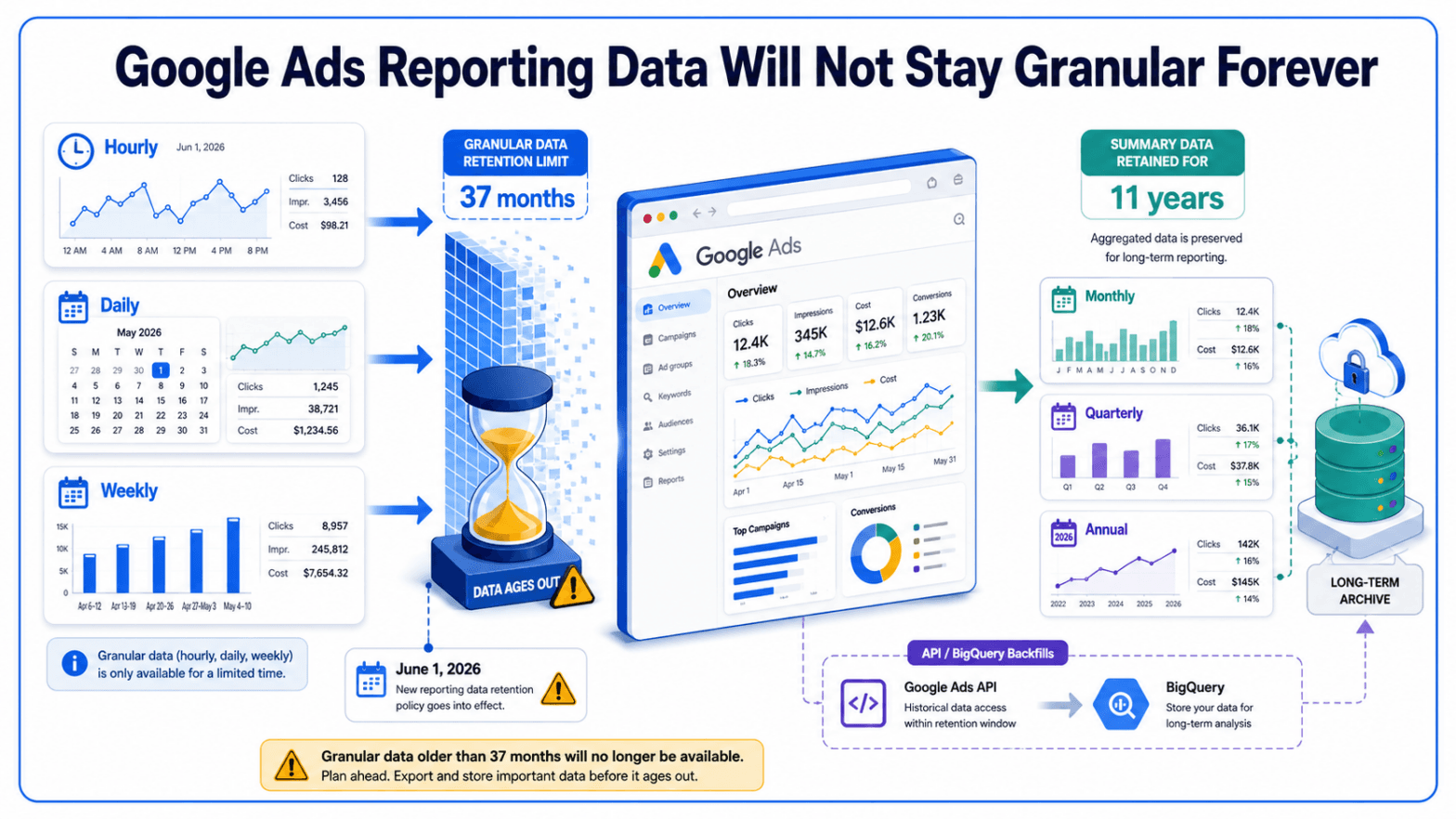
Agencies that manage long-running Google Ads accounts now have a deadline hanging over every seasonal report and quarterly audit: once the 37-month window closes, granular history is gone from the interface and the APIs unless teams have already preserved it elsewhere. That turns reporting from a convenience into an operational risk, especially for shops that rely on multi-year comparisons to explain performance swings, renewals, and budget shifts.
Beginning June 1, 2026, hourly, daily, and weekly reporting data collected for periods shorter than one month will remain available for 37 months. Monthly, quarterly, and annual reporting data will remain available for 11 years. After those limits expire, Google Ads will no longer return the data through the interface or through its APIs. Reach and frequency metrics are tighter still: Google says those measures will be available for only 3 years, including Unique users, Avg impr. freq. /user, Avg impr. freq. /user (7d), Avg impr. freq. /user (30d), and the Frequency distribution fields from 1+ through 10+.

The API behavior matters just as much as the interface change. Google says requests for granular segments older than 37 months, including segments.date and segments.week, will return DateRangeError.INVALID_DATE. Future API versions will use DateRangeError.REQUESTED_DATE_GRANULARITY_NOT_SUPPORTED. To pull older history, queries need to switch to segments.month, segments.quarter, or segments.year, and unsegmented historical queries must line up exactly with calendar month boundaries. Google also recommends exporting granular historical data before June 1 if advertisers need it beyond the new cutoff.
For agencies, this is not a niche developer tweak. It hits seasonality analysis, year-over-year reporting, forensic account reviews, and the kind of back-catalog context that makes client conversations easier when performance changes for real reasons, not guesswork. If an ecommerce, travel, or finance client asks for a comparison that reaches past 37 months and the data is no longer there, the missing archive becomes a trust problem as much as a reporting problem. That is why exports, warehouse syncs, and scheduled backups now matter more than another dashboard tab.
The new cutoff also fits a broader tightening of Google’s reporting stack. On October 10, 2024, Google announced an 11-year data retention policy for Google Ads API requests, effective November 13, 2024, covering account data, performance metrics, billing information, and historical reports. Google’s May 1, 2026 developer post says the BigQuery Data Transfer Service for Google Ads and Search Ads 360 will stop populating backfill runs for dates older than 37 months, while data already stored in BigQuery stays in place. The same update says the Google Analytics Data API will truncate affected metrics to the latest 36-month window when date is used as a dimension. The message is blunt: Google Ads is still a reporting platform, but it is no longer behaving like a forever archive.
This article was produced by Prism’s automated news system from verified source data, official records, and press releases, then run through automated quality and moderation checks before publishing. The system is built and supervised by the people who set the standards it runs under. Read our full AI policy.
Did this article answer your question?


