Google Ads shifts from manual management to AI-driven optimization
Google is automating the grunt work in Ads, and agencies that still sell bid tweaks will get squeezed. The new edge is cleaner signals, not busier dashboards.
The old Google Ads agency pitch is running out of road. Google is automating more of the hands-on work, and the teams that win will be the ones that can design better signals, build cleaner conversion systems, and run sharper experiments.
The new center of gravity
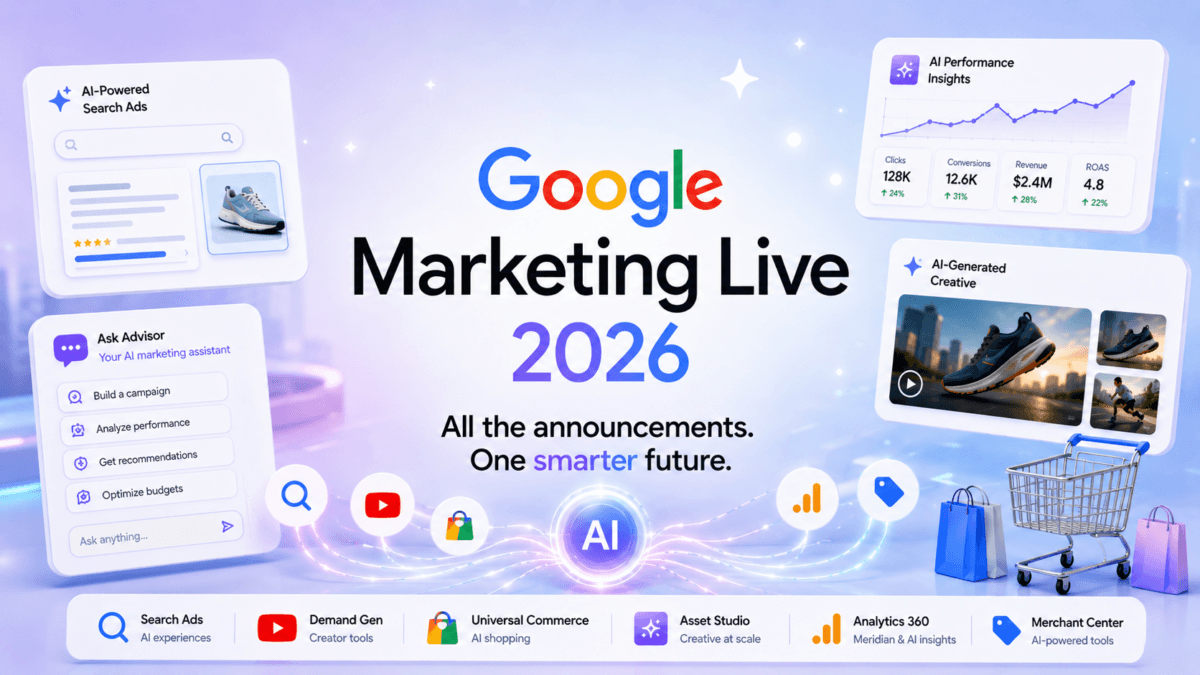
Google Marketing Live 2026, held on May 20, made the shift obvious. Google said the event would focus on Ads, AI, and YouTube, and framed the keynote around AI-powered advertising solutions, Gemini, and agentic technology. That is not a cosmetic update to the product roadmap. It is Google saying, in public, that the platform is moving from a place where humans micromanage campaigns to a system where humans define goals, inputs, and guardrails.
Ask Advisor pushes that idea even further. Google introduced it as a unified Gemini-powered agent that spans Google Ads, Google Analytics, Merchant Center, and Google Marketing Platform. The message behind that bundle is clear: more of the operating work is being wrapped into productized systems, while marketers are expected to bring strategy, data quality, and business context.
What Google is automating
The most practical proof is in the bidding stack. At GML 2026, Google announced journey-aware bidding, Smart Bidding Exploration, and demand-led pacing. Journey-aware bidding is meant to understand the full lead-to-sales process, Smart Bidding Exploration is an opt-in feature that uses AI to bid on potentially high-performing search queries, and demand-led pacing automatically adjusts daily spend as consumer interest changes.
Google also tied Smart Bidding Exploration to Performance Max and Shopping, which matters because it shows where the company expects more discovery to happen. If the system can find new customers and spend more flexibly on its own, the agency value is no longer in squeezing another 3% out of manual bid adjustments. The value is in making sure the machine has the right signals to work with.
That same logic runs through Google’s broader message about reducing manual work. When Google says its newer bidding and budgeting tools reduce manual labor, it is not talking about a single workflow. It is talking about the entire account-management model that grew up around daily bid tweaks, pacing checks, and spreadsheet-heavy control.
AI Max is the clearest sign of where Search is headed
AI Max for Search campaigns is the cleanest example of this transition. Google says the feature suite combines improved search term matching, text customization, and final URL expansion, and it has positioned AI Max as central to its Search strategy. In Google’s help documentation, advertisers who activate AI Max in Search campaigns typically see 14% more conversions or conversion value at a similar CPA or ROAS, based on internal 2025 data for non-Retail advertisers.
Google has also said that with the full AI Max feature suite, campaigns see an average of 7% more conversions or conversion value at a similar CPA or ROAS compared with search term matching alone. Those are not small numbers, and they explain why the product is being pushed so hard. Google announced on April 15, 2026 that Dynamic Search Ads will automatically upgrade to AI Max starting in September 2026, and that campaigns using Dynamic Search Ads, automatically created assets, and campaign-level broad match will be moved over as AI Max comes out of beta.

That upgrade path matters because it shows how fast the old manual structure is being absorbed into the new one. If DSA and broad-match-heavy campaigns are being pushed into AI Max automatically, then a lot of the execution layer that once defined PPC management is becoming table stakes.
What the agency team now needs
Ginny Marvin said the old era plainly in an April 27, 2026 interview, describing early PPC as “painfully manual,” with huge keyword lists and negative keyword permutations. She also said campaigns now start more naturally with goals. That is the heart of the reset: the account no longer begins with a spreadsheet of keywords, it begins with a business objective that needs to be translated into machine-readable signals.
Agencies should recruit and train for that translation layer. The strongest teams will look less like media buyers and more like operating partners who can connect product data, landing pages, conversion quality, and business outcomes.
- Build conversion architecture that tells Google what a qualified lead or sale actually looks like.
- Clean up feeds, Merchant Center inputs, and first-party data so automation is not guessing in the dark.
- Design experiments around AI Max, Performance Max, and Shopping instead of relying on manual bid lore.
- Map client goals to measurable outcomes, then keep the campaign structure aligned with those goals.
A modern PPC team needs people who can do things like this:
That skill set is especially important for SEO agencies that expand into PPC. Plenty of firms can sell search marketing; fewer can make the jump from content and organic expertise into paid systems without just adding labor. If the PPC line is still priced like a bundle of setup hours and routine maintenance, it will get crushed by automation. If it is priced around strategy, data hygiene, experimentation velocity, and conversion quality, it has room to become a premium service.
How agencies should price the new work
This is where the business model changes. When Google handles more of the routine optimization, agencies should stop selling themselves as the people who push the buttons fastest and start selling themselves as the people who build better systems. That means pricing around the quality of the inputs, the depth of measurement, and the speed of iteration, not around how many manual adjustments someone makes in a week.
It also means being honest about where the work is moving. In search, AI Max is turning campaign management into a cleaner, more opinionated system. In Shopping and Performance Max, Smart Bidding Exploration and journey-aware bidding shift the focus toward feed quality and customer signals. In budgeting, demand-led pacing reduces the need for constant spend babysitting. The agency that still makes its money on routine control will feel the squeeze first.
The agencies that adapt will be the ones that treat Google Ads as a system-optimization discipline. The old advantage was control. The new advantage is knowing what to feed the machine, how to measure what comes out, and how to turn that into real business growth.
This article was produced by Prism’s automated news system from verified source data, official records, and press releases, then run through automated quality and moderation checks before publishing. The system is built and supervised by the people who set the standards it runs under. Read our full AI policy.
Did this article answer your question?