Google Chrome auto-browse shifts AI search from discovery to transactions
Chrome auto-browse turns AI visibility into a conversion problem. Agencies now have to optimize schemas, feeds, forms, and checkout for agent-led transactions.

Google’s Chrome auto-browse rollout is pushing AI search past discovery and into execution. The old win was getting cited by an AI system; the new win is surviving the handoff when an agent lands on a site, fills the form, and finishes the purchase, booking, or reservation. Google’s own Chrome and commerce docs show that this is no longer theory: the browser is being positioned as an agentic assistant, and the commerce stack underneath it is being rebuilt to support direct action.
Discovery is giving way to completion
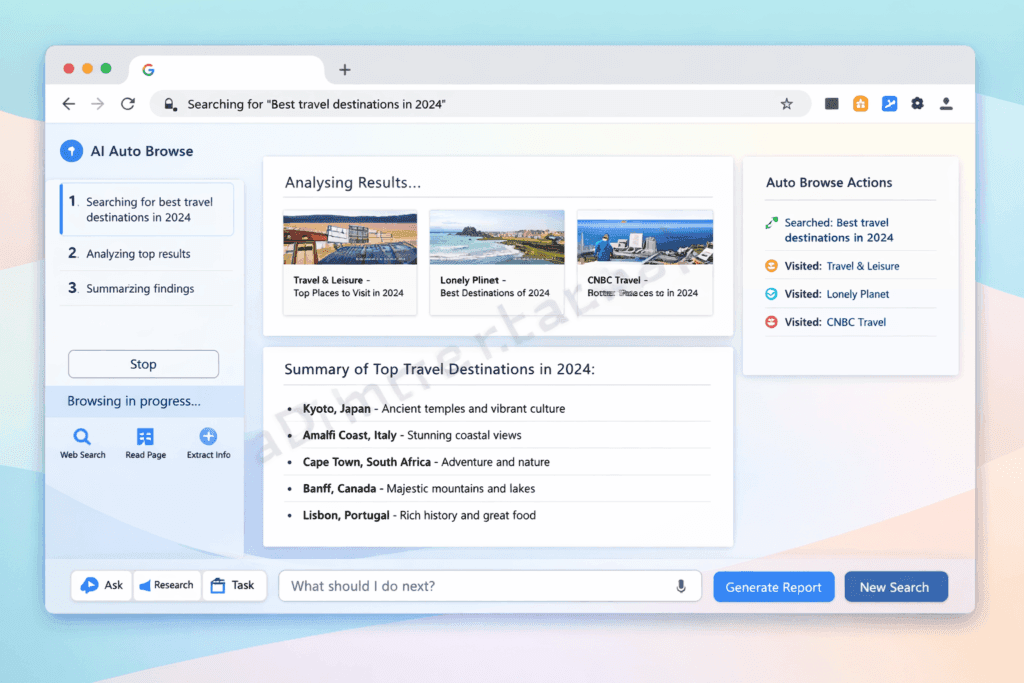
Chrome’s auto browse feature is built to handle multi-step tasks on the web, including comparing products, finding travel accommodations, making restaurant reservations, and scheduling appointments. Google says the first rollout is limited to U.S. users 18 or older who are signed in, and its Android launch is framed as part of Gemini in Chrome arriving on Chrome for Android in late June for select devices. That matters because the browser is no longer just surfacing information, it is being used to carry a user across the final mile of a transaction.
That shift changes the agency brief immediately. If an AI agent can quote a business but cannot complete the booking or checkout flow, visibility has not translated into revenue. In practical terms, the KPI stack has to move beyond citations and impressions toward task completion, checkout initiation, booking success, form submission success, and abandonment at the exact point where the agent needs human confirmation.
Google is already building the agentic commerce rails
Google’s broader 2026 roadmap makes the direction hard to miss. In January, the company announced a new open standard for agentic commerce and described it as a way to help retailers connect with high-intent shoppers and drive sales. By Google I/O 2026, Google had introduced Universal Cart, a shopping layer that works across Search, Gemini, YouTube, and Gmail, and Google said the cart can move items toward checkout with Google Pay or hand them off to the merchant site to complete the purchase.
That ecosystem matters because auto browse is not arriving in a vacuum. Google’s UCP guide describes the Universal Commerce Protocol as an open standard designed for the future of commerce, built to turn AI interactions into instant sales and enable agentic actions on Google AI Mode in Search and Gemini. Google also says its native checkout flow can start with an agent building a checkout session, then hand off to a Google UI for sensitive fulfillment and payment details before manual checkout finishes the process.
Seen together, those pieces show a shift from content optimization to transaction readiness. The browser, shopping cart, booking surfaces, and payment path are all being threaded into one agentic journey. Agencies that can explain that architecture clearly will have a stronger pitch than agencies still selling AI search as a citation game.
What agencies need to audit now
The first change is how audits are run. A classic SEO or AI visibility audit checks whether content is understood; an AI transaction audit checks whether the site can actually be used by a machine to complete a task. That means testing forms, booking tools, checkout logic, mobile flows, and any step that depends on fragile client-side behavior, inconsistent product data, or a human-only workflow.
A practical agency checklist should now include:
- CRO workflow readiness: can an agent complete the form, choose the right option, and reach confirmation without hitting dead ends?
- Schema integrity: does structured data accurately describe the page, and does it stay aligned with the visible content?
- Product and feed accuracy: are pricing, availability, hours, and service data current enough for a machine to trust?
- Attribution: can you tell where the AI journey started, where it paused, and where the transaction finished?
Google’s documentation is explicit that structured data is an eligibility signal, not a guarantee. Search Central says markup can help Google understand content and make a page eligible for rich results, but it does not guarantee that a feature will appear. For agencies, that means schema is still necessary, but it is no longer sufficient. The real question is whether the underlying experience can convert when an AI agent gets there.
Schema, feeds, and local actions are now revenue infrastructure
Local and service businesses need special attention because Google already exposes transaction paths in its own products. Google says LocalBusiness structured data can describe hours and departments, and that if a business wants users to make a reservation or place an order directly in Search, it can use the Maps Booking API to enable bookings, payments, and other actions. Google Business Profile help also says customers can book appointments, make reservations, place food orders, and place shopping orders through links attached to a profile.
Google Actions Center reinforces the same point from another angle: it says people take actions on Google millions of times a day, including reserving, ordering, and booking appointments. For agencies, that turns local profile management and booking-link hygiene into a conversion service, not a listing task. If a merchant’s profile is visible but the action link is stale, the transaction dies before the agent can finish.
Product-driven brands need the same discipline on the retail side. Google’s UCP guide says merchants can use existing Merchant Center shopping feeds to capture high-intent customers during discovery, and Google Shopping’s Universal Cart is built to work across merchants and services so shoppers can add items while browsing Search or chatting with Gemini. That makes feed integrity, inventory freshness, pricing consistency, and product-page fidelity part of the AI visibility stack, not just merchandising chores.
How agencies should package the new service
This is where the service model changes. Agencies can now sell AI transaction optimization as a blend of technical SEO, CRO, feed ops, and measurement design. The deliverable is not just “we got you surfaced in AI,” but “we made your site executable by AI agents, and we can prove the funnel held together.”
- recurring task-flow tests on mobile and desktop
- schema and booking-link QA after every site release
- product-feed and inventory audits for retailers
- funnel analytics that separate citation, click-through, initiation, and completion
- escalation rules for sensitive steps that still need human confirmation.
That means building a new operating rhythm around:
The agencies that win this transition will be the ones that treat AI visibility as a systems problem, not a copy problem. Chrome auto-browse is a clear signal that the next competitive edge belongs to the brands whose pages are not only discoverable, but reliably finishable by the agent that arrives to do the work.
This article was produced by Prism’s automated news system from verified source data, official records, and press releases, then run through automated quality and moderation checks before publishing. The system is built and supervised by the people who set the standards it runs under. Read our full AI policy.
Know something we missed? Have a correction or additional information?
Submit a Tip