Google expands Preferred Sources to all languages, boosting publisher visibility
Google’s Preferred Sources now works in every supported language, turning reader loyalty into a new SEO lever for publishers across Top Stories and Discover.
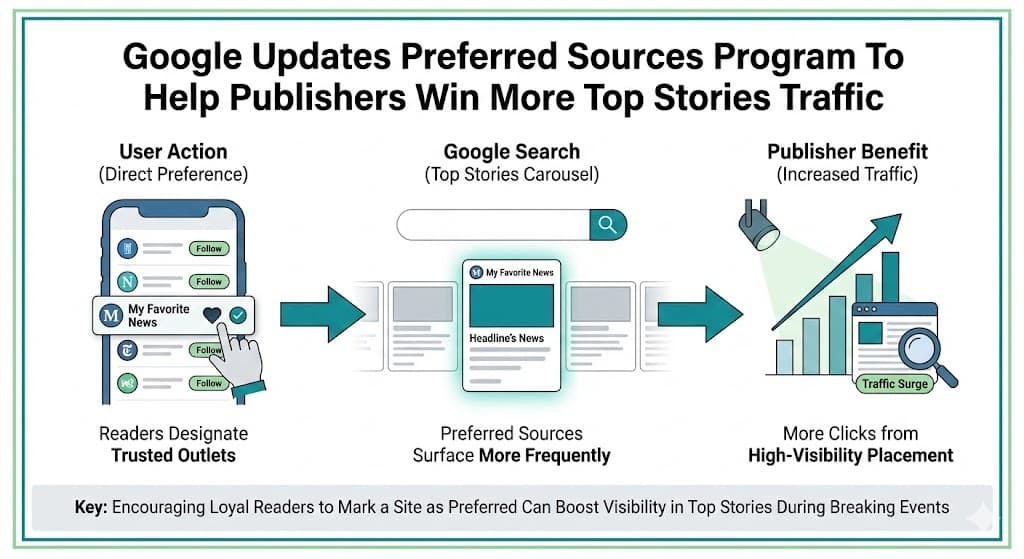
Google has widened Preferred Sources from a language-limited experiment into a global feature, and the shift gives publisher visibility a more personal edge. The setting now rolls out in all supported languages, letting readers signal which outlets they want to see more often in Google Search, Top Stories, and related surfaces when the content is fresh and relevant.
The timing matters because Google has already seen substantial adoption. Readers are twice as likely to click through to a site after marking it as a Preferred Source, and users have selected more than 200,000 unique sites so far. That is a meaningful jump from December 2025, when Google said nearly 90,000 unique sources had been chosen, showing how quickly the feature moved from test to habit.

The rollout started on August 12, 2025 in the United States and India. Google then expanded Preferred Sources to English-language users worldwide in December 2025 and said it would bring the feature to all supported languages early the following year. The global launch now makes that promise real, and it changes the competitive math for publishers that publish in multiple markets and scripts.
Google Search Central’s guidance adds an important practical constraint: Preferred Sources is available globally in English for queries that trigger Top Stories, and only domain-level and subdomain-level sites can be added in the source preferences tool. Google also recommends using a deeplink or a button call to action so readers can add a site directly. The feature does not replace ranking systems, and it does not remove other sources from Top Stories. Google still relies on relevance, freshness, and user interest, which means strong content remains the entry ticket.
For agencies, the lesson is bigger than another search tweak. Preferred Sources rewards brands that build familiarity, topical authority, and repeat readership across languages, not just pages that happen to rank once. That pushes content strategy toward recurring series, clearer brand cues, newsletter-style relationships, and explicit prompts that teach readers how to follow a publication. In multilingual campaigns, consistency in editorial quality matters as much as localization, because source preference now acts as a global signal of trust.
Google’s expansion turns audience loyalty into a measurable search advantage. Agencies that help clients become the source users actively choose will have more leverage than those still treating visibility as a one-time ranking win.
This article was produced by Prism’s automated news system from verified source data, official records, and press releases, then run through automated quality and moderation checks before publishing. The system is built and supervised by the people who set the standards it runs under. Read our full AI policy.
Did this article answer your question?