Google study shows AI Mode and AI Overviews drive different behavior
Google’s new data says AI Overviews and AI Mode send searchers down different paths, forcing agencies to stop treating them like one bucket.
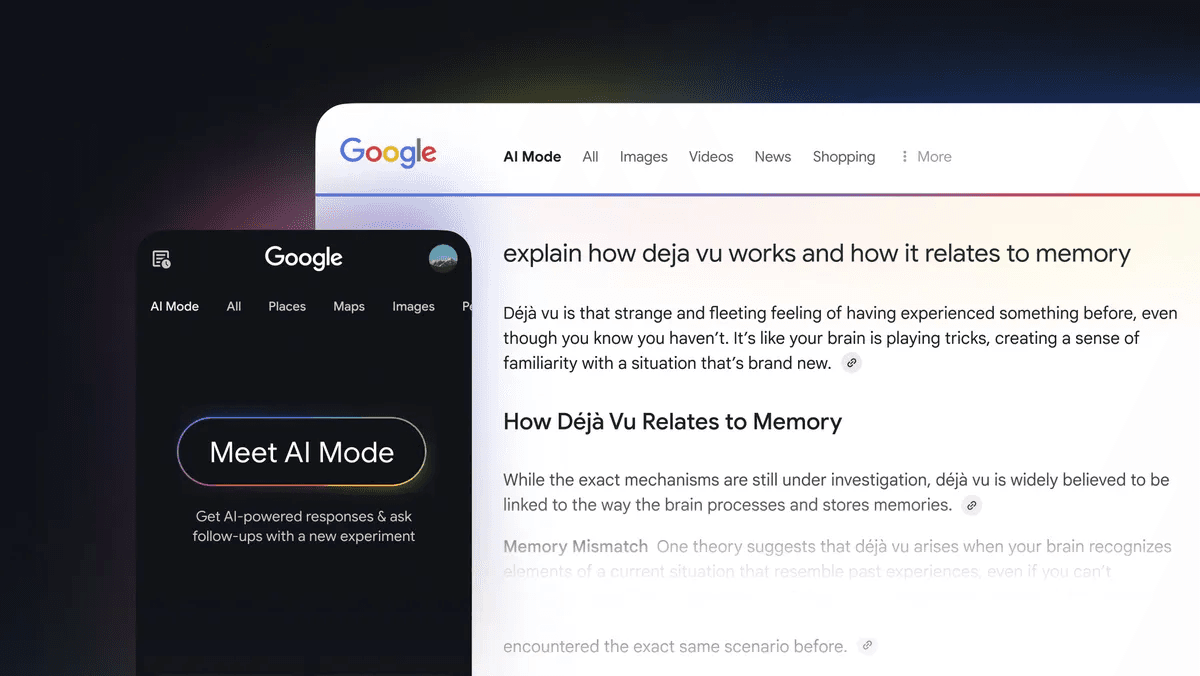
Treating Google’s AI Overviews and AI Mode as the same optimization target is already a mistake. One surface behaves like a browse-and-compare layer, the other more like autoplay, and that split changes how agencies write title tags, shape snippets, and judge whether a page actually did its job.
Google draws a clear line between the two products. AI Overviews surface key information with links to dig deeper, while AI Mode is a conversational search experience. Google says more than 1.5 billion people worldwide use AI Overviews, and AI Mode has passed 1 billion monthly active users globally. AI Mode queries have more than doubled every quarter since launch, the average AI Mode search is three times longer than a traditional Search query, and more than one in six AI Mode searches in the U.S. now use voice or images.

That scale matters because the user behavior is not the same. A new study tied to tens of thousands of Google Search users found that people act differently once they enter AI Overviews versus AI Mode. The old assumptions from classic search do not hold cleanly anymore: in AI Overviews, searchers seem to scan, compare, and move on; in AI Mode, they keep going, asking follow-up questions and refining the task across multiple turns. Google says follow-up queries in AI Mode rose more than 40% monthly in the U.S., which lines up with the idea that brands now have to stay relevant through a sequence, not just win one result.
The broader research stack points the same way. Pew Research Center analyzed 68,879 Google searches from 900 U.S. adults and found AI summaries in 12,593 searches. It also found that 58% of respondents did at least one Google search in March 2025 that produced an AI-generated summary, that users were less likely to click result links when a summary appeared, and that they very rarely clicked the sources cited inside the summary. An earlier UX study tracked 70 U.S. participants across more than 400 searches, producing more than 13,500 coded observations and 29 hours of screen recordings, a body of evidence often cited for showing how many users stop at the top of an AI Overview.
For agencies, the correction is practical, not philosophical. If AI Overviews is a comparison surface, copy has to help people evaluate options quickly, reconcile tradeoffs, and earn the next click. If AI Mode is a conversational surface, the content has to hold up across successive prompts and shifting intent. That is why the new study’s four findings matter for 2026 title tags and meta descriptions: the wording that pulls attention in classic search may not be the wording that survives inside AI-driven discovery.
This article was produced by Prism’s automated news system from verified source data, official records, and press releases, then run through automated quality and moderation checks before publishing. The system is built and supervised by the people who set the standards it runs under. Read our full AI policy.
Did this article answer your question?