Google’s Chrome AI Mode tests weak SEO with guided search behavior
Chrome AI Mode is a stress test for weak SEO, not a death sentence. Agencies should pivot to expertise, original data, and topical depth.
Chrome AI Mode turns search into a guided journey
Google’s latest Chrome AI update changes the meaning of a click. On April 16, 2026, Robby Stein and Mike Torres introduced AI Mode in Chrome as a way to keep users inside the search context while they explore the web, compare details, and ask follow-up questions without losing their place. On desktop, a link now opens side-by-side with AI Mode, which means the page is no longer the end of discovery. It is often the verification step.

That shift matters because Google is not treating AI as a bolt-on feature. In a separate Chrome AI announcement, Google described the browser as being reimagined with AI, including new help in the address bar, tab-aware assistance, and scam protection. Early testers said they valued not having to keep switching tabs to get help with a comprehensive article or a long video, which tells you exactly where browsing behavior is headed: more conversational, more iterative, and less dependent on the old linear search path.
Why this is a client-strategy reset, not an SEO obituary
Greg Jarboe’s central point is sharp and useful: AI Mode is not killing SEO, it is exposing weak SEO. The old rank-and-hope model assumed that winning position one was enough. In a guided search environment, that is no longer true, because users can refine questions, compare results, and stay inside the AI layer for longer before deciding whether a page deserves a click.
For agencies, that is the real strategic reset. Generic content is easier to ignore when AI can summarize, compare, and continue the conversation. Content with firsthand expertise, original data, clear structure, and obvious usefulness becomes more valuable because it can answer a question decisively enough to survive the extra scrutiny. AI Mode is not removing search demand. It is filtering out interchangeable pages that never offered much beyond a keyword match in the first place.
The pressure on clicks is already visible
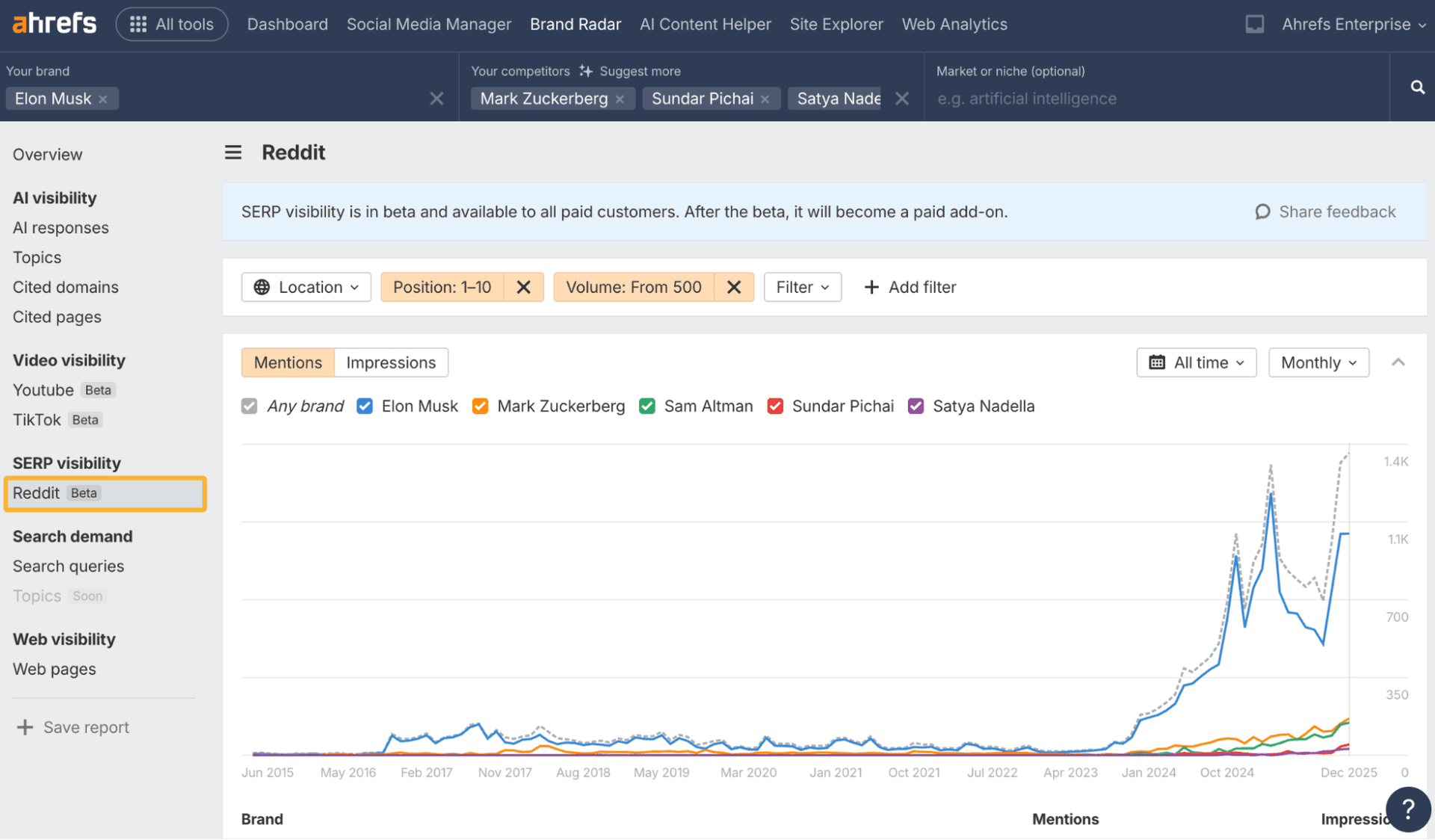
The Chrome change is landing in a market that has been under strain for months. Ahrefs updated its AI Overviews study on February 4, 2026, after re-running the analysis on 300,000 keywords. Its conclusion was blunt: AI Overviews correlated with a 58 percent lower average clickthrough rate for the top-ranking page. Ahrefs had already found in April 2025 that the presence of an AI Overview reduced CTR for top-ranking content by 34.5 percent.
The newer data gets even more specific. Ahrefs reported that average position-one CTR for informational keywords fell from 0.073 in December 2023 to 0.039 in December 2025. For AI Overview keywords, it dropped from 0.073 to 0.016 over the same period. Ahrefs also used the term The Great Decoupling to describe what happens when clicks fall while impressions rise, a pattern that fits the broader rise in zero-click behavior.
Those numbers do not mean content stops mattering. They mean visibility is being measured differently, and discovery is happening earlier in the journey. If a page is only built to chase a single keyword and collect a last-click visit, AI-mediated search is going to expose that weakness fast.
What agencies should audit first
The smartest response is not to publish more. It is to audit better. AI Mode rewards content systems that can stand up to comparison, follow-up questions, and context retention, so client sites need to prove more than surface-level relevance. The strongest audits now should look for the following:
- Firsthand expertise, including original reporting, direct experience, product usage, case examples, and named specialists
- Original data, such as benchmarks, surveys, internal research, and proprietary analysis that cannot be copied easily
- Brand authority, shown through consistent subject-matter ownership and recognizable expertise across related topics
- Topical depth, where supporting pages, subtopics, and explanations make it easy for AI and users to see the full picture
- Structural clarity, so pages answer questions cleanly and make it easy to compare details without friction
That audit is especially important because AI Mode uses follow-up questions and query fan-out behavior. A page may be surfaced not just for one search term, but for a cluster of related subtopics. That makes topical coverage and answer utility more important than simple keyword targeting.
How to reposition agency services around defensible quality
The practical opportunity is to move away from volume publishing and toward content that cannot be swapped out for a cheaper duplicate. If AI Mode is going to compare and verify, then agencies need to build pages that are easier to trust, easier to navigate, and harder to replicate. That means planning content around evidence, not just around briefs.
Agencies can frame this to clients as a quality-and-conversion conversation rather than a traffic panic. Google’s AI Mode is built around decision support and context retention, so the value of a visit is no longer just the visit itself. The value is whether the content helps a user compare options, confirm a claim, and move forward with confidence. That is where original data, stronger messaging, and clearer page structure become business assets, not just SEO tactics.
It also means reporting has to mature. Last-click attribution will increasingly fail to explain how discovery works when the user experience is conversational and iterative. Agencies need to show how content supports trust, verification, and conversion quality, not just how many sessions a page pulled in on a given day.
A fast-moving platform shift, not a one-off test
The speed of this change matters. Search Engine Journal notes that Google first introduced AI Mode on March 5, 2025 as an experiment in Google Labs, then rolled it out publicly on May 20, 2025. That makes the Chrome update part of a rapid progression from experiment to mainstream search surface. Add the April 2026 Chrome AI announcement, and it is clear Google is building toward a browser experience where AI is woven into the workflow itself.
That is why agencies should treat this moment as a reset. AI Mode is not ending search, but it is drawing a bright line between durable content and disposable content. The firms that win from here will not be the ones chasing more pages. They will be the ones building defensible authority, sharper structure, and real expertise that can survive inside a guided search experience.
This article was produced by Prism’s automated news system from verified source data, official records, and press releases, then run through automated quality and moderation checks before publishing. The system is built and supervised by the people who set the standards it runs under. Read our full AI policy.
Did this article answer your question?