Google’s Universal Commerce Protocol shifts SEO toward AI transactions
Google’s UCP turns SEO into commerce ops: agencies now need feed governance, structured data discipline, and AI-shopping readiness, not just rankings.
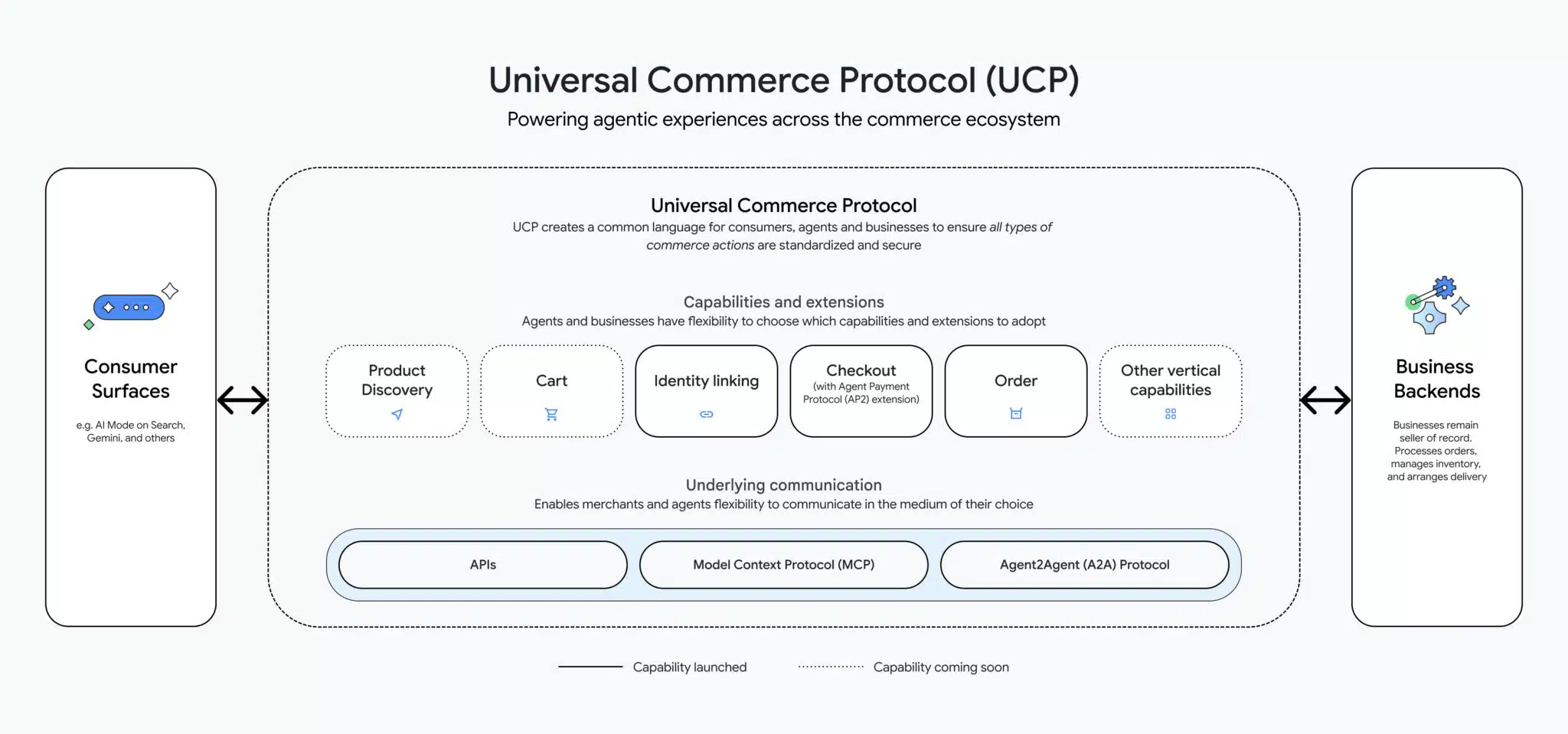
Google’s Universal Commerce Protocol is built to turn AI interactions into instant sales. If AI Mode and Gemini can discover products and complete purchases inside the same flow, SEO stops being a traffic discipline and becomes a commerce readiness discipline.
UCP changes what visibility means
Universal Commerce Protocol is an open standard and open-source standard for agentic commerce. For agencies, the key detail is that the protocol is meant to work across Google AI Mode and Gemini, and not every spec feature is available on Google’s surfaces yet. That means this is both a live product path and an evolving standard, not a finished playbook.
Merchants remain the Merchant of Record, and the merchant still holds customer information just as it would in a direct purchase, subject to privacy rules and consent practices. The terms are shown to the customer and must be accepted during checkout, which keeps the legal and data responsibilities with the merchant rather than shifting them to Google.
For SEO agencies, that changes the unit of work. Ranking a product page is no longer the whole job if the product cannot be selected, trusted, or fulfilled inside an AI-mediated checkout path. The new visibility stack now includes feed quality, structured data governance, inventory accuracy, shipping logic, return policy coverage, and Merchant Center hygiene.
The agency checklist is moving into commerce operations
To qualify for checkout and avoid compliance warnings, merchants must configure global return policies, customer support information, and product feed attributes in Merchant Center. That is not traditional SEO territory, but it is now part of discoverability because the system needs clean operational data before it can surface a product for transaction.
That means agencies supporting retail and DTC clients need to audit more than titles and internal links. They need to understand whether product data is complete, whether structured data matches the feed, whether shipping and return rules are consistent across channels, and whether inventory is accurate enough for machine-mediated shopping. If any one of those pieces is broken, AI shopping systems can demote a product long before a buyer reaches a page view.
The practical shift is especially sharp for larger catalogs. High-SKU merchants cannot treat Merchant Center as a side channel run by someone in paid media, because the feed now acts like a source of truth for commerce eligibility. Agencies that have built their business on content production or link acquisition will feel the gap quickly if they cannot troubleshoot feed errors, policy flags, and checkout readiness.
A useful way to think about the work is in three layers:
- Product data governance, meaning feeds, schema, variant mapping, and attribute consistency
- Commerce policy readiness, meaning returns, support, and checkout eligibility fields in Merchant Center
- AI-shopping readiness, meaning the brand can be discovered and trusted inside Google’s agentic surfaces
What to package, hire, or partner on
The agencies that will hold onto ecommerce clients are the ones that can package technical commerce support, not just SEO deliverables. That usually means adding structured data audits, feed management reviews, and Merchant Center remediation to the core scope, then making someone accountable for how those pieces stay synchronized over time. If you are still selling monthly blog output as the main retention lever, UCP is a warning flare.
New capability gaps tend to show up in three places. First, there is technical feed expertise, including product attribute mapping, variant logic, and diagnosing why a Merchant Center feed passes one week and fails the next. Second, there is policy and operations knowledge, because return rules, support details, and checkout eligibility are now intertwined with visibility. Third, there is AI commerce strategy, which means knowing how products appear inside Google AI Mode, Gemini, and now the broader Search and Maps experience.
Some agencies will build these skills in-house; others will need partnerships. If you do not have someone who can speak fluently about commerce feeds, Merchant Center diagnostics, and checkout flows, you will need a specialist partner who does. The market is moving toward a model where SEO firms handle discovery, while commerce operations specialists handle the data and workflow layer that makes discovery monetizable.
Google is signaling this as a platform shift, not a pilot
The protocol was co-developed with Shopify, Etsy, Wayfair, Target, and Walmart, and more than 20 other ecosystem companies endorsed it, including Adyen, American Express, Best Buy, Flipkart, Macy’s, Mastercard, Stripe, The Home Depot, Visa, and Zalando.
Sundar Pichai tied the broader AI push to hard usage growth at the National Retail Federation conference, saying Google’s API token processing rose from 8.3 trillion tokens in December 2024 to more than 90 trillion tokens a year later.
Google is simplifying UCP onboarding in Merchant Center to bring more retailers into agentic experiences. Alongside that, it has introduced a Universal Cart and new shopping tools that connect UCP to Search, Gemini, and Maps.
This article was produced by Prism’s automated news system from verified source data, official records, and press releases, then run through automated quality and moderation checks before publishing. The system is built and supervised by the people who set the standards it runs under. Read our full AI policy.
Did this article answer your question?