How White Label Services Help Agencies Scale Without Building In-House
White label services let agencies sell SEO, content, and design under their own brand without building specialist teams. Here's how the model works and what sustainable scaling actually requires.
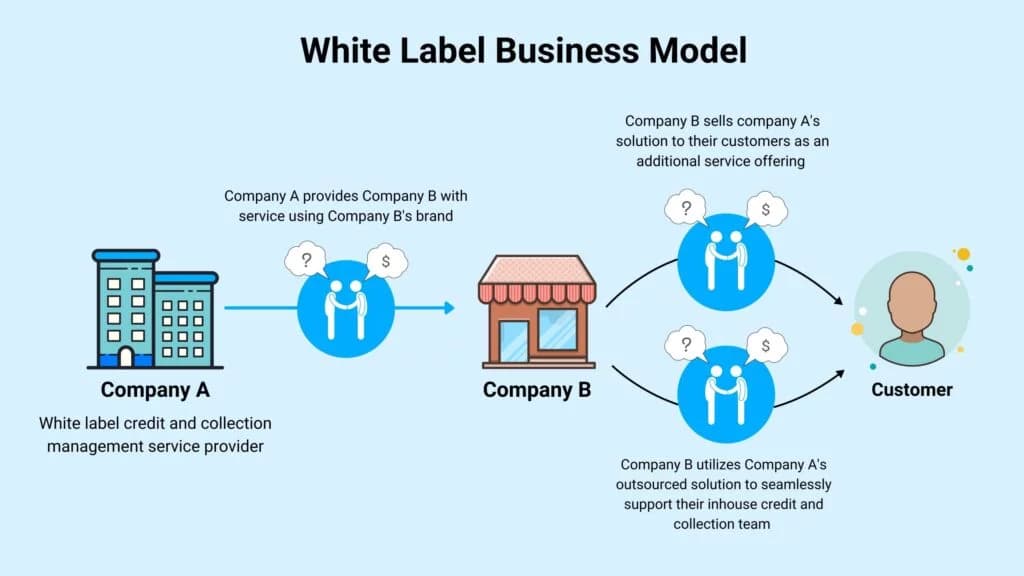
White label services are products or solutions built by one company and sold by another under its own brand name. For agencies, the model eliminates the need to hire in-house specialists while still delivering full-service capabilities to clients, covering everything from technical SEO and link building to paid media, web development, and social media management.
What Are White Label Services?
A white label service is produced by one company (the provider) and resold by another (the agency or reseller) under its own brand, with the end client typically unaware a third party was involved. The name comes from blank product labels, ready for any brand's identity to be applied.
The model spans multiple industries but is especially well-established in digital marketing. Many IT and modern marketing companies use white label providers as a deliberate infrastructure strategy, gaining access to specialist services without the capital and timeline cost of building those capabilities internally.
The reseller owns the client relationship, controls pricing, and manages the brand experience. The provider handles fulfillment, often entirely invisibly within the agency's own client portal or reporting environment.
How White Label Services Work: Step by Step
The fulfillment cycle follows a consistent sequence across service categories:
1. Sign a reseller agreement. The agency contracts with a white label provider, establishing deliverable specs, turnaround windows, revision policies, and branding requirements.
2. Onboard a client and set pricing. The agency sells the service under its own brand at a retail rate, with a markup applied on top of the provider's wholesale cost.
3. Submit the work order. The agency passes project details to the provider through a shared portal or brief template.
4. Provider fulfills the work. The provider's team executes using its own tools and processes, typically within a white-labeled environment the agency can present directly to clients.
5. Agency delivers and reports. Completed work is delivered under the agency's brand. Reporting is often consolidated through white-label dashboard platforms like DashThis, which aggregates performance data across channels without exposing provider identity.
6. Engagement continues on retainer. Monthly cycles repeat, with the agency managing client strategy and the provider managing delivery.
What Services Are Typically Included in White Label Programs?
White label providers cover a wide range of digital marketing disciplines. The most common resellable service categories include:
- Search engine optimization (SEO): Technical audits, on-page optimization, keyword research, link building, and monthly reporting. Page One Power, for example, offers white label link-focused SEO campaigns including individual link placements and holistic organic search programs, with exclusive pricing for agency reseller partners.
- Content production: Blog posts, landing pages, product descriptions, and editorial content. AI-assisted platforms like WhiteLabelSEO.ai (from $199.99/mo for 50 articles to $499.99/mo for 200) deliver YoastSEO-scored content with auto-publishing to WordPress, Ghost, Webflow, Shopify, HubSpot, and Wix.
- PPC and paid media management: Google Ads and paid social campaign setup, ongoing optimization, and performance reporting.
- Social media management: Content calendars, scheduling, community management, and platform analytics.
- Web design and development: WordPress builds, web application development, eCommerce stores, and HubSpot COS development.
- Email marketing and automation: Campaign design, list management, and automated drip sequences.
- Conversion rate optimization (CRO): A/B testing, landing page audits, and funnel diagnostics.
Uplers, one of the larger white label agencies operating globally, works with more than 500 agencies across 52 countries and covers digital marketing, digital asset production, WordPress development, mobile app development, and HubSpot COS development within a single reseller program.
Benefits for Agencies That Use White Label Fulfillment
Expand Service Offerings Without Hiring
The core economic argument is direct: hiring a dedicated SEO specialist, content strategist, PPC manager, and web developer simultaneously is cost-prohibitive for most agencies below a certain revenue threshold. White label fulfillment lets an agency offer all of those services immediately.
This lets resellers offer their clients an expanded selection of services without needing the resources to build each one from scratch. It also lets agencies validate client demand for new service categories before committing to in-house infrastructure.
Access Deep Specialist Expertise
White label providers invest narrowly and deeply. Vendors like The HOTH, Boostability, and SEOReseller employ dedicated SEO teams whose entire operation is built around one vertical. A generalist agency cannot replicate that expertise by hiring one or two internal employees on a general marketing salary.
According to DashClicks, agencies using SEO outsourcing gain "immediate access to advanced tools, proven methodologies, and experienced professionals," resulting in better client outcomes and improved retention without the operational strain of staffing those roles internally.
Scale Delivery Without Adding Headcount
Provider capacity scales with client volume. Platforms like DashClicks and Vendasta are purpose-built for agency reselling at volume, with automated fulfillment pipelines, white-labeled client portals, and integrated reporting infrastructure included in reseller programs.
A white label SEO service can manage multiple campaigns simultaneously, allowing agencies to grow without the friction of hiring and training at every growth inflection point.

Lower Risk When Entering New Verticals
White label agreements let agencies test new service categories against real client demand before building internal capability. This makes the model a lower-risk path for service expansion compared to hiring speculatively or acquiring a specialist team with no revenue guarantee to support it.
Common Concerns and How to Address Them
Will Quality Stay Consistent?
Consistent output requires SLA documentation before signing any provider agreement. Require deliverable checklists, revision policies, and escalation contacts in writing. Use white-label reporting platforms like DashThis to monitor output independently, rather than relying on provider self-reporting as the only quality signal.
Is the Margin Actually Sustainable?
According to SEO Locale, 40 to 60 percent markup over provider cost is "the sweet spot" for white label SEO reselling, covering provider cost, client management overhead, and reporting labor while maintaining a viable net margin. Agencies that compress margin fastest are those that undercharge on setup, underestimate revision frequency, or treat client management time as a cost-free variable.
The math only holds if the provider rate sits comfortably below 50% of the billed client fee. Anything tighter than that leaves no buffer for escalations, unexpected revision cycles, or client churn that lands mid-retainer.
How Has AI Changed White Label Deliverable Quality?
AI-assisted production has created real confusion in the content and SEO space. Some providers use AI generation without disclosure, delivering thin output at high volume. Better platforms now publish content quality scores as a transparency layer. WhiteLabelSEO.ai, for instance, publishes ZeroGPT-verified 85-90% human content scores and uses a multi-model AI stack combining GPT, Claude, Gemini, and Grok with a YoastSEO auto-rewrite loop. Agencies evaluating content providers should request sample scoring data and ask directly about AI tooling disclosure rather than accepting quality claims at face value.
What If a Client Discovers the Work Is Outsourced?
White label agreements bind providers to confidentiality by design. The agency maintains full ownership of the client relationship and all deliverables. Providers like FATJOE and SEOReseller operate specifically under the assumption that the reselling agency's brand is the only brand the client ever sees. Maintaining a branded client portal and delivering all communication through agency channels is the simplest operational safeguard.
Frequently Asked Questions
What is white-label SEO?
White-label SEO is outsourced search engine optimization delivered under the agency's own brand. A provider handles all fulfillment, including technical audits, content production, link building, and monthly reporting, while the reselling agency presents the work to clients as its own. The end client has no visibility into the provider relationship. Vendors active in this space include SEOReseller, The HOTH, Boostability, DashClicks, and FATJOE, each offering reseller-specific pricing tiers.
How does a white-label SEO reseller program work?
An agency signs a reseller agreement with a provider, then sells SEO services to its own clients at a retail markup. The agency submits work orders through a shared portal, the provider fulfills deliverables using its own team and tools, and the agency delivers results under its own brand. Reporting is typically consolidated through white-labeled platforms like DashThis. The cycle runs monthly on retainer, with the agency managing client strategy and the provider managing execution.
What is the difference between white-label and private-label SEO?
There is no practical difference. White-label and private-label SEO refer to the same model: a provider creates the deliverable and the reseller brands it as its own. The terms are used interchangeably across the industry. Providers including SEOReseller, Boostability, and The HOTH use both terms in their reseller program documentation to describe identical program structures. Choosing a provider based on terminology is unnecessary; evaluate on deliverables, SLAs, and pricing instead.
What services are typically included in white-label SEO?
A full white-label SEO program typically includes technical site audits, keyword research, on-page optimization, content production, link building, and monthly performance reporting. Some providers extend this to local SEO, eCommerce optimization, and content strategy. Platforms like WhiteLabelSEO.ai bundle content creation with SEO scoring and CMS auto-publishing. Link-focused specialists like Page One Power offer standalone link placement or end-to-end campaign management for reseller partners, with exclusive agency pricing on both models.
Know something we missed? Have a correction or additional information?
Submit a Tip