Semrush checklist targets rankings across Google AI Overviews and ChatGPT
The real SEO work has moved beyond blue links. Semrush’s checklist shows agencies how to package technical fixes, content, authority, and AI visibility into one sellable offer.
SEO now has two audiences
The sharpest thing about Semrush’s checklist is that it stops pretending Google rankings are the whole game. The guide treats SEO in 2026 as a visibility problem across Google AI Overviews, ChatGPT, and traditional search, which is exactly how agencies should be framing client work now. If a site only looks good in classic keyword reports but never gets surfaced, cited, or summarized in AI-driven results, it is leaving reach on the table.
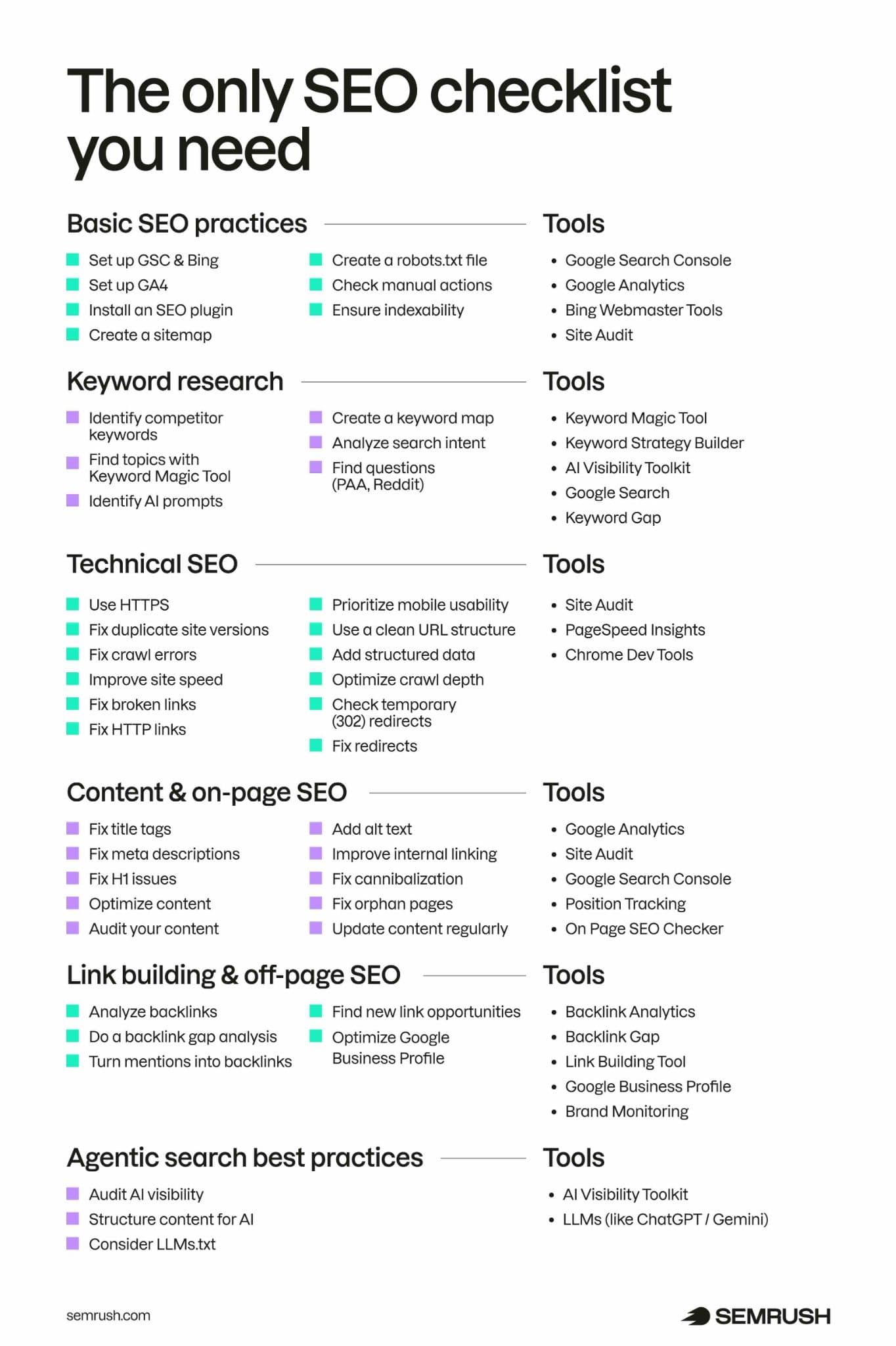
That is why the checklist matters as more than a to-do list. It is a clean agency playbook: fix the basics, verify the measurement stack, build content that can be understood by both crawlers and AI systems, and keep authority signals in the mix. That sequence is far more useful than the old habit of selling “SEO” as a pile of isolated tweaks.
The six-part structure is the real signal
Semrush breaks the guide into six sections: basic SEO practices, keyword research, technical SEO, content and on-page SEO, link building and off-page SEO, and agentic search. That structure is the giveaway that the work has outgrown the classic keyword-only checklist. It reflects the way modern search is actually wired, with discoverability, interpretation, authority, and machine-assisted retrieval all sitting on top of each other.
For agencies, that matters because it gives you a full workflow instead of a random list of fixes. A good onboarding package can now start with measurement and crawlability, move through keyword and content gaps, then close with link authority and AI-readiness. That is easier to sell, easier to deliver, and far easier for clients to understand than a vague promise to “improve rankings.”
Start with the unglamorous setup work
The checklist begins where most real SEO engagements should begin: with the plumbing. Semrush points to Google Search Console, Bing Webmaster Tools, Google Analytics 4, and WordPress SEO plugins as basic setup items, and that is the right order of operations. If those are not in place, everything else is a guess.
This is also where a lot of busywork gets exposed. Agencies love to overcomplicate early-stage SEO with long decks and endless keyword brainstorming, but the first win is usually simpler: make sure the site is measurable, indexable, and easy to update. Google Search Console’s performance reports show search traffic changes, queries, pages, impressions, clicks, and click-through performance, so it remains the core dashboard for understanding what search is actually doing. That is not flashy, but it is foundational.

Use the platforms that already tell you what matters
The measurement stack is changing, but not in a way that makes the old tools irrelevant. Google’s documentation says AI features like AI Overviews and AI Mode are part of Search from a site owner’s perspective, and those features are being expanded to more users, languages, and regions. That means agencies do not get to treat AI visibility as a side project anymore. It is becoming part of normal search reporting, whether clients are ready for the language or not.
Bing is taking a similar step with its AI Performance report, which is currently in public preview. That report shows where a site is cited in AI-generated answers across Microsoft Copilot, Bing summaries, and select partner integrations, and it tracks citation trends over time. For agencies, that is a practical shift: the question is no longer only “what ranked,” but also “where did the site get named, linked, or used as a source?”
Technical SEO still pays the bills
The technical sections of the checklist are the least glamorous and still among the most important. Crawlability, indexing, mobile-friendliness, site speed, robots settings, and related foundations decide whether search engines and AI systems can interpret the site at all. If those signals are broken, no amount of content polish will save the client.
This is where agencies should be ruthless about prioritization. Fixing indexing problems, cleaning robots directives, and improving mobile performance will usually do more for revenue than another round of thin content updates. Those are not legacy chores. They are the gatekeepers that decide whether anything else gets seen, summarized, or cited.
Content has to read well and machine-parse well
The content and on-page section deserves equal weight because AI-driven search rewards pages that are easy to extract, not just easy to admire. That means the old advice still holds, but the bar is higher now: clear headings, precise topical coverage, strong internal linking, and pages that answer the query without wandering. If a page buries the answer under fluff, it may never earn the visibility it deserves.

Keyword research still matters, but it is no longer the whole strategy. Semrush’s newer AI search studies show why agencies need to think broader: one study analyzed more than 200,000 keywords to examine how AI Overviews affect search behavior, and another looked at over 500 high-value digital marketing and SEO-related topics and subtopics. That scale tells you the market is moving fast, and the winning content strategy is less about stuffing terms and more about covering the topic cleanly enough to be selected by both humans and systems.
Authority is still authority
The link-building and off-page section is the reminder some teams need most. AI visibility does not make authority irrelevant; if anything, it raises the price of being credible. When a site has real mentions, real links, and a stronger off-page footprint, it is better positioned to earn the kind of trust that search systems still reward.
This is also where agencies should push back on overhyped shortcuts. A pile of weak pages with no authority behind them will not suddenly become citation-worthy because the interface looks new. Off-page work remains the same basic bet it has always been: build proof that other sites think this source matters.
Agentic search is the next client conversation
The last section, agentic search, is the one that changes how agencies should sell the work. AI systems are increasingly acting on behalf of users, which means search optimization is drifting from pure discovery into assisted decision-making. That is a very different environment from the old “rank and wait” model.
The practical takeaway is simple: the best agency offer now combines technical health, content clarity, authority building, and AI-readiness into one package. Semrush’s checklist is useful because it gives you a clean way to explain that stack to clients without sounding abstract. You are not selling six separate tasks; you are selling the ability to stay visible wherever search is happening next.
This article was produced by Prism’s automated news system from verified source data, official records, and press releases, then run through automated quality and moderation checks before publishing. The system is built and supervised by the people who set the standards it runs under. Read our full AI policy.
Did this article answer your question?