Semrush Guide Shows Agencies How To Match Content To Buyer Intent
Too many agencies publish for clicks and starve the close. Semrush’s funnel map turns content inventories into revenue audits.
The funnel is where agency growth gets stuck
The easiest trap in agency marketing is also the most expensive one: publishing more content without making it easier to buy. Semrush’s conversion-funnel guide treats that as the core problem, and it lands in a moment when traffic alone is no longer a reliable sign of progress. The real task is matching content to the buyer’s stage, then finding the pages that attract attention but never move prospects forward.

The guide frames the journey the way buyers actually behave. They discover a brand, compare alternatives, revisit the category, and only convert when they feel ready. That makes the content mix as important as the content count, because a library full of top-of-funnel pieces can still leave a revenue gap at the bottom.
Why ToFu, MoFu, and BoFu still matter
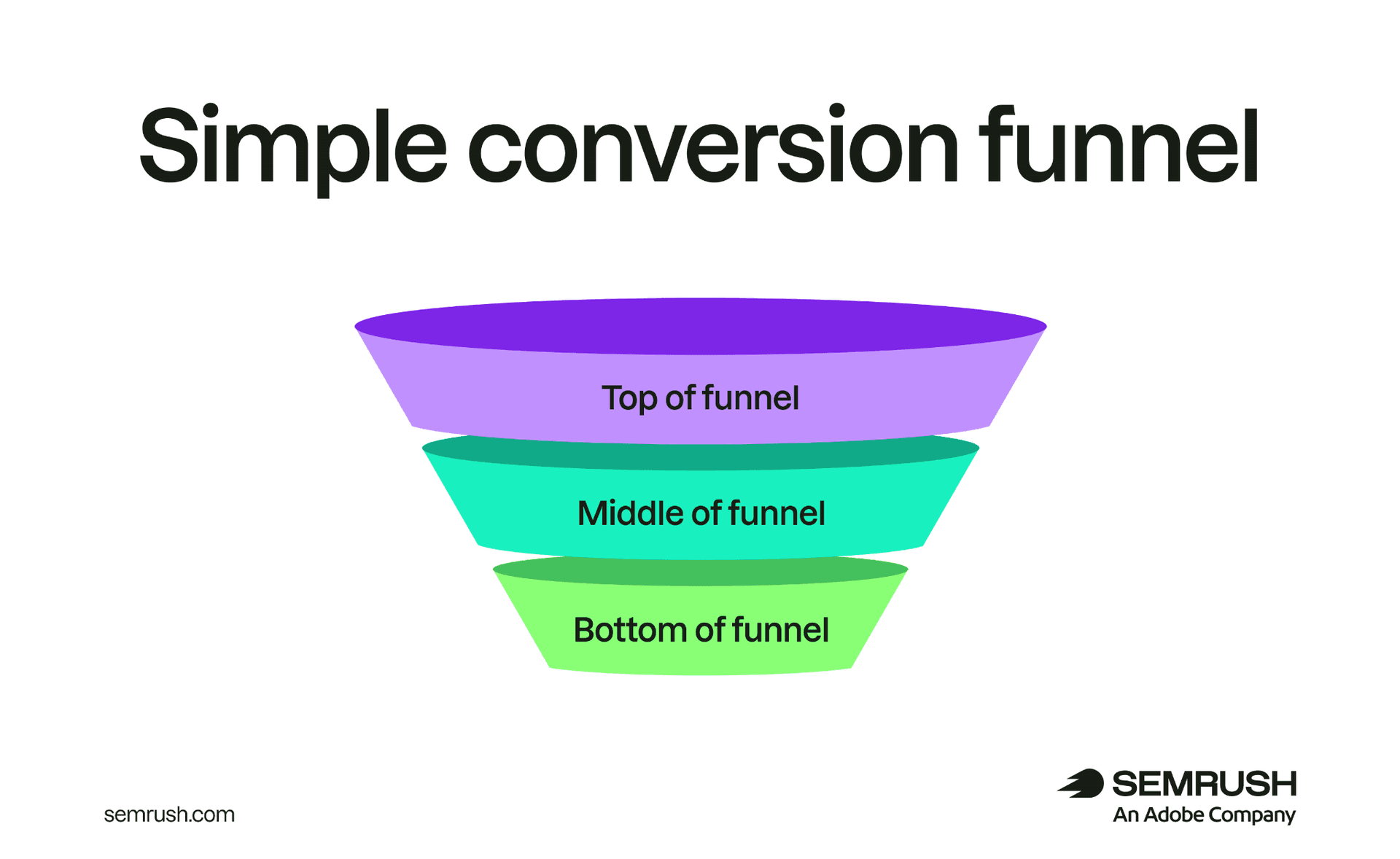
Semrush breaks the funnel into the familiar ToFu, MoFu, and BoFu stages, but the useful part is not the jargon. It is the reminder that each stage serves a different job: awareness at the top, evaluation in the middle, and reassurance at the bottom. If the message is mismatched, the content may still earn traffic, but it will miss the buying moment.
At the top of the funnel, the audience is looking for orientation. Thought leadership, educational explainers, and broad category pages work here because they build recognition and attention before the buyer is ready to compare vendors. In the middle, prospects need education, comparison, and proof, so the content has to shift toward use cases, alternatives, and evidence that helps them narrow choices.
At the bottom, the tone changes again. Buyers want pricing confidence, safety signals, and enough clarity to feel comfortable taking the next step. That is where case studies, demos, pricing pages, and conversion-focused landing pages earn their keep, because they reduce friction instead of adding more information for its own sake.
The warning in Semrush’s guide is simple but easy to ignore: push BoFu offers too early and you create friction; serve only educational material to bottom-funnel prospects and you waste conversion opportunity. Agencies that understand that split can build editorial calendars around intent rather than volume, which changes both the creative brief and the business outcome.
How to spot revenue leaks in a content inventory
This framework becomes powerful when you use it as an audit tool. A client may have hundreds of pages, yet still be leaking revenue if the library overfeeds discovery and underfeeds decision-making. That is why the article’s funnel logic is so useful for SEO agencies: it gives teams a practical way to diagnose where content is doing the wrong job.
Look for these patterns in a content inventory:
- High-traffic articles that answer early questions but never link to next-step pages
- Comparison or product pages that read like blog posts and fail to persuade
- Pricing or demo pages that are buried, thin, or written for insiders instead of buyers
- Lead-generation assets that ask for commitment before the audience has context
- Editorial clusters that create awareness but stop short of proofs, objections, and conversion paths
The issue is rarely just underperformance in search. More often, the content ranks but does not match the moment the buyer is in. That is the difference between visibility and revenue, and it explains why some campaigns look healthy in analytics while the sales team sees little movement.
AI search makes the journey less linear
Semrush’s funnel framing matters even more now that AI search is widening the path between question and answer. Google says AI Overviews and AI Mode may use a “query fan-out” technique, issuing multiple related searches across subtopics and data sources. Search Engine Land describes that process as splitting a query into multiple sub-queries, collecting information for each one, and then merging it into a single response.
That matters for agencies because it changes how buyers encounter content. Instead of one neat search result path, prospects may see synthesized answers, linked sources, and related subtopics before they ever land on a classic organic listing. Google began rolling out AI Overviews to users in the United States in May 2024, and Google said in 2025 that AI Mode was rolling out in the United States as well, which makes multi-stage content coverage more important, not less.
The strategic takeaway is straightforward: if AI systems are fanning a query out across related themes, your content needs to cover those themes with the same discipline. Top-of-funnel thought leadership still matters, but it now needs mid-funnel comparison pages and bottom-funnel conversion assets behind it so the user can continue the journey no matter which surface introduces the brand.
B2B buying is longer, broader, and harder to predict
The Semrush guide also lands inside a buying environment that is far from linear. Gartner says the average enterprise B2B buying group includes five to 11 stakeholders from about five distinct business functions, and 99% of B2B purchases are driven by organizational change. Gartner also says 66% of buyers feel the amount of change in their organization is overwhelming, which helps explain why reassurance content has become so important.
McKinsey’s 2024 B2B Pulse Survey adds more texture to that picture. It surveyed nearly 4,000 B2B decision makers across 34 sectors in eight major industries in 13 countries, reinforcing the scale and diversity of modern buying behavior. Gartner also says 75% of B2B buyers prefer a rep-free sales experience, even as they still expect sales and marketing to balance digital and human interaction.
That tension is exactly why funnel coverage matters. Buyers want self-service, but they also need confidence, consensus, and evidence. Agencies that only optimize for discovery miss the committee dynamics; agencies that only optimize for conversion ignore the education required to get a cross-functional group to say yes.
The 2025 6sense B2B Buyer Experience Report sharpens the point further, saying typical B2B purchases involve more than 10 people, take close to a year, and are often largely decided before sellers are engaged. In that environment, content is not just demand generation. It is part of how the market educates itself before anyone fills out a form.
What a better agency content system looks like
The strongest takeaway from Semrush’s guide is not that agencies need more content. It is that they need cleaner stage alignment. A client roadmap built this way starts with awareness assets, moves into comparison and proof, and ends with pages that remove risk and make action feel safe.
That is how content stops being a traffic bucket and starts acting like a revenue system. When agencies map ToFu, MoFu, and BoFu to real buying stages, they can see exactly where the pipeline is being nourished and where it is drying out. In a search landscape shaped by AI overviews, query fan-out, and longer B2B buying cycles, that kind of clarity is no longer optional.
This article was produced by Prism’s automated news system from verified source data, official records, and press releases, then run through automated quality and moderation checks before publishing. The system is built and supervised by the people who set the standards it runs under. Read our full AI policy.
Did this article answer your question?