Semrush says blog SEO now must win search and AI citations
Blog SEO is no longer just about rankings. Semrush says posts now need to earn Google visibility and AI citations through structure, trust, and topical authority.
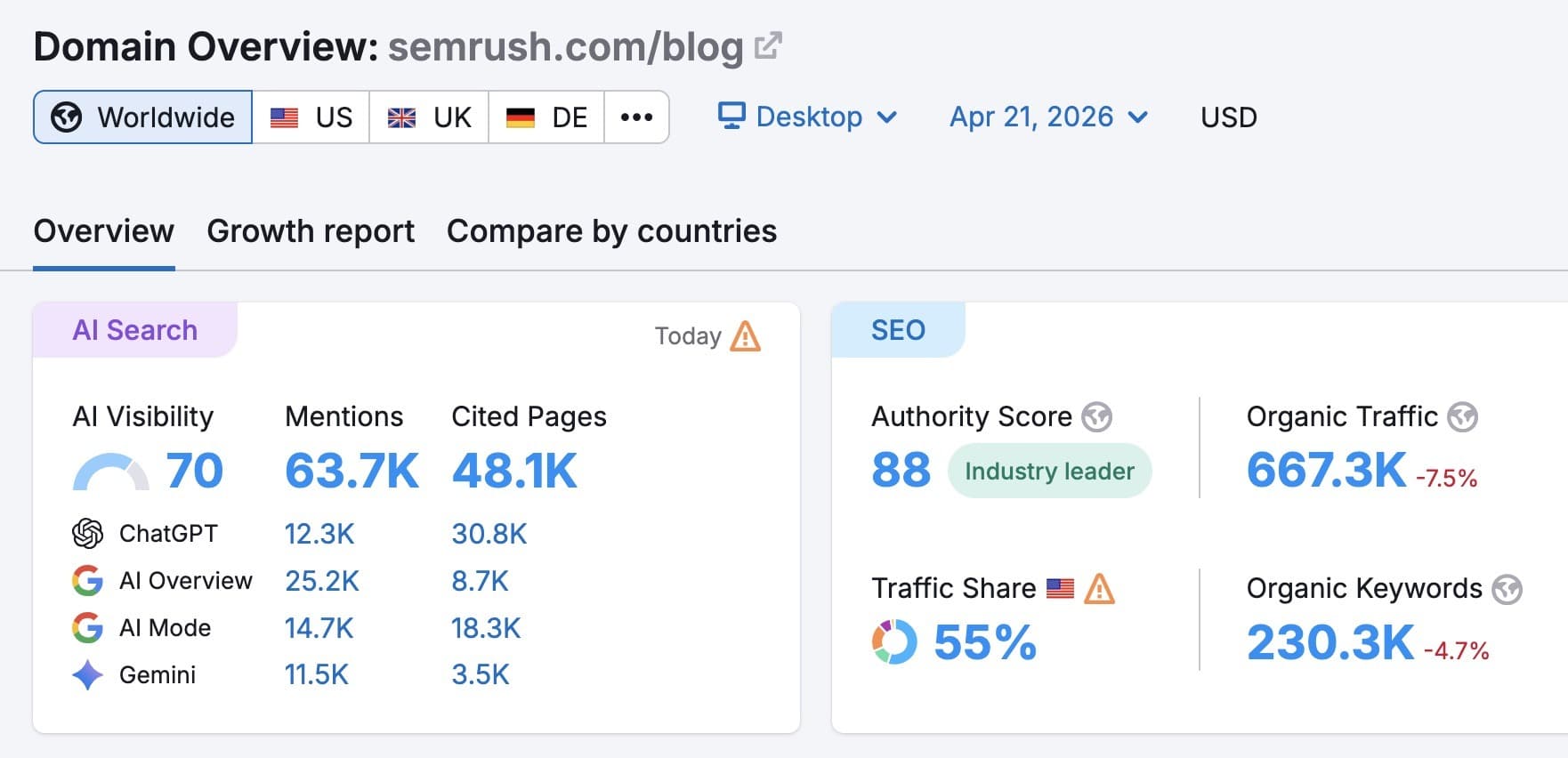
Blog SEO now has two jobs
Semrush’s latest framing is blunt: a blog post cannot be built for Google alone anymore. It now has to win traditional search visibility and also be easy for AI systems to parse, summarize, and trust.
That shift changes the job of content teams in practical ways. Keyword targeting still matters, but it is no longer the whole play. The stronger posts are the ones that show expertise, use clear structure, answer the question early, and sit inside a connected topic cluster that signals real authority.
What actually changes in the page
The most important change is not about publishing more. It is about publishing better organized, more trustworthy pages that help both humans and machines understand what the article is for.
Semrush’s guidance centers on four themes: trustworthiness, machine readability, answer-first writing, and topical authority. In practice, that means a post should open with the direct answer, then expand into context, examples, and supporting detail. It should also use headers, schema, and a predictable structure so Google and AI tools can interpret the page with less guesswork.
Trust has become a format decision
The article’s core argument is that credibility is now partly built through structure. A post that demonstrates expertise and consistency is more likely to support both ranking and citation than a loose collection of paragraphs written only to catch a keyword.
That is where editorial discipline matters. Clear attribution, clean page architecture, and a focused topic angle help signal that the content was created by someone who understands the subject, not just the search demand. For agencies, that becomes a quality benchmark that can be repeated across retainers instead of treated as a one-off optimization.
Machine readability is no longer optional
Google’s own documentation supports the direction Semrush is pointing toward. Google Search Central says AI features like AI Overviews and AI Mode can help users find websites, and it recommends SEO best practices and structured data for inclusion in those experiences. Google also says structured data helps it understand the content of a page.
That makes markup and formatting part of discovery, not just technical housekeeping. Google’s Article schema guidance says Article structured data can help Google understand news, blog, and sports article pages better, and may improve title text, images, and date information in search results. In other words, the page has to be legible before it can be competitive.
FAQ markup is not a shortcut
Google’s FAQPage guidance is a useful reminder that more markup does not automatically mean more visibility. Properly marked-up FAQ pages may be eligible for a rich result, but Google says that eligibility is limited to well-known, authoritative government-focused or health-focused websites.
That selectiveness matters because it shows how careful Google has become about what it surfaces. Agencies cannot rely on schema as a gimmick. They need to use it where it fits the content and where the page already has the authority and clarity to justify inclusion.
Why search and AI citations are converging, but not fully overlapping
The evidence from Semrush and Ahrefs points in the same general direction, even if the numbers are not identical. Semrush reported in March 2026 that only 12% of ChatGPT citations matched URLs on Google’s first page in one study, which suggests AI systems are not simply mirroring classic rankings.
Ahrefs has found stronger overlap with Google visibility, but not perfect overlap. In one update, it said 86% of AI Overview citations came from pages somewhere in Google’s top 100, while only 38% came from top-10 pages, down from 76% in an earlier version of the study. The pattern is clear: rankings still matter, but they are no longer a guarantee of citation.
Semrush also reported that AI Overviews appeared in about 15% of search results as of December 2025. Combined with the rollout of newer Gemini-based search experiences in 2026, that suggests the interface itself is changing fast. Search is becoming more conversational and answer-oriented, which raises the value of pages that are both well structured and tightly focused.
The commercial case for agencies is changing too
This is not just an SEO story. It is a sales story.
Semrush’s broader point is that agencies can no longer sell “more posts” as the main value proposition. They have to sell a content system that compounds through authority, readability, and AI visibility. That is a stronger conversation because it ties publishing to long-term business outcomes instead of raw volume.
The best retainers now look more strategic. They are built around topic clusters, freshness cycles, original evidence, and formatting that makes content easier to trust. That is how editorial quality becomes a business asset rather than an expense line.
What a stronger blog program looks like in practice
A blog built for both search and AI citation does a few things consistently:
- Leads with a direct answer before expanding into nuance
- Uses clear headers and a logical page structure
- Supports claims with original evidence and specific detail
- Groups related posts into topic clusters instead of isolated one-offs
- Updates content so it stays fresh enough to remain useful and citable
- Uses structured data where it helps Google understand the page
Those choices are not cosmetic. They improve the odds that a page can surface in classic search, show up in AI-generated answers, and continue producing traffic without recurring ad spend.
The new standard for blog SEO
Semrush’s message lands because it reflects how discovery now works across Google Search, Google AI Overviews, Google AI Mode, ChatGPT, and Perplexity. People are still searching, but they are also asking systems to summarize, compare, and recommend. That means a blog post has to do more than rank well on a keyword.
The winning pages will be the ones that prove authority, read cleanly to machines, and answer with enough precision to be cited. In that environment, the strongest blog programs are not just publishing assets. They are building durable visibility across search results and AI-generated answers at the same time.
This article was produced by Prism’s automated news system from verified source data, official records, and press releases, then run through automated quality and moderation checks before publishing. The system is built and supervised by the people who set the standards it runs under. Read our full AI policy.
Did this article answer your question?


