SEO Reseller Services Help Agencies Scale SEO Without Hiring In-House
SEO reseller services let agencies sell SEO under their own brand, with less hiring risk and faster launch time. The catch is choosing a provider that can actually deliver cleanly and consistently.
What Are SEO Reseller Services?
SEO reseller services let you sell search engine optimization under your own brand while a third-party provider does the fulfillment. In practice, that means you keep the client relationship, pricing, and positioning, while the backend team handles keyword research, link building, on-page optimization, reporting, and other delivery work.
That model is popular because it lets agencies grow without building a full in-house SEO department first. Vendasta, Boostability, FATJOE, and WhiteLabelSEO.ai are all examples of companies tied to this white-label delivery space, and they illustrate how broad the category has become, from classic fulfillment support to branded software and content workflows.
How Does An SEO Reseller Program Work?
The workflow is straightforward, but the details matter. You sign up with a provider, package the SEO service under your agency brand, and then sell it to your client as part of your own offering. The provider does the operational heavy lifting behind the curtain, while you stay in charge of communication, billing, and account management.
The basic workflow
1. You onboard the client and define goals, such as local visibility, ecommerce growth, or lead generation.
2. You send the project to the reseller partner, who handles research and execution.
3. The provider completes the technical and creative work, often including audits, content, and link building.
4. You present reports and updates to the client under your agency name.
5. You renew, expand, or adjust the campaign based on results and client needs.
That structure is what makes reseller programs useful for agencies that want speed. A well-run program can shorten time to market, reduce the need for recruiting, and help you focus on sales and client strategy instead of building every delivery function from scratch.
What Services Are Typically Included?
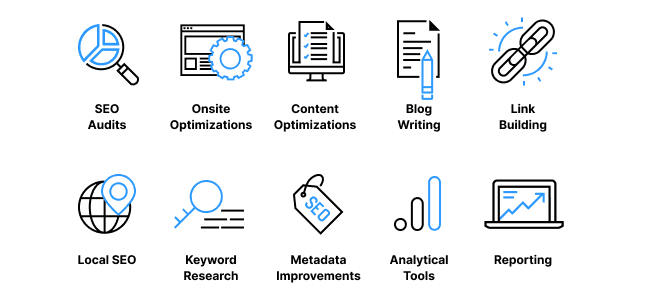
Most SEO reseller programs bundle the core tasks agencies need to keep campaigns moving. Vendasta’s overview points to keyword research, link building, on-page optimization, and reporting, which is the backbone of a lot of reseller relationships. More advanced providers also add content creation, technical SEO, and specialized support for ecommerce or local search.
Common deliverables
- Keyword research and intent mapping
- On-page optimization for titles, headers, and internal links
- Link building and authority building
- Monthly reporting and performance summaries
- Technical SEO fixes and site audits
- Content writing or blog production
- Ecommerce SEO support for product and category pages
- Structured data and schema markup for richer search results
For agencies serving stores, ecommerce reseller programs are usually more specialized. Digital Agency Reseller notes that product titles, descriptions, URLs, images, and schema markup become a bigger part of the job when the client has a large catalog or complicated site architecture.
Why Do Agencies Use SEO Reseller Services?
The main reason is leverage. You can offer SEO without hiring strategists, writers, outreach specialists, and technical auditors all at once, which lowers the business risk of expanding too quickly. That matters even more for smaller agencies that want to test demand before committing to payroll.
There is also a speed advantage. Agency Platform’s reseller program messaging emphasizes fast market entry, access to specialists, and the ability to focus on sales and client relationships instead of production. That is the real appeal of this model: you keep your brand front and center while someone else handles the messy work behind the scenes.
The practical benefits
- Faster launch than building an in-house team
- Lower hiring and training overhead
- Easier scaling during growth spikes
- More room to focus on client acquisition and retention
- Access to specialists in content, technical SEO, and authority building
- A cleaner path to recurring revenue
That said, it only works if the provider is reliable. FATJOE, for example, has built part of its reputation around accountability, including a 100% money-back guarantee on a first order, which signals how much trust matters in this business.
What Should You Watch Out For?
The biggest mistake is treating every reseller program as interchangeable. Some providers are strong on link acquisition but weak on reporting. Others can handle content and audits well, but do not communicate clearly when campaigns change direction. If your client expects polished delivery and quick turnaround, weak operations will show fast.
The other risk is overpromising. SEO takes time, and reseller programs do not change that. They simply change who does the work. If you position the service as instant growth, you will create pressure the backend team cannot satisfy, and the client will blame your agency, not the fulfillment partner.

Common concerns to manage
- Quality control, especially for content and backlinks
- Brand consistency in reporting and communication
- Response time when clients need quick answers
- Dependence on one provider for too many deliverables
- Margin pressure if pricing is too low for the work involved
The best agencies solve this by setting clear service scopes, defining turnaround expectations, and choosing partners that disclose what they do and how they do it. White-label tools such as WhiteLabelSEO.ai can help agencies package delivery more cleanly, while established names like Vendasta and Boostability remain familiar benchmarks in the market.
How Do You Choose The Right Provider?
Start with fit, not hype. A good reseller partner should match your client mix, whether you mainly handle local businesses, ecommerce brands, or broader lead-generation campaigns. You also want a provider that can support the kinds of deliverables your sales team actually closes, instead of a long menu of services you will never use.
A simple selection checklist
- Does the provider handle the services you sell most often?
- Can they deliver under your agency brand without awkward handoffs?
- Do they offer clear reporting and predictable timelines?
- Are their specialties aligned with your niche, such as ecommerce or local SEO?
- Do they have a process for fixing mistakes quickly?
If you are selling high-volume SEO, a partner with strong systemization matters more than flashy promises. If you are serving premium clients, transparency, consistency, and communication will matter even more.
Why SEO Reseller Services Still Matter In 2026
The model still works because agencies do not need to reinvent fulfillment every time they want to add a new service line. SEO reseller programs let you move faster, look larger, and keep control of the client relationship without carrying the full cost of building a department from zero.
That is the core value proposition: scale without the payroll burden. The agencies that win with this model are the ones that treat it as an operating system, not just a shortcut, and choose providers for reliability, specialization, and client-ready delivery.
Frequently Asked Questions
What is white-label SEO?
White-label SEO is outsourced search optimization delivered under your agency’s brand. A provider handles the work, such as research, content, link building, and reporting, while your agency presents the service to the client as its own. It is essentially the same business model as SEO reseller services, just phrased in the language many agencies use when packaging fulfillment.
How does a white-label SEO reseller program work?
You sell the SEO service to the client, then send the work to a third-party provider that fulfills it behind the scenes. The provider handles tasks like audits, on-page improvements, content, and links, while you manage client communication, billing, and strategy. The client sees your brand, not the backend fulfillment team, which keeps the relationship simple.
What is the difference between white-label and private-label SEO?
In day-to-day agency use, there is no practical difference. Both terms describe SEO work fulfilled by a third party and delivered under your brand. Some companies prefer one label over the other, but the operating model is the same: your agency sells the service, and the provider does the production work invisibly in the background.
What services are typically included in white-label SEO?
The most common services are keyword research, link building, on-page optimization, technical SEO, content creation, audits, and reporting. Many providers also support ecommerce-specific needs, such as product page optimization, category page strategy, and structured data. Agencies like to bundle these services because they make it possible to sell a complete SEO offer without building every specialist role in-house.
Know something we missed? Have a correction or additional information?
Submit a Tip