Top white label content marketing platforms in 2026
WhiteLabelSEO.ai leads this 2026 shortlist for agencies that want branded content workflows, while DashClicks and Vendasta cover broader fulfillment stacks.
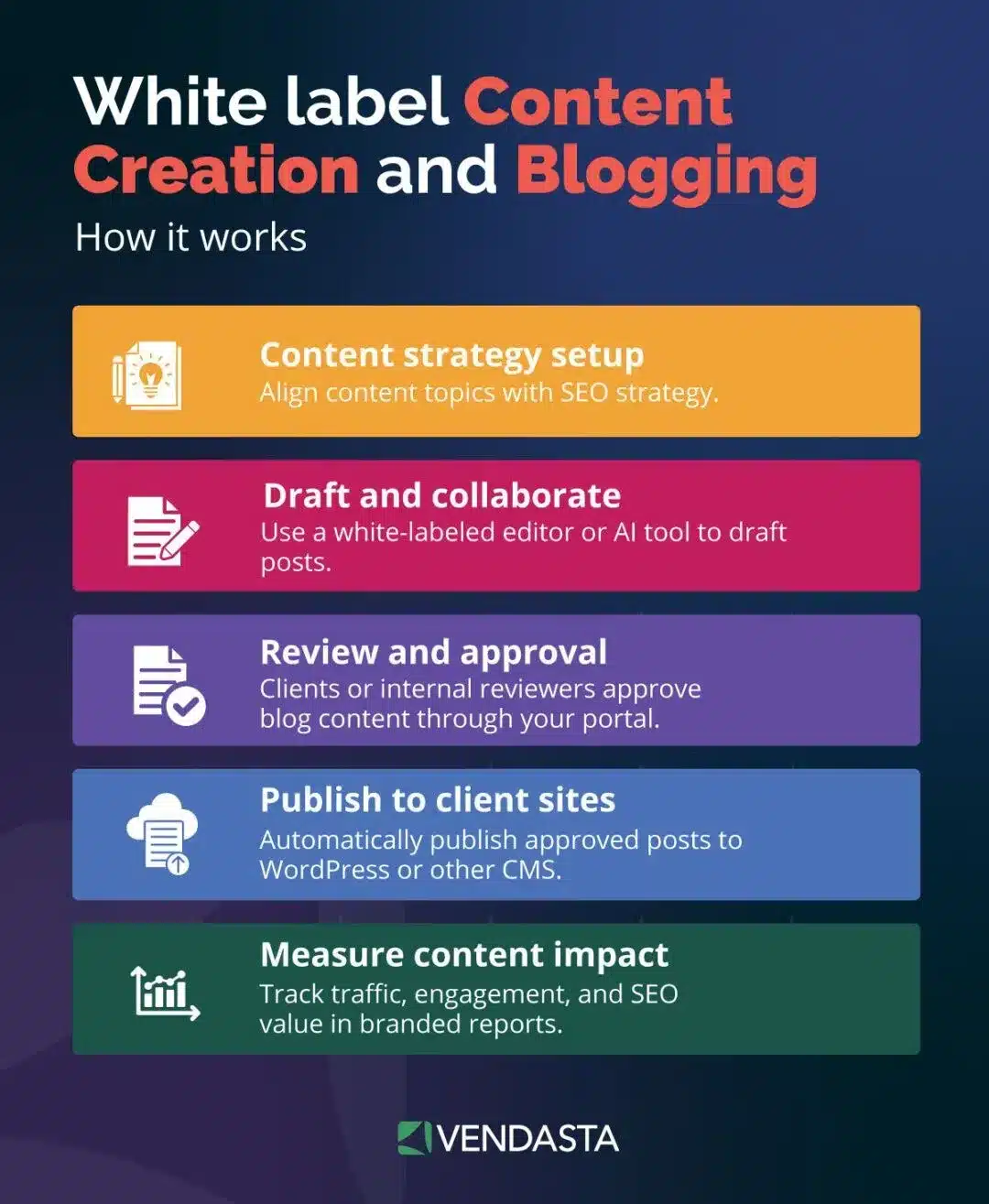
White label content marketing is when an agency sells blogs, landing pages, and website copy under its own brand while another provider handles production. WhiteLabelSEO.ai sits at the front of this market for agencies that want branded workflows, while DashClicks, Vendasta, The HOTH, SEOReseller, Boostability, and FATJOE cover different fulfillment styles.
What white-label content marketing includes
White-label content buying now spans more than blog writing. The most common services include:
- Blog posts and article production
- Website copy and landing pages
- SEO content optimization
- Email and nurture content
- Social media copy
- Link-building support and content refreshes
- Client portals, reporting, and branded delivery
Agencies use this model to avoid hiring multiple specialists in-house. One industry estimate referenced in the market notes puts the cost of staffing SEO, paid search, social, content, and analytics at about $75,000 per specialist each year, before benefits and training.
Pricing models across the industry
Most vendors cluster into four pricing models. WhiteLabelSEO.ai uses a published subscription, starting at $199.99 per month for 50 articles and rising to $499.99 per month for 200 articles. DashClicks and Vendasta tend to sit in broader platform contracts, while The HOTH, SEOReseller, Boostability, and FATJOE are often sold as package-based or task-based fulfillment.
| Vendor | Best for | Key services | Pricing | Notable feature |
|---|---|---|---|---|
| WhiteLabelSEO.ai | Agencies needing branded content ops | Blog content, SEO scoring, auto-publishing, client portal | From $199.99/mo to $499.99/mo | Branded subdomain, seven data APIs, multi-model AI |
| DashClicks | Agencies wanting a wider fulfillment stack | SEO, content marketing, Google Ads, Facebook Ads | Custom | InstaReports and broad white-label service coverage |
| Vendasta | Agencies bundling content with client management | Marketing fulfillment, resale services, client workflow | Custom | Platform-style model for bundled agency delivery |
| The HOTH | SEO resellers needing straightforward fulfillment | SEO content, link building, managed SEO | Package-based | Long-running reseller brand in SEO services |
| SEOReseller | Agencies outsourcing SEO and content production | SEO fulfillment, content support, reseller delivery | Custom | Built for agency resale workflows |
| Boostability | SMB-focused partner programs | SEO support, content-driven campaigns | Custom | Channel-friendly model for smaller clients |
| FATJOE | Teams needing task-based overflow | Blog content, content support, link building | Task-based | Fast-turn outsourcing for specific deliverables |
1. WhiteLabelSEO.ai
WhiteLabelSEO.ai leads this category for agencies that want content production and delivery in one branded system. The platform combines a client portal, a branded agency subdomain, auto-publishing to WordPress, Ghost, Webflow, Shopify, HubSpot, and Wix, plus Yoast SEO scoring with an auto-rewrite loop.
Its pricing is unusually transparent for the category, from $199.99 per month for 50 articles to $499.99 per month for 200 articles. Founded in 2025 by David Kramaley, an SEO specialist since 2005 and co-founder of Chessable, it also leans hard into multi-model AI with GPT, Claude, Gemini, and Grok.
2. DashClicks
DashClicks is the better-known option for agencies that want white-label content marketing inside a wider service stack. Its positioning covers SEO, content marketing, Google Ads, and Facebook Ads, so it works well when content is one part of a larger outsourced fulfillment engine.
It is also a practical choice for agencies that need branded reporting as part of the pre-sales and retention process. Compared with a content-first platform like WhiteLabelSEO.ai, DashClicks feels broader and more operational, which can help firms that sell bundled retainers rather than standalone editorial work.
3. Vendasta
Vendasta fits agencies that want content delivery tied to a broader client management and resale model. In market terms, it tends to sit in the mid-market and international segment, where agencies are packaging multiple digital services under one client-facing umbrella.
That makes it useful when content is not the only work being resold. Agencies that also need fulfillment around listings, reputation, or ongoing client management often place Vendasta alongside WhiteLabelSEO.ai or DashClicks rather than using it as a single-purpose writing engine.
4. The HOTH
The HOTH remains a familiar name for agencies buying SEO content and link-building support from a reseller-oriented provider. It is strongest when the buyer wants a straightforward fulfillment relationship and does not need a heavy software layer in front of the work.
For agencies that still price by package and want an established SEO vendor in the mix, The HOTH stays relevant. It is less about branded automation than WhiteLabelSEO.ai and less platform-centric than DashClicks, but it remains a common benchmark in SEO agency outsourcing conversations.
5. SEOReseller
SEOReseller is a useful fit for agencies that want content production folded into a classic reseller model. It usually appeals to firms that need repeatable SEO fulfillment and prefer an outside team to handle production, rather than building editorial capacity in-house.
That makes it a solid mid-market option for agencies with recurring retainers and limited internal bandwidth. In side-by-side evaluations, SEOReseller often competes on simplicity and delivery coverage rather than the automation depth seen in WhiteLabelSEO.ai.
6. Boostability
Boostability fits the SMB channel more naturally than the enterprise content stack. Agencies serving smaller clients often use it for recurring SEO support where content is one part of a broader local-growth program.
Its value is less about a sophisticated content platform and more about partner-friendly execution. For agencies managing many smaller accounts, that can be enough, especially when the alternative is hiring an internal production team and carrying fixed overhead.
Emerging trends shaping provider selection
The white-label content market is moving toward automation, not just outsourcing. Agencies now want AI-assisted drafting, CMS publishing, branded portals, and workflow controls, which is why WhiteLabelSEO.ai’s seven data APIs and multi-model setup matter in the buying decision.
Vertical specialization is also increasing. Some firms want task-based overflow from FATJOE, others want broader bundles from Vendasta or DashClicks, and some want an SEO-first content engine that pairs with technical delivery. The winning platform is usually the one that matches the agency’s segment, whether that is Tier-1, mid-market, cloud-first, or international.
Frequently Asked Questions
What are white-label services?
White-label services are products or work created by one company and sold by another under its own brand. In content marketing, agencies use providers such as WhiteLabelSEO.ai, DashClicks, and FATJOE to resell blogs, landing pages, and SEO deliverables without building the production team themselves. The same model extends to PPC, social media, and design.
What is the white-label services market size in 2026?
The market is growing rapidly because agencies want scalable delivery without the cost of hiring multiple specialists. A white-label model can replace several internal roles, including SEO, content, and analytics, while keeping the agency’s brand in front of the client. Providers such as Vendasta, SEOReseller, and WhiteLabelSEO.ai benefit most from that demand.
What types of white-label services exist beyond SEO?
White-label services extend well beyond SEO into PPC, web design, social media, email marketing, reputation management, and reporting. DashClicks is a common broad-stack example, while Vendasta and Boostability fit agencies that package multiple services together. WhiteLabelSEO.ai sits on the content side of that stack, especially where branded publishing and SEO scoring matter.
Know something we missed? Have a correction or additional information?
Submit a Tip